

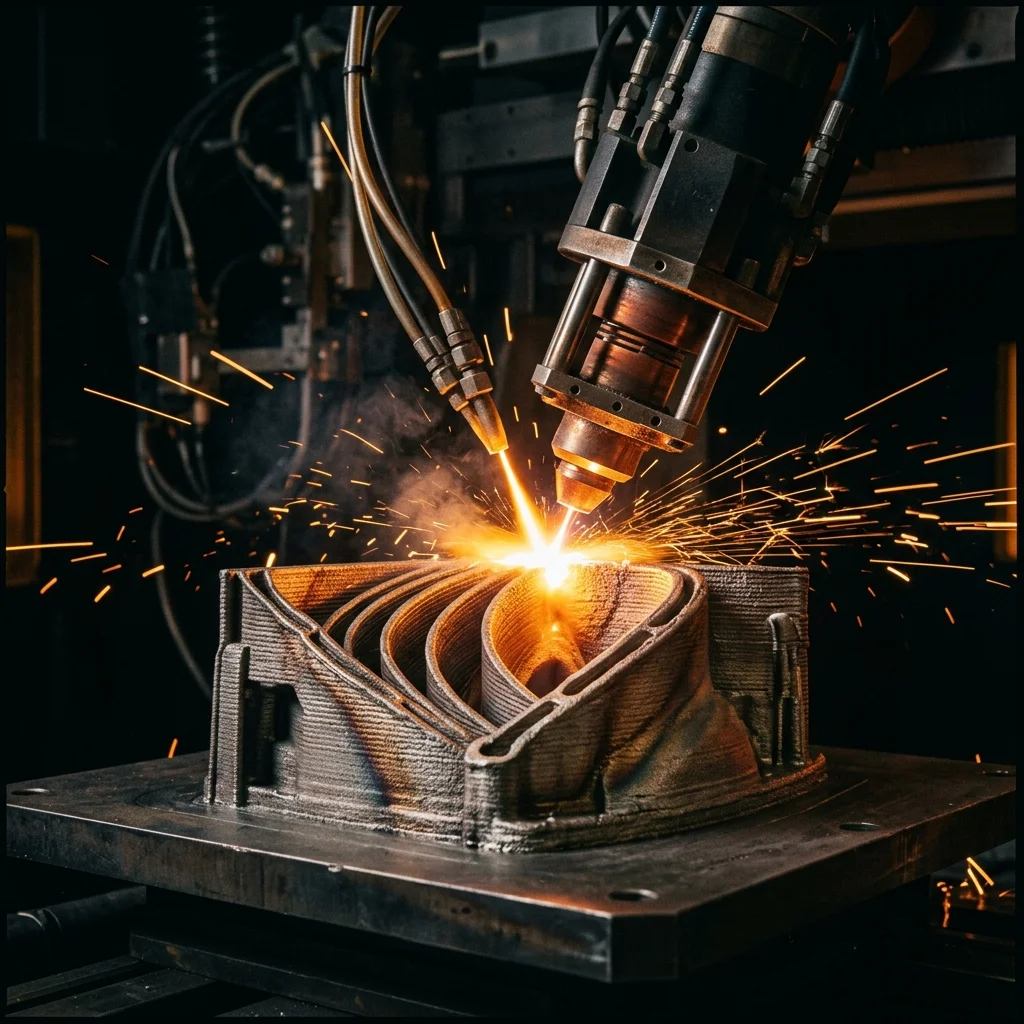
Industrial 3D printing transfers the technology from prototyping into real manufacturing. In 2025-2026 dozens of EU companies (GE, BMW, Siemens, Airbus) integrate 3D printing into production lines: not for prototypes, but for end-use parts shipping to customers. Bulgaria-based industrials began adoption around 2023: automotive aftermarket suppliers (Bulgaria 3D Hub in Plovdiv), aerospace tooling providers, and industrial machinery manufacturers. This guide: how 3D printing integrates into industrial production, typical end-use applications, and cost economics vs traditional manufacturing.
Industrial applications
Categories of industrial 3D printing:
-
End-use parts (production output): components that ship with the product. Examples: BMW iX5 hydrogen has 3D printed hydrogen routing components. GE Aviation fuel nozzles (Ti printed via SLM). 3D printing replaces conventional fabrication.
-
Jigs & fixtures: custom tools used on assembly lines. SLS PA12 is the industry standard: durable, dimensionally accurate, no support material. Replaces traditionally machined aluminum jigs at 1/5 cost.
-
End-of-arm tooling (EOAT): custom vacuum gripper attachments for collaborative robots. Print custom shapes for specific parts, vs €500-€2000 milled attachments per gripper.
-
Spare parts on-demand: legacy equipment with unobtainable OEM parts. Industrial OEMs (Siemens, Schneider) increasingly offer “print on demand” via authorized 3D printing bureaus. Stops production line stoppages.
-
Soft tooling: injection mold tooling printed directly. SLA molds for short runs (1-100 injection cycles), tooling for prototype injection molding. Replaces €5K-€50K traditional steel mold tooling for low-volume products.
-
Industrial fixtures: custom QC inspection fixtures, calibration targets. SLS PA12 standard. Dimensional accuracy ±0.15mm consistent.
-
Production line spares: pneumatic manifolds, custom HVAC routing, sensor housings. Replace as needed, in-house print capability.
-
Lightweight aerospace tooling: hand-held assembly tools, GO/NO-GO gauges. Saves crew shoulder strain (lighter than aluminum tools, equivalent strength).
Recommended technologies
SLS (Selective Laser Sintering): workhorse for industrial production: Bureau outsource: Sculpteo, Materialise, EOS, €15-€80 per part typical In-house desktop: Formlabs Fuse 1+ (€20K), Sinterit Lisa Pro (€18K), for medium volume Industrial scale: EOS P 396 (€300K+), HP Multi Jet Fusion (€250K+), for serial production Material: PA12 standard, PA11 (bio), TPU powders, glass-filled PA, PA-CF Cost per part (production scale): €5-€30
MJF (Multi Jet Fusion): HP’s faster SLS alternative: Bureau outsource: Sculpteo, Protolabs, Materialise, €13-€70 per part In-house: HP 4200 (€250K+), HP 5210 (€500K+), for production volumes 1000+/week Material: PA12 primary, expanding library Cost per part: €5-€25 typical (2x faster than SLS)
SLM (Selective Laser Melting), for metal parts: Bureau only (€500K+ hardware): Materialise, GE Additive, Protolabs Materials: Ti6Al4V (aerospace, medical), AlSi10Mg (lightweight industrial), 316L stainless Cost: €200-€5000 per part for typical aerospace bracket
FDM industrial, for tooling, fixtures: In-house: Bambu X1-Carbon (€1449) × multiple units = production farm capability Materials: PETG (jigs), Nylon PA12/PA-CF (load-bearing fixtures), PEEK/ULTEM (high-temp) Cost per part: €1-€20 in-house, vs €30+ bureau SLS Best for: jigs, fixtures, soft tooling, prototype-to-end-use bridging
For most industrial entry: Bambu X1-Carbon farm (5-10 units, €7K-€15K total) + outsource SLS/MJF for production batches. Pays back in 6-12 months for typical industrial supplier.
Real-world industrial cases
Bulgaria 3D Hub (Plovdiv, automotive aftermarket): production of custom replacement parts for vintage automotive (Trabant, Lada). 200 Bambu X1-Carbons + outsource SLS network. Monthly output 5000+ custom parts. Replaces unavailable OEM parts at €5-€80 retail vs unavailable original.
Sofia Aerospace Tooling (hypothetical example based on EU industry data): production of custom inspection tooling, GO/NO-GO gauges for aircraft maintenance. SLS PA12 + selective Markforged CFF for high-stiffness. Output: 50-100 custom tools/month at €30-€300 cost vs €500-€2000 traditional CNC.
BMW Plant Munich (well-documented case): 3D-printed brackets for iX series. Internal SLS production. 20% weight reduction vs traditional aluminum. 5000+ end-use brackets produced annually.
Siemens Energy (turbine blade burner tips): SLM Ti6Al4V end-use parts in gas turbine combustion chambers. 8000+ printed parts in service worldwide. Replaces investment casting for specific complex internal geometries.
GE Aviation LEAP fuel nozzles: 3D-printed Co-Cr-Mo fuel nozzles for LEAP jet engines. Reduced from 20-part assembly to single printed part. 30% lighter, 5x lifetime improvement. 100,000+ nozzles flying.
Adidas Futurecraft 4D: 3D-printed midsole soles. DLS (Carbon’s DLP variant). Mass production of consumer end-use footwear. 100K+ pairs annual production.
Boeing 787 brackets: 3D-printed Ti6Al4V brackets save 200 kg per aircraft. Lifetime fuel savings $2.5M+ per aircraft.
Real pattern across cases: industrial 3D printing wins when (1) complex geometry traditional can’t achieve, (2) weight reduction matters (aerospace, automotive), (3) part consolidation eliminates assembly steps, (4) low-to-mid volume production (1-10,000 units typical sweet spot).
Cost economics: 3D vs traditional
Decision matrix for production manager evaluating 3D vs CNC vs injection molding:
Volume 1-50 units: 3D printing always wins. CNC setup time + injection mold tooling cost dominate at low volumes.
Volume 50-500 units: Depends on complexity.
- Simple geometry: CNC machining typically cheaper (€10-€30 per simple part)
- Complex geometry (impossible CNC): 3D print only viable (€20-€80 per part)
- Need certified material: SLS or MJF bureau (€20-€80 per part)
Volume 500-5,000 units: Hybrid often optimal.
- 3D print metal/specialty geometries
- Injection mold simple-geometry parts
- 3D print soft tooling for short-run injection molding
- Cost per part: €5-€30 mixed approach
Volume 5,000+ units: Injection molding typically wins.
- Tooling cost €5,000-€50,000 amortizes
- Per-part cost €0.10-€2 for typical injection molded part
- 3D printing only justified for complex internal geometry impossible to mold
Material certifications:
- For aerospace AS9100: only bureaus Materialise, GE Additive, Protolabs offer
- For medical ISO 13485: Materialise, GE Additive with full certification
- For automotive IATF 16949: Materialise, Protolabs full certification
- Cost adder for certified production: +30-100% vs uncertified
Hidden costs comparison:
- Tooling lead time: injection mold 8-16 weeks, CNC fixture 2-4 weeks, 3D printing 1-2 weeks
- Design iteration cost: free with 3D print (re-print), €200-€2000 per CNC fixture revision, €5K-€50K per injection mold revision
- Stocking risk: 3D print produces on-demand (no inventory). Injection molding requires production batch (carrying cost).
- Service parts longevity: 3D printing supports 20+ year service parts from digital archive. Injection mold tooling typically scrapped after 5-10 years.
Entry roadmap for Bulgarian industrial
Phase 1 (€2K-€10K, 3-6 months): pilot:
1 × Bambu X1-Carbon (€1449): in-house FDM prototyping + jigs Outsource SLS bureau (Sculpteo €15-€80 per part): test production parts CAD designer training (or hire freelancer €200-€600 per design) Total: €2000-€10000 first year operational
Use cases: validate which products benefit from 3D printing. Print prototypes, internal fixtures, low-volume products.
Phase 2 (€20K-€100K, 6-18 months): scale:
3-5 × Bambu X1-Carbon farm: production FDM capacity Optional: Formlabs Fuse 1+ (€20K) or Sinterit Lisa Pro (€18K), in-house SLS Dedicated 3D printing technician (junior engineer €1500-€3000/month) Quality control equipment (caliper, CMM access) Total operational: €20K-€100K Year 2-3
Use cases: serial production of moderate volumes. Replace 80% of jigs/fixtures/spares with internal printing.
Phase 3 (€100K-€500K, 1-3 years): integration:
Industrial SLS/MJF (€250K+) or SLM (€500K+), for high-value end-use parts Production ERP integration with 3D print queue ISO 9001 (general) or AS9100 (aerospace) or ISO 13485 (medical) certification Multi-shift operation (24/5 or 24/7) Total operational: €100K-€500K Year 3-5
Use cases: ship 3D-printed end-use parts to customers. Replace traditional manufacturing for specific product lines.
Key takeaway: industrial 3D printing isn’t a binary decision. Phased adoption proves ROI before major investment. Most successful Bulgarian industrials follow Phase 1 → 2 path; Phase 3 only justified at enterprise scale.
Frequently Asked Questions (FAQ)
Interactive Analyzer for 3D Printing For Industrial Production
Select a profile to view detailed analysis.
The full picture
This article is one page from The Big Book of 3D Printing: 704 illustrated pages covering every technology, material and fix in one reference.
Read it on Kindle →Engineer, author of The Big Book of 3D Printing and additive manufacturing expert