

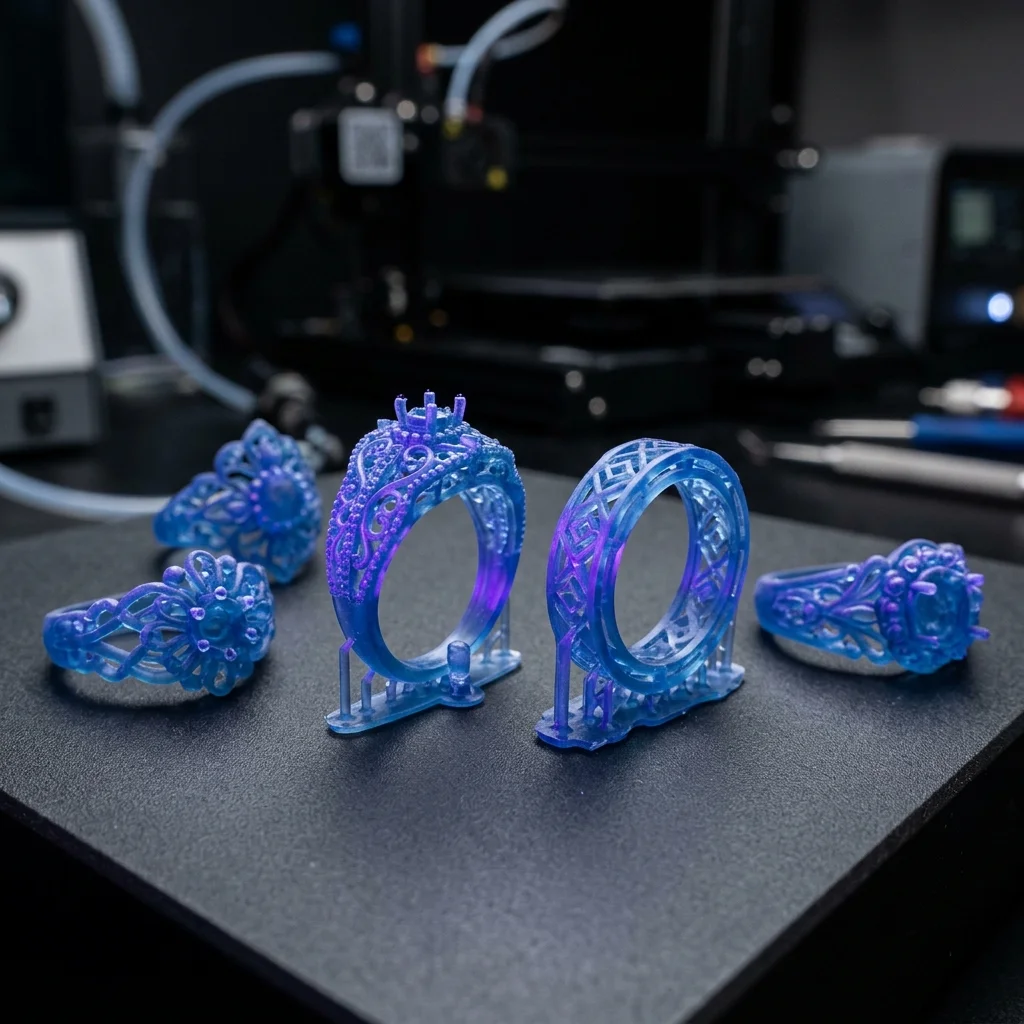
3D printing in jewelry doesn’t replace gold smith craft: it’s a tool that scales it. With an 8K MSLA printer + castable resin, an independent jeweler can design + print + cast custom rings in one working day, instead of weeks of hand-carving wax. In Sofia and Plovdiv, over 30 jewelry studios work with 3D printing production by 2026. This guide: which printers and resins the pros choose, the full workflow from CAD to finished gold ring, and cost structure for typical custom commissions.
Why 3D printing for jewelry
Before 3D printing, a jeweler had two main options for custom design:
-
Hand-carve in wax. 8-16 hours per ring, 16-30 hours for complex pendant. Hours of jewelry experience required.
-
CNC mill in wax. 1-3 hours per print, but size limitations (mill cannot access undercuts), and hardware cost €5000+.
3D printing revolutionizes the workflow:
- CAD design: 1-3 hours (learn the software once, applies to all designs)
- 3D print: 20-60 minutes per piece
- Investment + burnout: 6-8 hours (overnight)
- Cast + polish: 1-2 hours
Total time CAD → finished gold ring: 24-30 hours, mostly overnight. Hand-carving equivalent: 5-7 days dedicated work.
Quality advantages:
- Symmetry: 3D print gives identical halves naturally. Hand-carving: never quite symmetric.
- Repeatability: print 10 identical rings? Trivial. Hand-carve 10 identical? Impossible.
- Detail: filigree, micro-engraving, intricate prong patterns. 3D print hits 25-50 µm detail. Hand carving limited to mm-scale.
When 3D printing NOT optimal: very large statement pieces over 50mm (build volume limit), pieces requiring specific texture (organic hand-feel, hammered metal finish, better added after casting), one-off masterpiece sentiment items (where hand-craft IS the value).
Printer + CAD setup
Hardware setup for entry-level professional jewelry studio:
Anycubic Photon Mono M5s (€368) or Elegoo Saturn 3 Ultra (€402): 8K MSLA with auto-leveling.
Wash & Cure Plus (€110) or Mercury Plus (€100).
Burnout kiln (€500-€2000): for casting. Cheap option Vevor burnout kiln (€450). Mid-tier Neycraft (€1500). Premium Romanoff Vulcan III (€3500).
Casting equipment: vacuum or centrifugal caster. Romanoff Mini Caster (€800). Vacuum cast with platinum-grade pump (€2500). Spincaster (€1500).
Flasks: stainless steel investment flasks (€20-€50 each). Need 3-5 in rotation.
Investment: gypsum-based jewelry investment (€30-€60 per 10kg).
Metal: silver wire (€600-€700/kg for sterling), gold grain (€60-€80/g for 14k).
Total setup for small jewelry studio: €1500-€4000 for entry, €5000-€10,000 for medium production.
CAD software:
Rhino 7/8 + RhinoGold or Matrix: industry standard for professional jewelry CAD. €1500 Rhino + €2500 RhinoGold = €4000 setup.
Blender (free) + JewelCraft addon: cheaper alternative, learning curve steeper but powerful.
Fusion 360 (free for personal use, €600/year commercial): CAD-engineering oriented, good for mechanical jewelry but less specialized.
ZBrush: sculpting tool for organic forms. €900 one-time. Best for pendants with sculptural elements.
Lychee Slicer (€60/year): slicer with jewelry presets. Worth the cost vs free ChiTuBox for professional use.
Castable resin selection
For small studio with Anycubic M5s or Elegoo Saturn:
Siraya Tech Cast (€60-€80/liter): most popular hobby-pro choice. Burnout characteristics tested across many MSLA setups. Good for bronze, silver, basic gold casting.
Phrozen Wax-Like Castable (€70-€85/liter): premium quality, often used by jewelry pros. Cleaner burnout than Siraya Cast.
Resione W90 Castable (€55-€65/liter): Chinese alternative, decent quality at low cost. Good for prototype/test casting.
For professional studios with Formlabs Form 4:
Formlabs Castable Wax (€199/liter): industry gold standard for high-value casting. 40% wax content for absolutely clean burnout. Used in Tiffany, Cartier scale studios.
Formlabs Castable Wax 40 (€250/liter): premium version, even cleaner burnout. For very high-value pieces (€10K+ jewelry).
NextDent Cast (€120-€150/liter): dental crown resin, also works for fine jewelry. Form 4 + selected MSLA compatible.
For specialty applications:
BlueCast X10 Pro (€80/liter): specialized for fine filigree work. Premium clarity in cast.
Monocure 3D RapidCast (€55/liter): fast print, faster burnout cycle. Used for high-volume prototyping.
Casting workflow detail
Step-by-step workflow for custom gold ring commission:
Day 0 (consultation): client visits studio. Discuss design, gemstone (if any), metal choice. CAD designer takes notes, sketches.
Day 1 (CAD): designer models ring in Rhino + RhinoGold. 3-5 iteration cycle with client via screenshots and 3D renderings. 4-8 hours total CAD time.
Day 2 morning (print preparation):
- Export final STL
- Slice in Lychee Slicer with castable preset
- Orient: ring shanks vertical, stones up
- Add minimum supports (avoid visible surfaces after casting)
- Print: 30-60 minutes on Anycubic M5s
Day 2 afternoon (post-process):
- Wash: 2-3 minutes IPA, then 1 minute fresh IPA
- Dry: 10 minutes air
- SHORT cure (1-2 minutes per side ONLY for castable)
- Support removal while leather-hard
- Quality check under loupe
Day 3 (sprueing):
- Attach pattern to sprue base with wax
- For batch production: attach 5-10 patterns to tree
- Mount on rubber base ready for investment
Day 3 afternoon (investment):
- Mix gypsum-based investment with water (typical 38-42 parts water per 100 parts powder)
- Pour into flask, vacuum-debubble for 2-3 minutes
- Let set 2-3 hours
Day 3 evening to Day 4 morning (burnout):
- Place flask in kiln
- Programmed ramp: 30°C → 150°C → 350°C → 730°C
- Hold at 730°C for 1-2 hours
- Total cycle: 6-8 hours overnight
Day 4 (casting):
- Cool flask to casting temperature (550-650°C for gold)
- Melt metal in crucible (1064°C for pure gold)
- Centrifugal or vacuum cast into hot flask
- Wait 15-20 minutes for metal solidification
Day 4 afternoon (finishing):
- Devest: break investment in water
- Pickle: clean metal in pickling solution
- Cut sprue from piece
- File, sand, polish (1-2 hours)
- Set stones (if any, 30-60 minutes per stone)
- Final polish
- Hallmark stamp (for fine metal)
Day 4 evening: client photo, packaging, delivery.
Cost structure for typical commission
Small gold ring example (10g 14k gold, 0.5ct diamond):
Material costs: CAD time: 4 hours × €25/hr internal = €100 (or €50-€150 client invoice) Castable resin: €3 (using €70/L bottle, ~50ml per print) Investment: €1 Gold: 10g × €60/g = €600 Diamond (set, not provided by client): €400-€800 Casting + finishing labor: 4 hours × €30/hr = €120 Polishing materials, hallmark: €10
Total cost: €1234-€1684
Typical retail markup: Cost: €1234 Studio overhead + profit: 40-60% markup Retail price: €1700-€2000
For client-provided diamond: Material cost: ~€834 Retail: €1170-€1330
Volume production (10 identical rings, no diamond): Batch material cost: €600 × 10 = €6000 gold + €30 castable CAD: amortized €10/piece Labor batch: 4 hours per batch (not per piece) Cost per piece: €640 Retail per piece: €900-€1100 (lower margin for volume)
Premium pieces (large statement, complex setting): CAD: 16+ hours Multi-stone setting labor: 8+ hours Material: variable but typically €2000-€10,000+ Total: €5000-€30,000+
Frequently Asked Questions (FAQ)
3D Printing For Jewelry And Casting Calculator
Interactive optimization calculator.
The full picture
This article is one page from The Big Book of 3D Printing: 704 illustrated pages covering every technology, material and fix in one reference.
Read it on Kindle →Engineer, author of The Big Book of 3D Printing and additive manufacturing expert