

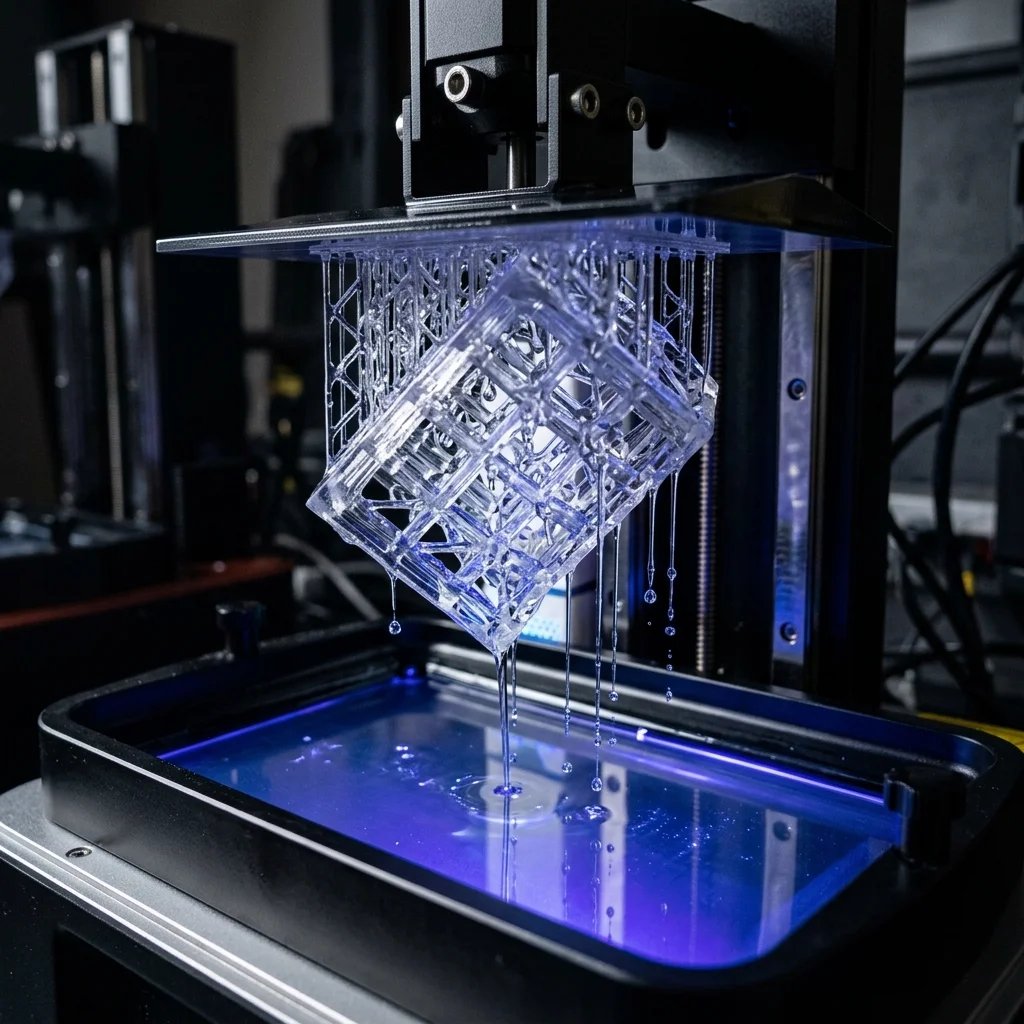
Clear resin (or transparent resin) is a specialized MSLA family for applications requiring light transparency: optical prototypes, lighting concepts, fluid flow visualization, medical visualization models, and decorative crystal-like pieces. Unlike standard resin, clear formulations have special chemistry to minimize UV scattering, higher refractive index, and pristine optical quality after polish. This guide: which printers, resins, and post-processing techniques turn cloudy prints into crystal-clear final pieces.
What makes clear resin different
Standard resin print comes out translucent: light passes but scatters internally. After cure, the part looks milky. Clear resin formulation is optimized for:
- High refractive index (close to crystal/glass)
- Minimal pigmentation
- Self-leveling characteristics (minimizes layer artifacts)
- Special monomer chemistry that cures transparently
Fresh-off-printer clear part is ONLY translucent: surface texture from layers makes it cloudy. Real clarity comes from post-processing: polishing, dipping in clear coat, or vapor smoothing.
Typical clear resin achievements:
- Crystal-clear on flat surfaces: yes, with polish
- Crystal-clear on curved surfaces: yes, with more elaborate polishing
- Optical-grade lens quality: NO (requires injection molding or specialty industrial SLA)
- 70-80% light transmission post-polish: realistic
- 95%+ transmission: only with specialized optical resin (Formlabs Clear V5)
Recommended clear resin brands
Formlabs Clear V5 (€199/liter): gold standard. Engineered for Form 4. Excellent clarity, paint adhesion friendly. Premium choice.
Anycubic Clear Resin (€25-€30/liter): budget choice. Print clarity slightly less than Formlabs, but excellent value. Working choice for hobby.
Elegoo Translucent Clear (€22-€28/liter): slight yellow tint but good clarity after polishing.
Siraya Tech Build Clear (€35/liter): popular choice for prototyping with hobby MSLA. Print profile widely supported.
Phrozen Aqua Crystal Clear (€40/liter): Phrozen’s premium clear. Optimized for 8K MSLA detail.
FormFutura Performance Clear (€60/liter): engineering-grade clear with toughness.
For optical-grade prototypes: only Formlabs Clear V5 reaches near-optical quality. For decorative/visual prototypes: Anycubic or Elegoo good enough.
Print strategy for clarity
Layer height: 0.025-0.030 mm (25-30 µm). Thinner layers = less visible layer lines after curing.
Orientation: critical for clarity. Print with visible surface flat against build plate when possible: eliminate support marks on visual face. Long axes vertical minimizes support density.
Supports: minimum density. Use thin tips (0.20 mm). Better fewer supports + slight cleanup than many supports + major polishing.
Hollowing: NOT for clear parts. Hollow walls create double-layer optical interfaces that scatter light. Print solid.
Exposure: standard exposure or slightly less (lower exposure reduces UV scatter inside cured resin).
Anti-aliasing: maximum (8 if supported). Critical for smooth angled surfaces.
Post-print before wash: leave printed part in drained vat for 30 minutes, let surface resin level slightly. This step alone improves clarity 20-30%.
Post-processing for optical clarity
Standard post-process for a cloudy clear part:
- Wash in IPA 99%, 2-3 minutes.
- Dry thoroughly (any residual moisture causes haze).
- Initial cure: 3-5 minutes (LESS than tough, over-cure adds slight yellow tint).
- Support removal.
- INITIAL polish: 800-1000 grit wet sanding on all visible surfaces. Removes layer texture.
- Sand 1500 grit.
- Sand 2500 grit.
- Polish with plastic polish compound (Novus #2, Meguiars PlastX) with soft cloth.
- Final clear coat: spray Krylon Clear Gloss or dip in transparent epoxy for maximum clarity.
Alternative (faster, slightly less clear): chemical vapor smooth with methanol or other compatible solvent. Suspend part above resin-compatible solvent for 2-3 minutes. Surface dissolves slightly, re-cures glass-smooth.
Final cure after polishing: 5-10 minutes under UV. Solidifies the polished surface.
Quality check: hold up to bright light. Visible imperfections require additional polishing on affected areas.
Applications and cost
Common clear resin applications:
Lighting prototypes (LED housings, light diffusers): clear resin perfect for visualizing light dispersion patterns. Cost per prototype: €5-€15.
Fluid flow visualization (microfluidics, plumbing prototypes): allows seeing fluid path during testing. €10-€30 per medium part.
Medical visualization models (anatomy with transparent organs): high-detail clear for medical educators. €20-€50 per anatomical model.
Jewelry prototypes (visualizing stone settings): clear resin lets you see how stones sit before committing to castable. €5-€10 per ring.
Guides for surgical planning (transparent overlays of patient anatomy): specialized medical-grade clear required. €100-€500 per surgical guide.
Decorative items (transparent figures, paperweights, art pieces): hobby use. €5-€20 material cost.
Product prototypes (clear plastic enclosures): early stage product development. €15-€40 per prototype.
Watch faces and lens prototypes: needs optical-grade Formlabs Clear V5. €30-€80 per piece.
Frequently Asked Questions (FAQ)
Interactive Analyzer for Msla With Clear Resin, Transparent Prototypes And Visual Models
Select a profile to view detailed analysis.
The full picture
This article is one page from The Big Book of 3D Printing: 704 illustrated pages covering every technology, material and fix in one reference.
Read it on Kindle →Engineer, author of The Big Book of 3D Printing and additive manufacturing expert