

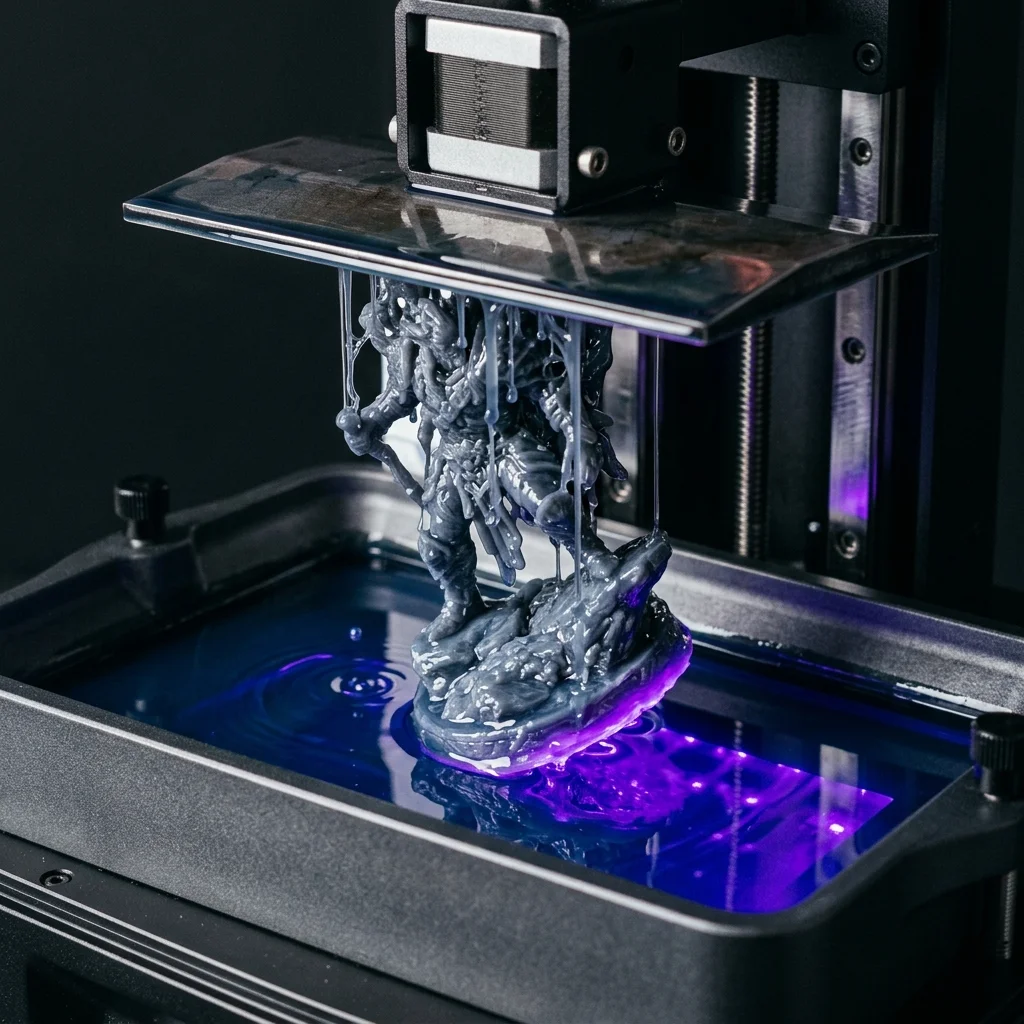
MSLA (Masked Stereolithography) is the technology that brought resin 3D printing to the masses: a €350 printer today produces detail that cost €5000 five years ago. Standard resin is the first type every new MSLA owner tries: easy to work with, cheap (€18-€30/liter), and demonstrating the core strength of the tech, photon-precise edges and fine surfaces. This guide covers which MSLA printers to choose, how to dial in exposure, how to do post-processing safely, and what standard resin is (and isn’t) good for.
Why MSLA, not FDM, for detail work
MSLA printers have advantages in three areas where FDM can’t compete:
Resolution: XY resolution of an 8K MSLA is 19 µm, 4K is 35 µm. Compare: the finest FDM nozzle is 0.2 mm = 200 µm. For miniatures (D&D, Warhammer, jewelry) the difference is dramatic.
Surface: MSLA layers are visually invisible after basic post-processing. FDM layers are always visible.
Speed for small parts: MSLA prints an entire layer at once, regardless of how many models are on the build plate. 100 miniatures print in the time of one.
When to prefer MSLA: miniatures, jewelry, dental models, precise prototypes, small mechanical parts with fine features.
When NOT: large functional parts (resins are brittle), outdoor parts (UV destroys resin), food-contact or skin-contact (standard resin is not certified).
Recommended MSLA printers
Anycubic Photon Mono M5s (€368): 12K display, the most accessible professional-grade MSLA in 2026. Auto-leveling, auto-resin-feed, excellent community support. Recommended for beginners and hobby.
Elegoo Saturn 3 Ultra (€402): 12K, larger platform (218×123 mm). Suited for batch printing many miniatures at once. Build quality better than entry-level.
Phrozen Sonic Mega 8K S (€1499): large platform (330×185 mm), 8K display, professional build. Recommended for business: dental studios, miniature ateliers.
Prusa SL1S SPEED (€1979): single-vat MSLA, best build quality on the market, integrated with Prusa cure-wash station, open-source software. Premium pick.
For under €300: Elegoo Mars 5 Ultra (~€280), solid entry without compromising resolution.
Recommended standard resin brands
Anycubic Standard Resin: most accessible professional brand (€20-€25/liter). Easy to print, baseline quality. Recommended for beginners.
Elegoo Standard Resin: nearly identical to Anycubic, sometimes slightly better layer adhesion. €18-€22/liter.
Phrozen Aqua Gray 8K: specifically formulated for high-resolution MSLA. Gray color (best for seeing fine detail), low odor. €30-€35/liter.
Siraya Tech Fast: optimized for fast print (4-6 sec/layer). Recommended for batch printing, especially miniatures. €25/liter.
Avoid the cheapest unbranded AliExpress resin: you risk gumming up the vat film and compromising your printer. Quality resin from a brand is an investment in your printer’s longevity.
Optimal settings for standard resin
Layer height: 0.05 mm (50 µm) is standard for miniatures. For larger prototypes 0.10 mm (for faster print). For absolute maximum resolution 0.025 mm: very slow but incredible detail.
Exposure time: depends on resin and printer. Start with manufacturer’s recommendation (typically 2.5-3.5 sec on an 8K printer for standard gray resin). Then calibrate with RERF (Resin Exposure Range Finder) print.
Bottom exposure: 25-35 sec, 5-7 bottom layers. Ensures the print sticks reliably to the build plate.
Lift speed: 60-80 mm/min. Faster risks detachment from plate. Slower increases total print time.
Lift distance: 6-8 mm.
Resting after retract: 1-2 seconds. Gives resin time to settle back over FEP film.
Anti-aliasing: level 4 (on printers that support it). Improves smoothness on angled surfaces.
Post-processing, safely and correctly
An MSLA print without post-processing is undercured: the resin is toxic in liquid form. Never handle a print without gloves in the first minutes after the printer.
Wash: 2-3 minutes in IPA (isopropyl alcohol) 95-99%. You can use a wash station (Anycubic Wash & Cure, Elegoo Mercury Plus) or just a glass jar of fresh IPA. Avoid acetone: it softens resin.
Dry: leave to air-dry 10-15 minutes (or with a compressor).
Cure: UV cure 5-10 minutes under a 405 nm lamp or in a cure station. For miniatures 5 minutes per side is enough. Over-curing makes resin brittle.
Support removal: best while the part is dry but not yet fully cured. With sharp clippers or hobby knife. Avoid pulling: risk breaking detail.
Safety: always gloves (nitrile), eye protection, and work in a ventilated room. Standard resin is a sensitizer: prolonged exposure can cause lifelong allergic reaction. Bandana or N95 mask for resin spills.
Frequently Asked Questions (FAQ)
Msla With Standard Resin, Complete Guide Exposure Calculator
Calculate optimal resin print time.
The full picture
This article is one page from The Big Book of 3D Printing: 704 illustrated pages covering every technology, material and fix in one reference.
Read it on Kindle →Engineer, author of The Big Book of 3D Printing and additive manufacturing expert