

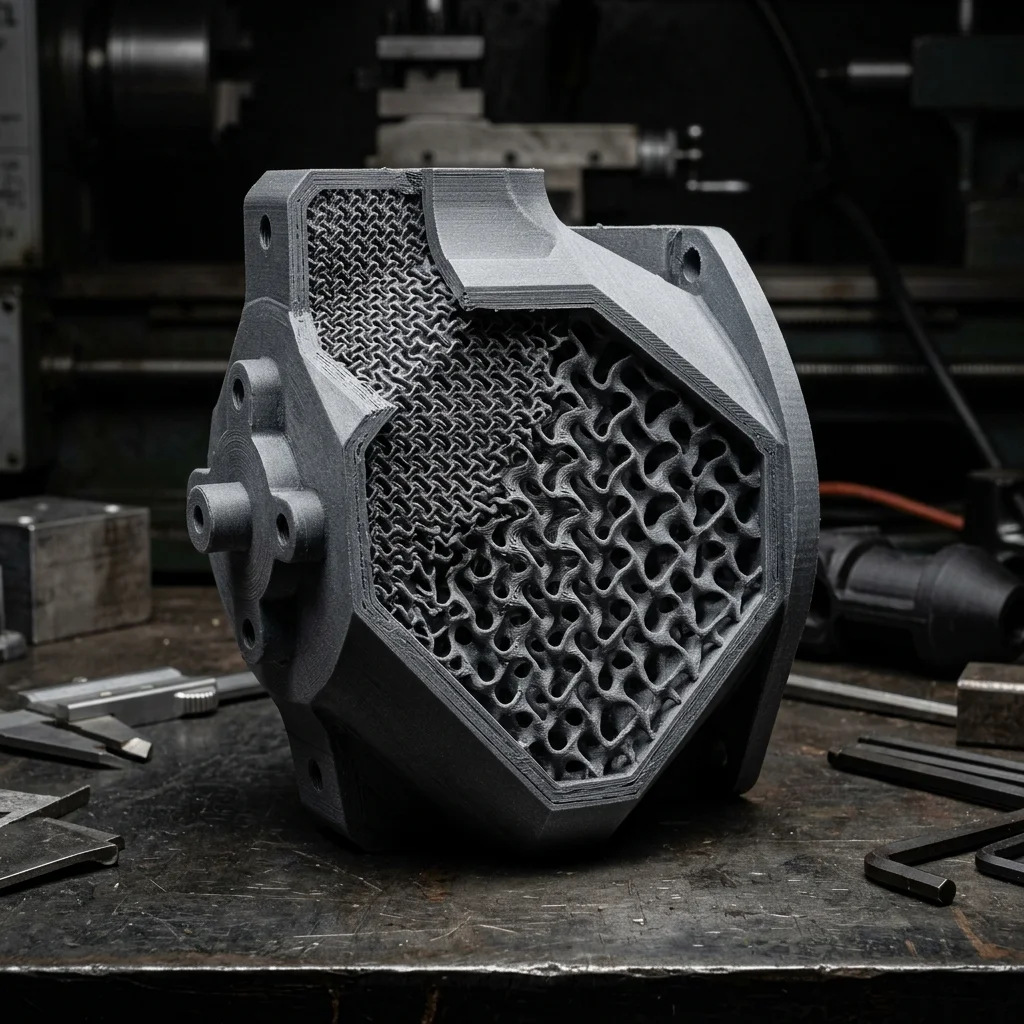
In 2025–2026, infill ratio optimization reduces material waste and carbon footprint. Most users print at 20% “default”, but optimal infill depends on application.
Recommendations
| Application | Infill % | Pattern | Material Savings |
|---|---|---|---|
| Visual models | 5–10% | Lightning | Up to 80% |
| Light load | 15–20% | Gyroid | Baseline |
| Heavy load | 50–80% | Grid/Gyroid | -50–75% |
Interactive Filament Selector
Answer 3 quick questions and find the optimal material for your project.
1. What are the mechanical requirements for the part?
2. What temperature will the part operate at?
3. Are there any specific environmental requirements?
Our recommendation:
PLA filament
Ideal for easy printing, model visualization and decorative parts.
Strategies
- Variable Infill. 2. Lightning Infill. 3. More walls + less infill. 4. FEA-guided optimization.
FAQ
Q:
Is 100% infill the strongest?
A:
Not always: 50% Gyroid can be more impact-resistant due to internal damping.
Interactive Analyzer for Sustainable Design: Infill Ratio Optimization For Minimal Waste
Select a profile to view detailed analysis.
Strength / Durability
45%
Print Speed
68%
The full picture
This article is one page from The Big Book of 3D Printing: 704 illustrated pages covering every technology, material and fix in one reference.
Read it on Kindle →Engineer, author of The Big Book of 3D Printing and additive manufacturing expert