

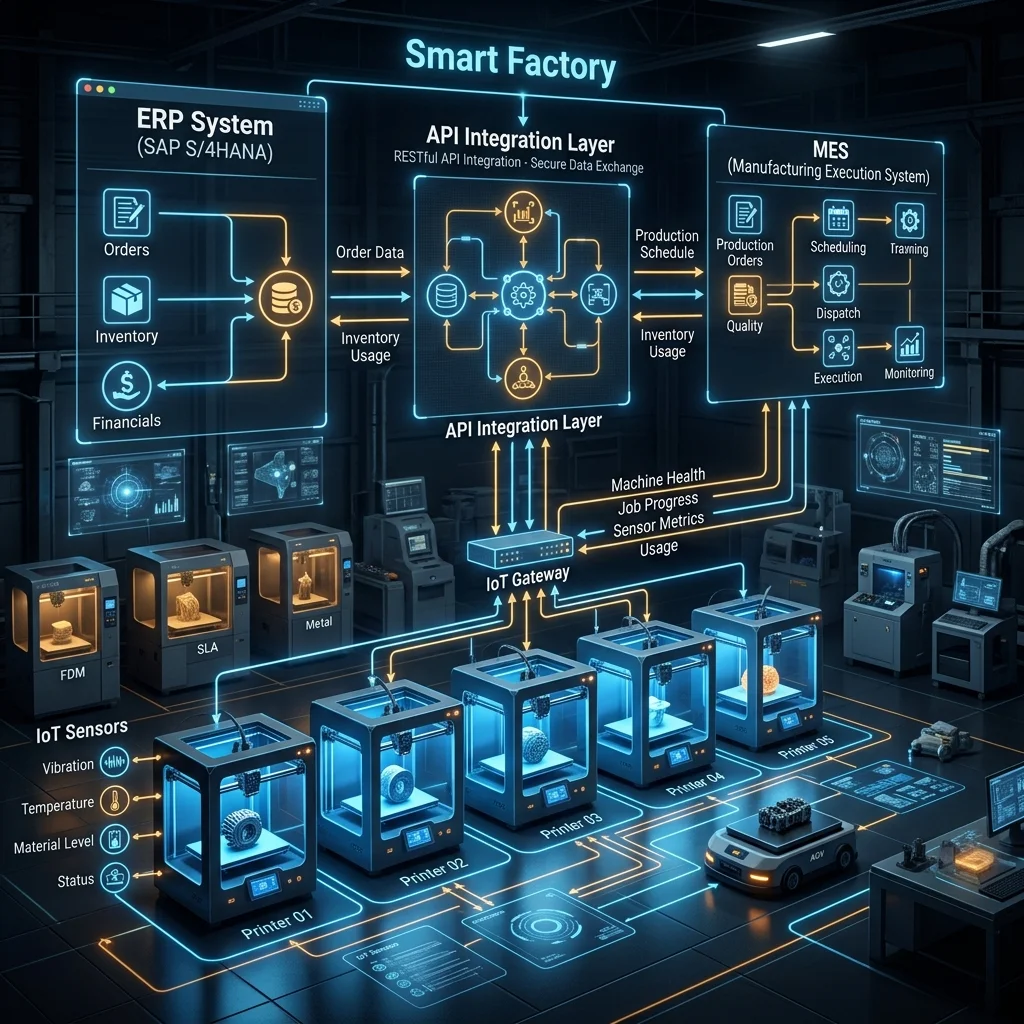
In 2025–2026, API integrations for shop floor automation connect 3D printers with MES, ERP, and SCADA systems via REST/MQTT/OPC-UA protocols for full Industry 4.0 integration.
Integration Protocols
| Protocol | Type | Purpose | Latency |
|---|---|---|---|
| REST API | Request/Response | Jobs, status, analytics | 50–500 ms |
| MQTT | Publish/Subscribe | Real-time telemetry | 1–10 ms |
| OPC-UA | Industrial standard | Machine-to-machine | 10–50 ms |
| WebSocket | Bidirectional | Live monitoring | 1–10 ms |
Interactive Filament Selector
Answer 3 quick questions and find the optimal material for your project.
1. What are the mechanical requirements for the part?
2. What temperature will the part operate at?
3. Are there any specific environmental requirements?
Our recommendation:
PLA filament
Ideal for easy printing, model visualization and decorative parts.
Key API Operations
- Job Submission: POST G-code + parameters to printer.
- Status Polling: GET temperature, progress, ETA.
- Telemetry Stream: MQTT per-second sensor data.
- Event Webhooks: Callbacks on completion, error, warning.
Pros and Cons
Pros:
- Full Automation: ERP order to finished part without manual intervention.
- Traceability: Every step documented in MES.
Cons:
- No Standard: No universal AM API standard (vendor-specific).
- Security: Industrial APIs require strong authentication.
- Complexity: Multi-system integration is non-trivial.
FAQ
Interactive Analyzer for Api Integrations For Shop Floor Automation: Rest, Mqtt, And Opc-Ua
Select a profile to view detailed analysis.
The full picture
This article is one page from The Big Book of 3D Printing: 704 illustrated pages covering every technology, material and fix in one reference.
Read it on Kindle →Engineer, author of The Big Book of 3D Printing and additive manufacturing expert