

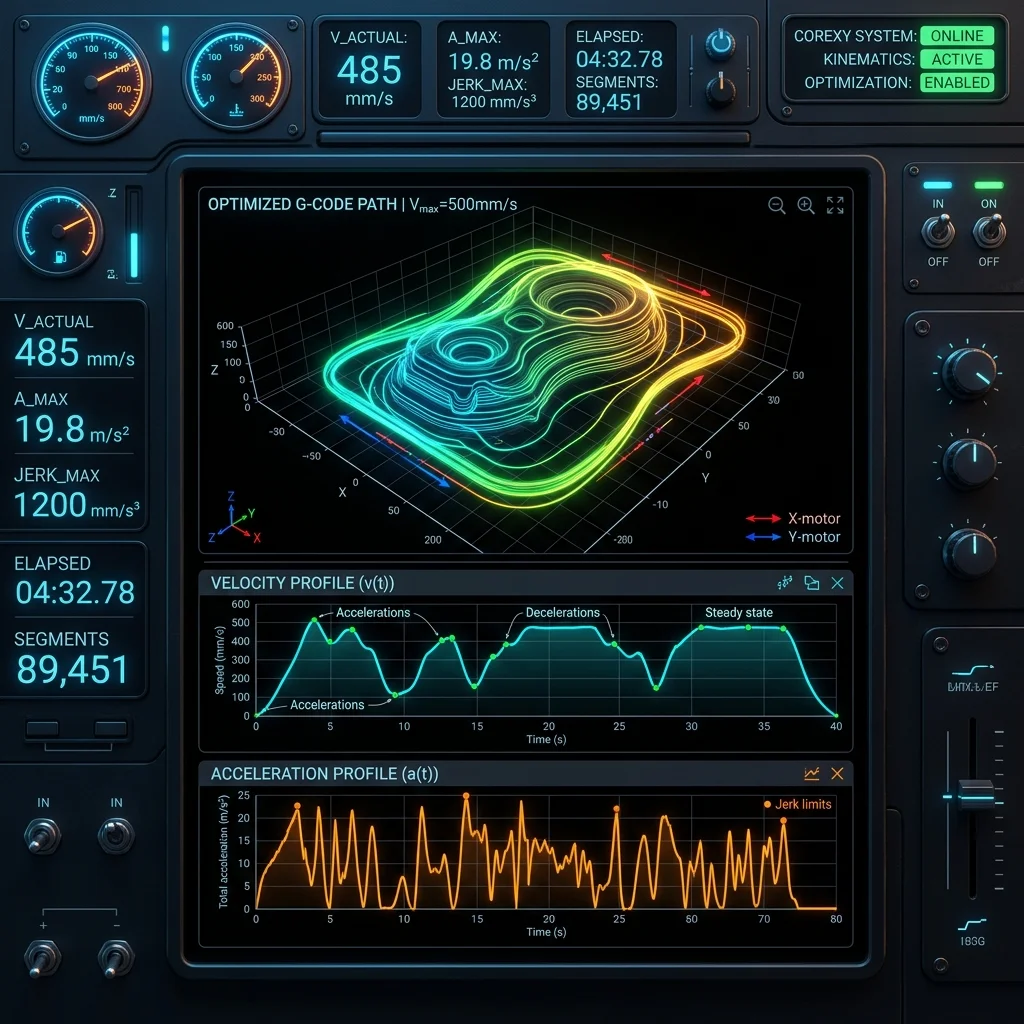
In 2025–2026, G-code optimization for high-speed kinematics addresses how slicers generate motion commands optimized for specific printer kinematic constraints. At speeds > 300 mm/s, standard G-code is insufficient: look-ahead planning, junction deviation, and acceleration profiling are essential.
The Problem
Standard G-code (linear segments) at high speed: micro-segments prevent reaching target speed, corners require deceleration, MCU must process thousands of commands per second.
Interactive Filament Selector
Answer 3 quick questions and find the optimal material for your project.
1. What are the mechanical requirements for the part?
2. What temperature will the part operate at?
3. Are there any specific environmental requirements?
Our recommendation:
PLA filament
Ideal for easy printing, model visualization and decorative parts.
Optimization Strategies
- Look-Ahead Buffer: Firmware analyzes next N segments (16–256), pre-plans speed profile.
- Junction Deviation: Allows controlled “error” at corners instead of full stops. Higher deviation → faster but rounded corners.
- Arc Support (G2/G3): Describes curves as arcs instead of many short segments. Reduces G-code size 30–70%.
- S-Curve Acceleration: Smooth transitions instead of instant jerk. Reduces vibrations.
Pros and Cons
Pros:
- Faster Printing: Eliminates unnecessary decelerations.
- Smoother Motion: S-curve and arc support reduce vibrations.
Cons:
- Firmware Dependent: Not all firmware supports all features.
- Complex Setup: Junction deviation requires kinematic understanding.
FAQ
G-Code Optimization For High-Speed Kinematics Speed Simulator
Optimize speed vs quality.
The full picture
This article is one page from The Big Book of 3D Printing: 704 illustrated pages covering every technology, material and fix in one reference.
Read it on Kindle →Engineer, author of The Big Book of 3D Printing and additive manufacturing expert