

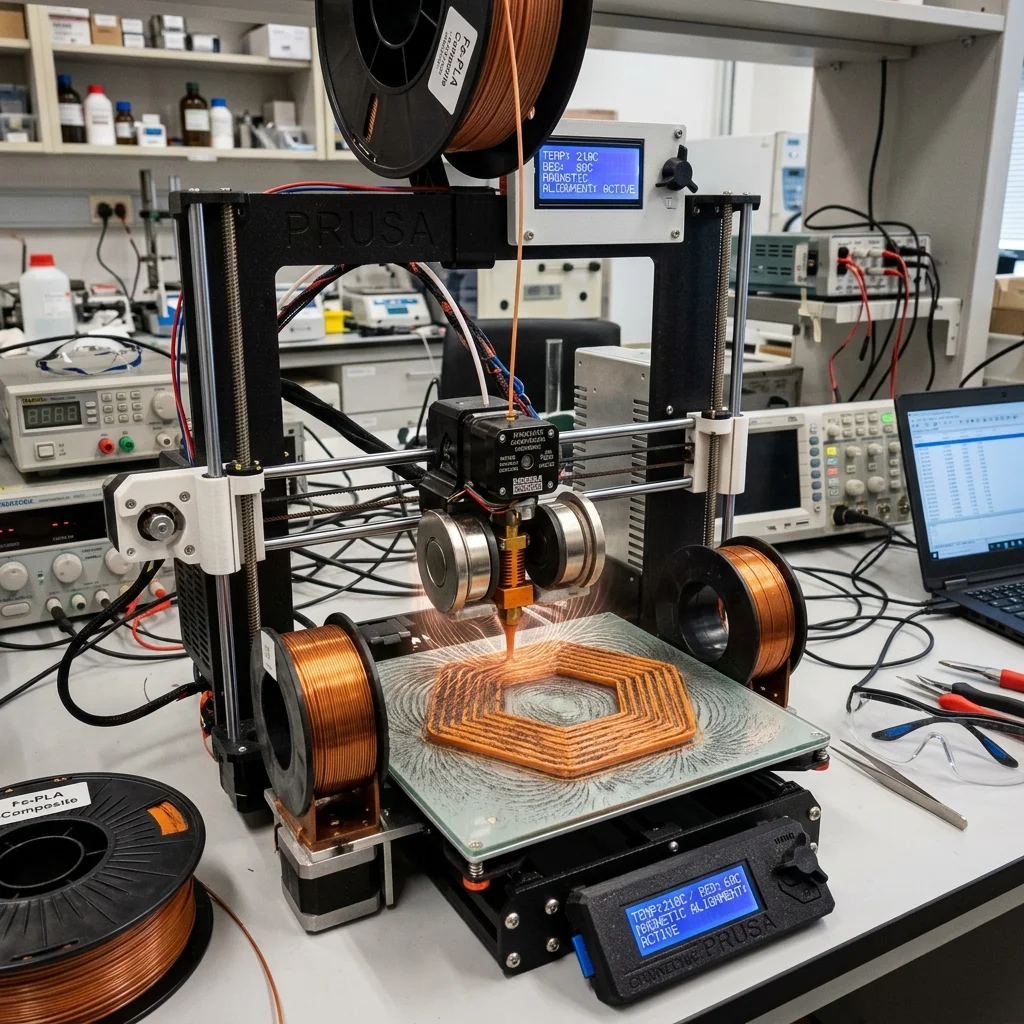
In 2025–2026, Magnetic Field-Assisted 3D Printing uses external magnetic fields to control particle orientation (fibers, nanoparticles, micro-magnets) within the polymer matrix during printing, creating anisotropic composites with controlled microstructure, enhanced properties, and functional gradients.
Principle: Magnetic Particle Orientation
- Magnetically responsive particles (Fe₃O₄ nanoparticles, nickel micro-fibers, NdFeB powder) are mixed into the polymer matrix.
- Magnetic field (permanent magnet or electromagnet) is applied during printing/curing.
- Particles align with field lines.
- Polymer solidifies, “freezing” the orientation.
Interactive Filament Selector
Answer 3 quick questions and find the optimal material for your project.
1. What are the mechanical requirements for the part?
2. What temperature will the part operate at?
3. Are there any specific environmental requirements?
Our recommendation:
PLA filament
Ideal for easy printing, model visualization and decorative parts.
Applications
- Anisotropic Composites: Controlled fiber orientation for maximum strength in specific directions.
- Soft Robotics: Magnetic elastomers with programmed deformation under applied field.
- Biomedicine: Magnetic scaffolds for guided tissue regeneration.
- Metamaterials: Structures with unique electromagnetic properties.
Pros and Cons
Pros:
- Microstructure Control: Particle orientation without mechanical means.
- Functional Gradients: Different orientation in different zones.
- Compatibility: Works with FDM, SLA, DLP, and direct ink writing.
Cons:
- Limited Materials: Requires magnetically responsive particles.
- Complex Setup: Magnetic coils or magnets must be precisely positioned.
- Research Phase: Few commercial products.
FAQ
Magnetic Field-Assisted 3D Printing: Microstructure Control Calculator
Interactive optimization calculator.
The full picture
This article is one page from The Big Book of 3D Printing: 704 illustrated pages covering every technology, material and fix in one reference.
Read it on Kindle →Engineer, author of The Big Book of 3D Printing and additive manufacturing expert