

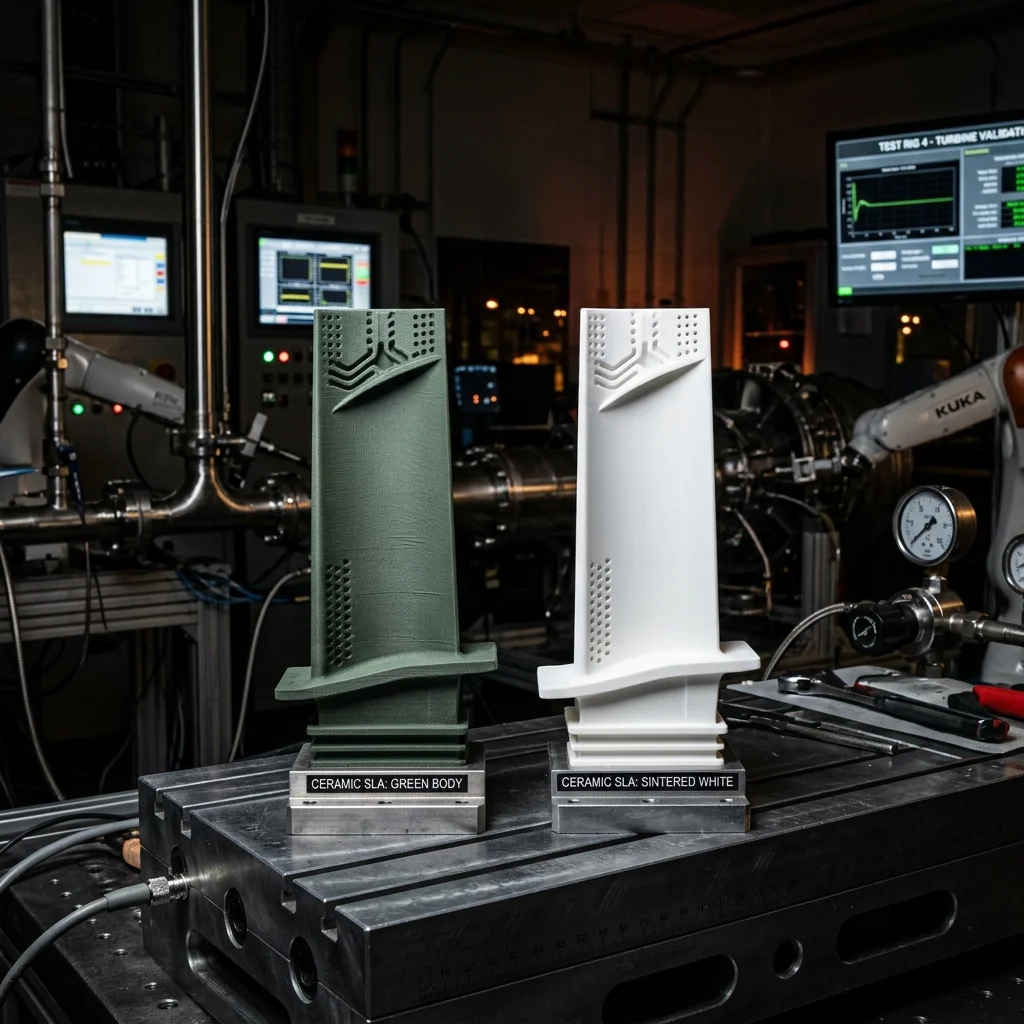
In 2025–2026, Ceramic Stereolithography (Ceramic SLA) has advanced to enable production of ceramic turbine blades and high-temperature components. Ceramic SLA combines the precision of photopolymerization with the unique properties of technical ceramics: temperature resistance > 1500°C, corrosion resistance, and exceptional hardness.
Process: Photopolymer + Ceramic Powder
- Ceramic Slurry: Photopolymer resin mixed with ceramic powder ($Al_2O_3$, $ZrO_2$, $Si_3N_4$, SiC) at 40–60 vol%.
- SLA/DLP Printing: Standard DLP or SLA cures the slurry layer by layer (25–100 μm resolution).
- Debinding: Green body heated slowly (0.5–2°C/min) to 400–600°C to burn out polymer binder.
- Sintering: 1400–1800°C. Particles fuse through diffusion, achieving > 95% theoretical density.
- Shrinkage: 15–25% linear, compensated in CAD model.
Interactive Filament Selector
Answer 3 quick questions and find the optimal material for your project.
1. What are the mechanical requirements for the part?
2. What temperature will the part operate at?
3. Are there any specific environmental requirements?
Our recommendation:
PLA filament
Ideal for easy printing, model visualization and decorative parts.
Ceramic Properties
| Ceramic | $T_{sinter}$ | Flexural Strength | Hardness (HV) | Application |
|---|---|---|---|---|
| $Al_2O_3$ | 1550–1650°C | 350–400 MPa | 1500–2000 | Turbine blades, insulators |
| $ZrO_2$ | 1400–1500°C | 800–1200 MPa | 1200–1400 | Dental crowns, blades |
| $Si_3N_4$ | 1700–1800°C | 700–1000 MPa | 1400–1700 | Bearings, turbochargers |
| SiC | 1800–2200°C | 300–500 MPa | 2400–2800 | Heat exchangers, armor |
Pros and Cons
Pros:
- Precision: DLP resolution 25–100 μm, higher than any other ceramic AM process.
- Complex Geometry: Internal channels and lattice structures impossible for conventional pressing.
Cons:
- Brittleness: Ceramics are brittle, impact causes catastrophic failure.
- Long Post-Processing: Debinding + sintering = 24–72 hours.
- Shrinkage: 15–25% requires precise compensation.
FAQ
Ceramic Stereolithography For Turbine Blades: High-Temperature Am Calculator
Interactive optimization calculator.
The full picture
This article is one page from The Big Book of 3D Printing: 704 illustrated pages covering every technology, material and fix in one reference.
Read it on Kindle →Engineer, author of The Big Book of 3D Printing and additive manufacturing expert