

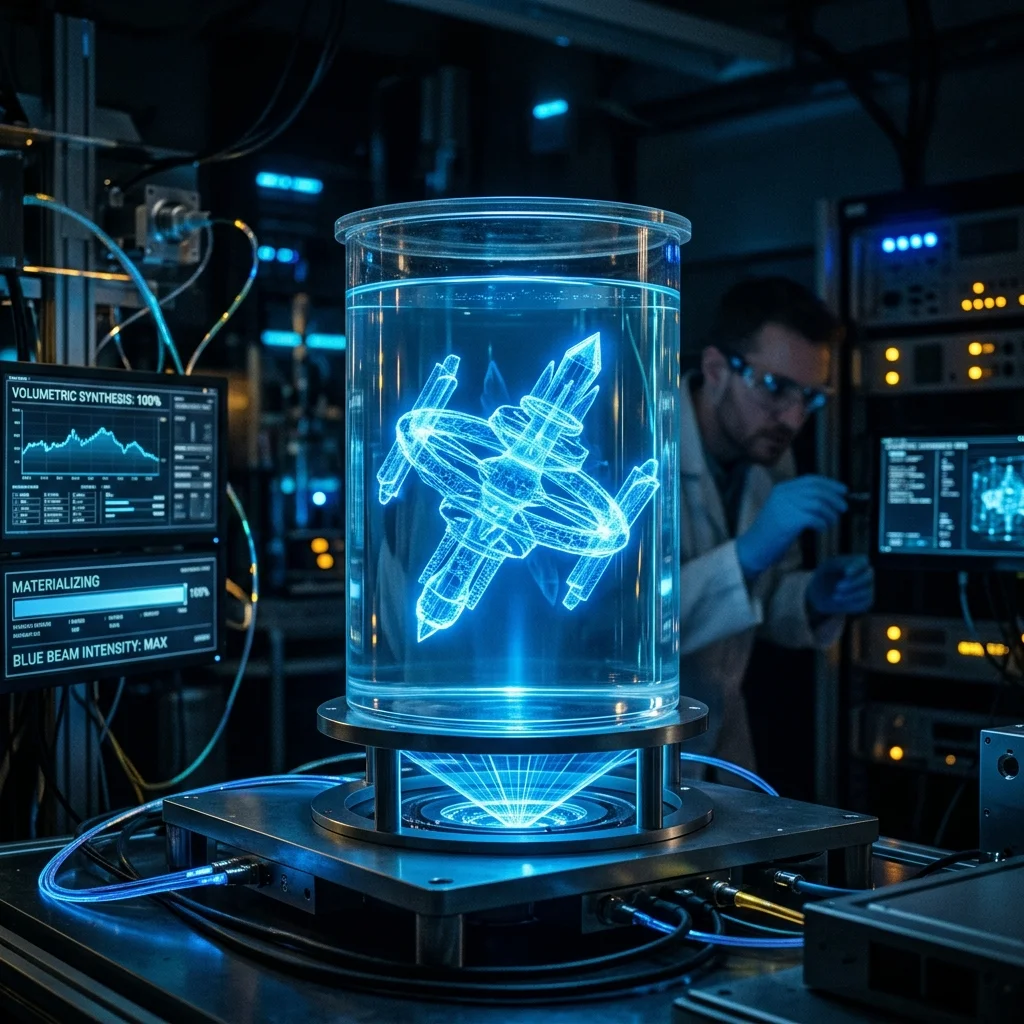
In 2025–2026, Volumetric Holographic 3D Printing has emerged as one of the most paradigm-shifting technologies in additive manufacturing. Instead of building parts layer by layer, the entire volume solidifies simultaneously through projection of computed light patterns into a photopolymer resin.
Principle: Computed Axial Lithography (CAL)
The most advanced implementation is Computed Axial Lithography (CAL), developed at UC Berkeley:
- Resin Container: A cylindrical container filled with photosensitive resin rotates slowly (1–2 RPM).
- DLP Projector: A series of 2D projections (analogous to CT X-ray slices) are projected through the rotating container from multiple angles.
- Dose Accumulation: At points where light doses from multiple projections accumulate above the polymerization threshold, the resin cures. In remaining zones, the dose stays below threshold.
- The entire object forms simultaneously within 30–120 seconds.
Interactive Filament Selector
Answer 3 quick questions and find the optimal material for your project.
1. What are the mechanical requirements for the part?
2. What temperature will the part operate at?
3. Are there any specific environmental requirements?
Our recommendation:
PLA filament
Ideal for easy printing, model visualization and decorative parts.
Advantages Over Layer-Based Technologies
| Property | Layer-Based SLA/DLP | Volumetric (CAL) |
|---|---|---|
| Layers | Yes (staircase artifacts) | No (layer-less) |
| Speed | Minutes–hours | 30–120 seconds |
| Supports | Required | Not needed |
| Surface Quality | Stepped | Smooth (optical) |
| Object Embedding | Impossible | Possible (print around existing objects) |
| Isotropy | Anisotropic (Z-weakness) | Isotropic |
Pros and Cons
Pros:
- Ultra-Speed: Tens of seconds for complete parts.
- Layer-Less Structure: Fully isotropic mechanical properties.
- No Supports: Uncured resin supports the part during printing.
- Embedding: Can print around existing objects (e.g., electronic components).
Cons:
- Early Stage: Technology is still primarily research-grade.
- Low Dose Contrast: Complex geometries with large density variations are challenging.
- Limited Size: ~100 mm maximum diameter currently.
FAQ
Interactive Analyzer for Volumetric Holographic 3D Printing: Complete Objects In Seconds
Select a profile to view detailed analysis.
The full picture
This article is one page from The Big Book of 3D Printing: 704 illustrated pages covering every technology, material and fix in one reference.
Read it on Kindle →Engineer, author of The Big Book of 3D Printing and additive manufacturing expert