

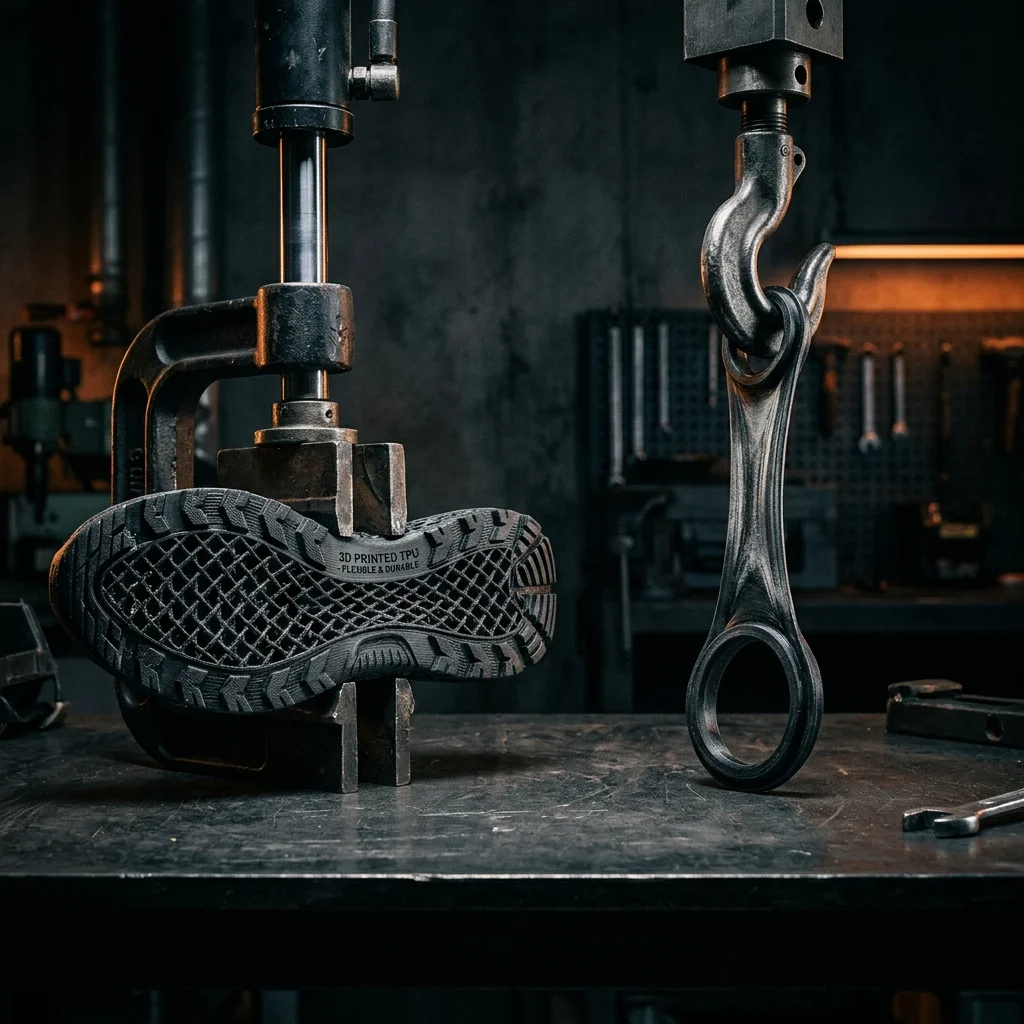
In 2025–2026, one of the most commercially successful applications of additive manufacturing is the production of elastomeric polyurethane (EPU) midsoles for athletic footwear. Carbon EPU 41 (the resin powering adidas Futurecraft 4D shoes and Riddell SpeedFlex helmets) demonstrates how 3D printing has transitioned from prototyping tool to mass manufacturing technology.
This article examines Carbon’s dual-cure CLIP process, lattice structure engineering, and the competitive advantages of EPU resins over conventional foam midsoles.
Carbon CLIP Technology: UV + Thermal Dual Cure
Carbon’s Continuous Liquid Interface Production (CLIP) is fundamentally different from conventional SLA/DLP technology. The key innovation is the dead zone: a thin oxygen-inhibited layer at the bottom of the resin vat:
Phase 1: UV Photopolymerization (Green Part)
- UV light projections (405 nm) cure successive cross-sections of the resin.
- An oxygen-permeable window creates a thin (10–20 μm) liquid layer that prevents the part from adhering to the vat floor.
- The result is a continuous “pulling” process: no peeling, no refilling, no inter-layer pauses.
- Build speed reaches 25–100 mm/hr in Z (5–10× faster than standard DLP).
- The green part is partially polymerized and mechanically weak.
Phase 2: Thermal Bake (Secondary Thermal Cure)
- The green part is placed in a convection oven at 120°C – 160°C for 4–12 hours.
- Blocked isocyanate groups in the polyurethane precursors “unblock” and react with polyols, forming urethane crosslinks.
- This secondary polymerization transforms the fragile green part into a highly elastic, fatigue-resistant polyurethane elastomer.
Interactive Filament Selector
Answer 3 quick questions and find the optimal material for your project.
1. What are the mechanical requirements for the part?
2. What temperature will the part operate at?
3. Are there any specific environmental requirements?
Our recommendation:
PLA filament
Ideal for easy printing, model visualization and decorative parts.
Mechanical Properties of Carbon EPU 41
| Property | Value | Significance |
|---|---|---|
| Elastic Modulus | 3.5 – 5.5 MPa | Soft, rubber-like material. |
| Elongation at Break | 250% – 350% | Extreme deformation without fracture. |
| Ultimate Tensile Strength | 6 – 8 MPa | Suitable for dynamically loaded components. |
| Tear Strength | 16 – 22 kN/m | Critical for lattice wall durability. |
| Energy Return (Resilience) | 60% – 70% | Mechanical energy returned upon unloading. |
| Fatigue Resistance | > 100,000 cycles | At 50% compression (key midsole test). |
| Shore A Hardness | 65 – 75 A | Medium hardness for elastomers. |
Lattice Structure Engineering
The true innovation of EPU 41 for footwear is not just the material, but its combination with generatively designed lattice structures:
Why Lattices Instead of Solid Fill?
- Weight Optimization: Lattices reduce midsole weight by 50–70% compared to solid elastomer.
- Zoned Cushioning: Different midsole zones (heel, arch, toe) can have different lattice densities → different stiffness and damping characteristics.
- Ventilation: Open lattice structures allow airflow circulation.
- Non-Linear Loading: Lattice walls buckle and collapse in a controlled manner, providing progressively increasing resistance, the desired “spring-back” effect.
Popular Lattice Topologies
- TPMS (Triply Periodic Minimal Surfaces): Schwarz-P, Gyroid, smooth, corner-free structures with excellent load distribution.
- Kelvin Cells: Periodic 14-sided cells with excellent isotropic compression.
- Custom Gradient Lattices: Lattice density increases as a gradient from surface to core (or reverse) for personalized damping.
Comparison with Conventional Midsole Materials
| Property | EVA Foam (Standard) | Carbon EPU 41 (3D) | TPU Injection Molded |
|---|---|---|---|
| Customization | None | Full (from foot scan data) | Limited |
| Fatigue Resistance | Degrades after 500 km | > 100,000 cycles | Good |
| Weight | Light | Light (lattice optimization) | Heavy |
| Zoned Cushioning | No | Yes (variable lattice density) | No |
| Production Cycle | Hours (molding) | Minutes (CLIP) + thermal oven | Hours (injection) |
| Tooling Cost | Expensive molds | Zero (digital design) | Expensive molds |
Pros and Cons
Pros:
- Mass Customized Manufacturing: Each midsole can be unique, different size, athlete weight, running style.
- Unmatched Fatigue Resistance: > 100,000 cycles at 50% compression, far exceeding EVA foam.
- CLIP Speed: Green part printing in 20–30 minutes (standard DLP: 4–8 hours).
- Zero Tooling: No mold costs, direct CAD to finished product.
Cons:
- Expensive Thermal Cure: Requires an industrial convection oven with precise temperature control.
- Closed Ecosystem: Carbon M-series printers only run Carbon resins on a subscription model.
- High Resin Cost: EPU 41 is significantly more expensive than mass-market TPU filaments.
- Limited Color Palette: Typically available in black/gray due to UV stabilizer additives.
Frequently Asked Questions (FAQ)
Interactive Analyzer for Polyurethane Elastomeric Resins (Carbon Epu 41) For Footwear
Select a profile to view detailed analysis.
The full picture
This article is one page from The Big Book of 3D Printing: 704 illustrated pages covering every technology, material and fix in one reference.
Read it on Kindle →Engineer, author of The Big Book of 3D Printing and additive manufacturing expert