

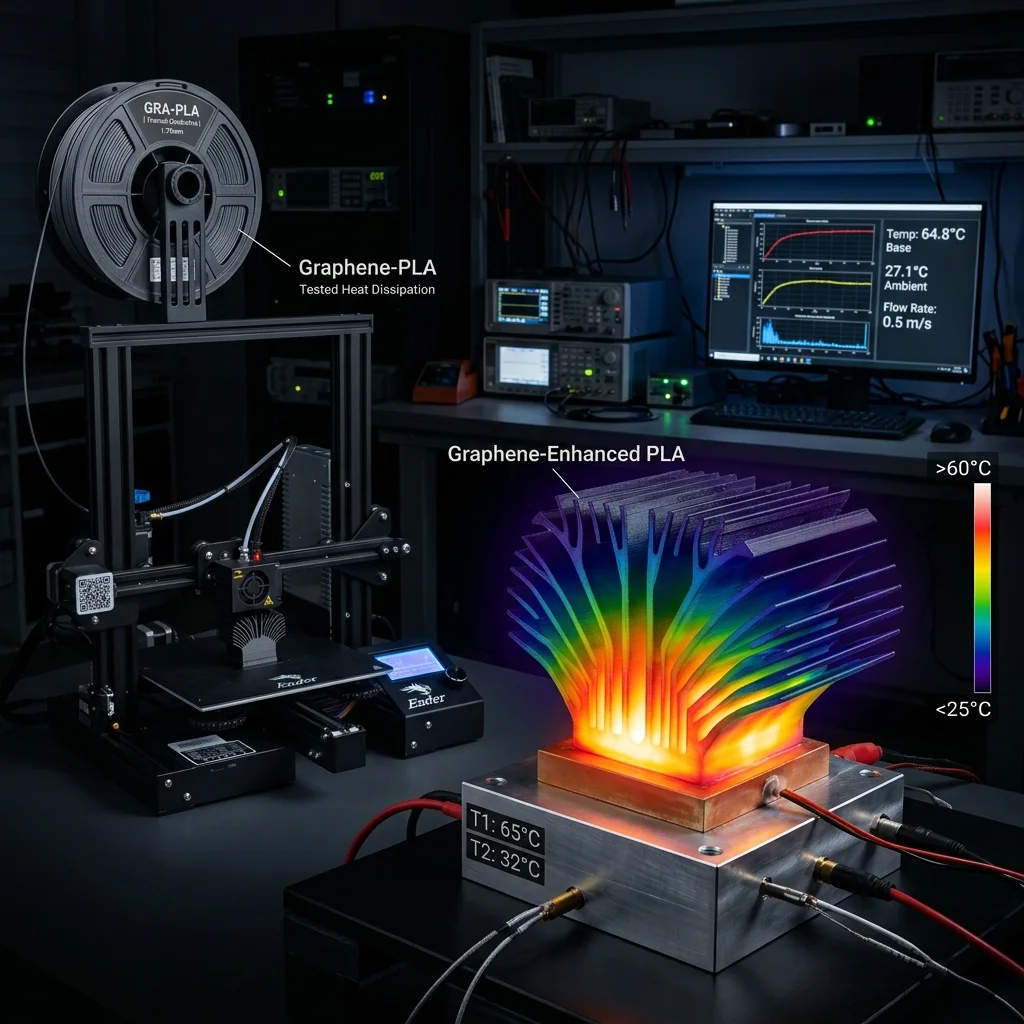
In 2025–2026, structural multi-functionality has become a major objective in material science for additive manufacturing. Graphene-Infused PLA represents a major leap, transforming a standard biological polymer into a functional composite with enhanced thermal and electrical properties.
By incorporating two-dimensional carbon sheets, this material enables the direct fabrication of electromagnetic shields, custom heatsinks, and integrated sensors on desktop FDM systems.
Physics of Percolation & Phonon Heat Transfer
Standard PLA is a thermal and electrical insulator with a low thermal conductivity of ~0.13 W/m-K. Compounding Graphene Nanoplatelets (GNPs) into the PLA matrix alters these transport phenomena:
1. Electrical Conductivity via the Percolation Threshold
Graphene possesses high electron mobility. However, macro-scale electrical conductivity only occurs when the fillers reach the percolation threshold. This is the critical concentration where graphene nanoplatelets touch or overlap to form a continuous 3D network through the polymer. In premium filaments, this threshold is achieved at 5% to 8% weight loading, reducing volume resistivity down to 1 – 10 Ohm-cm.
2. Phonon Heat Transport
Thermal transport in polymers occurs through lattice vibrations called phonons. Amorphous PLA chains scatter these phonons, restricting heat flow. Graphene’s rigid sp² carbon lattice allows phonons to travel with minimal scattering. Compounding GNPs raises the thermal conductivity to 1.5 – 2.0 W/m-K (a 10-fold increase), enabling passive heat dissipation for low-power microcontrollers or LED modules.
3D Cost Calculator
Results:
Abrasive Wear and Extrusion Hardware
Graphene is extremely hard. During extrusion, the nanoplatelets act as micro-abrasives on the internal geometry of the printing nozzle:
- Standard Brass Nozzles: Brass is soft and will wear out rapidly, expanding a 0.4 mm orifice to 0.6 mm or more after extruding less than 100g of material, ruining dimensional accuracy.
- Engineering Solution: A hardened steel, tool steel, or ruby-tipped nozzle is mandatory. Hardened steel has lower thermal conductivity than brass, requiring a print temperature increase of 5°C to 10°C to compensate.
Optimal Print Guidelines
- Extrusion Temperature: 210°C – 230°C (depending on nozzle material and thermal dissipation).
- Bed Temperature: 50°C – 60°C.
- Nozzle Diameter: $ge$ 0.4 mm (0.6 mm preferred to prevent cluster clogging).
- Print Speed: 30 – 50 mm/s. Lower speeds allow the graphene plates to align along the extrusion path, maximizing X/Y-axis electrical and thermal conductivity.
Pros and Cons of Graphene-Infused PLA
Pros:
- Enhanced Heat Dissipation: Suitable for custom heatsinks for electronic components.
- Electrical Conductivity: Enables direct printing of capacitive sensors, ESD-safe enclosures, and grounding paths.
- Stiffness Enhancement: Carbon nanoplatelets act as structural reinforcement, increasing the elastic modulus.
- Minimal Warping: Retains PLA’s ease of printing without requiring heated chambers.
Cons:
- Extremely Abrasive: Destroys standard brass nozzles rapidly.
- Reduced Ductility: Composites are stiffer but more brittle, with a lower elongation at break.
- Price Premium: High-quality graphene additives increase raw material cost.
- Z-Axis Anisotropy: Interlayer weld resistance is higher than planar resistance.
Frequently Asked Questions (FAQ)
Interactive Analyzer for Graphene-Infused Pla: Enhanced Thermal And Electrical Conductivity
Select a profile to view detailed analysis.
The full picture
This article is one page from The Big Book of 3D Printing: 704 illustrated pages covering every technology, material and fix in one reference.
Read it on Kindle →Engineer, author of The Big Book of 3D Printing and additive manufacturing expert