

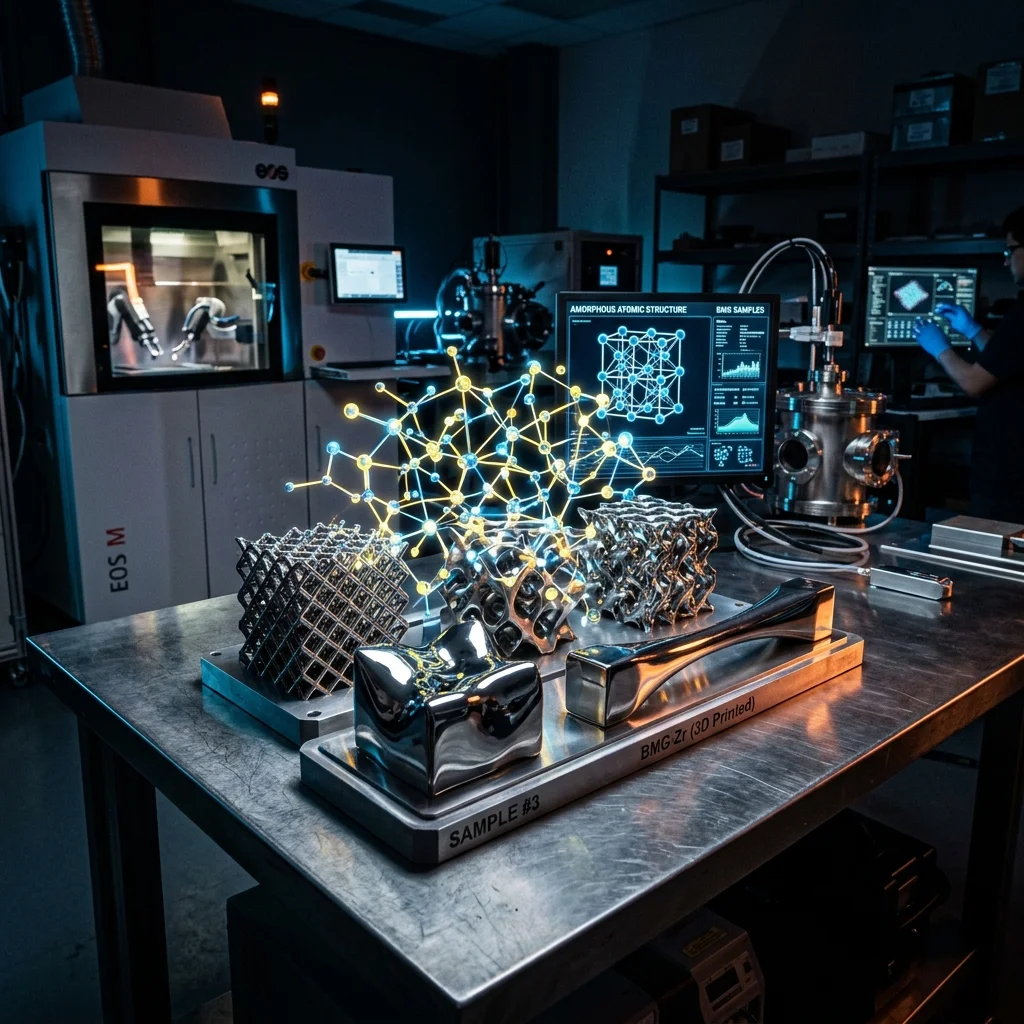
In 2025–2026, one of the most promising frontiers in metallurgy and advanced additive manufacturing is the processing of Amorphous Metal Alloys, widely known as Bulk Metallic Glasses (BMG).
Unlike conventional metals, which feature a rigid crystalline lattice, BMGs exhibit a disordered, liquid-like atomic structure. This unique state of matter yields components with a combination of high yield strength, extreme elastic limit, and exceptional corrosion resistance.
Physics of the Amorphous State
In standard metals and alloys, atoms arrange themselves into highly organized crystalline grains during cooling. Mechanical failures propagate along these grain boundaries and through lattice defects (dislocations).
- The Amorphous Structure: BMGs bypass crystallization. The atoms are cooled so rapidly that they remain frozen in a chaotic, liquid-like arrangement.
- Mechanical Performance: The complete absence of grain boundaries and dislocations gives BMGs their unique mechanical properties:
- High Tensile Strength: Often exceeding 1.5 to 2.0 GPa (double that of aerospace titanium).
- Super-Elasticity: Displays an elastic limit of ~2.0% (compared to less than 0.5% for standard steel or titanium), allowing components to undergo massive flexing and return to their original shape without permanent deformation.
- Corrosion Resistance: Because chemical corrosion typically initiates at grain boundaries, the homogeneous amorphous structure is highly resistant to acid and salt degradation.
Additive Manufacturing Challenges: The Devitrification Trap
To lock in the amorphous state, the molten alloy must be cooled below its glass transition temperature ($T_g$) at a rate faster than its critical cooling rate ($R_c$).
- Cooling Rates: While traditional metals require cooling rates of $10^6$ K/s to prevent crystallization, specially formulated BMG alloys (containing Zr, Cu, Ni, Ti, and Be) have lower critical cooling rates of $10$ to $1000$ °C/s.
- Laser Powder Bed Fusion (LPBF) Compatibility: LPBF is uniquely suited for BMG production. The laser melts a tiny weld pool, and the surrounding solid metal and powder beds act as a highly efficient heat sink, achieving cooling rates of $10^4$ to $10^6$ K/s.
The Devitrification Challenge
The primary engineering challenge lies in thermal accumulation. When the laser scans layer $N$, heat conducts down into the previously solidified amorphous layer $N-1$. If the temperature of this underlying layer rises above its crystallization temperature ($T_x$) for even a fraction of a second, the material undergoes devitrification (crystallization). This localized crystallization creates grain boundaries and brittle phases, which severely degrade the elastic limit and impact toughness of the printed part. Resolving this requires strict management of volumetric laser energy density ($E_v = P / (v cdot h cdot t)$) to balance melting and cooling.
Material Properties Comparison: BMG vs. Titanium vs. Stainless Steel
| Property | Bulk Metallic Glass (Zr-Based) | Titanium Grade 5 (Ti-6Al-4V) | Stainless Steel 316L |
|---|---|---|---|
| Atomic Structure | Amorphous (Non-crystalline) | Crystalline (HCP/BCC) | Crystalline (FCC) |
| Tensile Strength | 1700 – 2100 MPa | 950 – 1050 MPa | 500 – 650 MPa |
| Elastic Limit | ~2.0% | ~0.7% | ~0.2% |
| Hardness (Vickers) | 450 – 550 HV | 330 – 390 HV | 180 – 220 HV |
| Corrosion Resistance | Exceptional | Very Good | Good |
| Maximum Wall Thickness | Thermally constrained | Unlimited | Unlimited |
Interactive Filament Selector
Answer 3 quick questions and find the optimal material for your project.
1. What are the mechanical requirements for the part?
2. What temperature will the part operate at?
3. Are there any specific environmental requirements?
Our recommendation:
PLA filament
Ideal for easy printing, model visualization and decorative parts.
Pros and Cons of BMG in Additive Manufacturing
Pros:
- Unrivaled Elastic Performance: Ideal for spring elements, compliant mechanisms, and flexible hinges that undergo repeated loading cycles.
- Sub-nanometer Surface Finish: The absence of crystalline grains allows the material to be polished to a mirror-like finish with nanometric surface roughness.
- Biocompatibility: Zr-based BMGs exhibit an elastic modulus closer to human bone than traditional titanium implants, reducing the risk of stress shielding.
Cons:
- Ultra-Narrow Print Window: Demands meticulous laser power and scanning speed control to prevent heat accumulation and devitrification.
- High Feedstock Cost: BMG alloy powders require complex inert gas atomization processes, making them expensive.
- Geometrical Scale Restrictions: Bulky, solid cross-sections cool slower than thin walls, making it difficult to maintain amorphous structures in thick components.
Frequently Asked Questions (FAQ)
Interactive Analyzer for Amorphous Metal Alloys (Bmg): Ultra-Strength Without Crystal Lattice
Select a profile to view detailed analysis.
The full picture
This article is one page from The Big Book of 3D Printing: 704 illustrated pages covering every technology, material and fix in one reference.
Read it on Kindle →Engineer, author of The Big Book of 3D Printing and additive manufacturing expert