

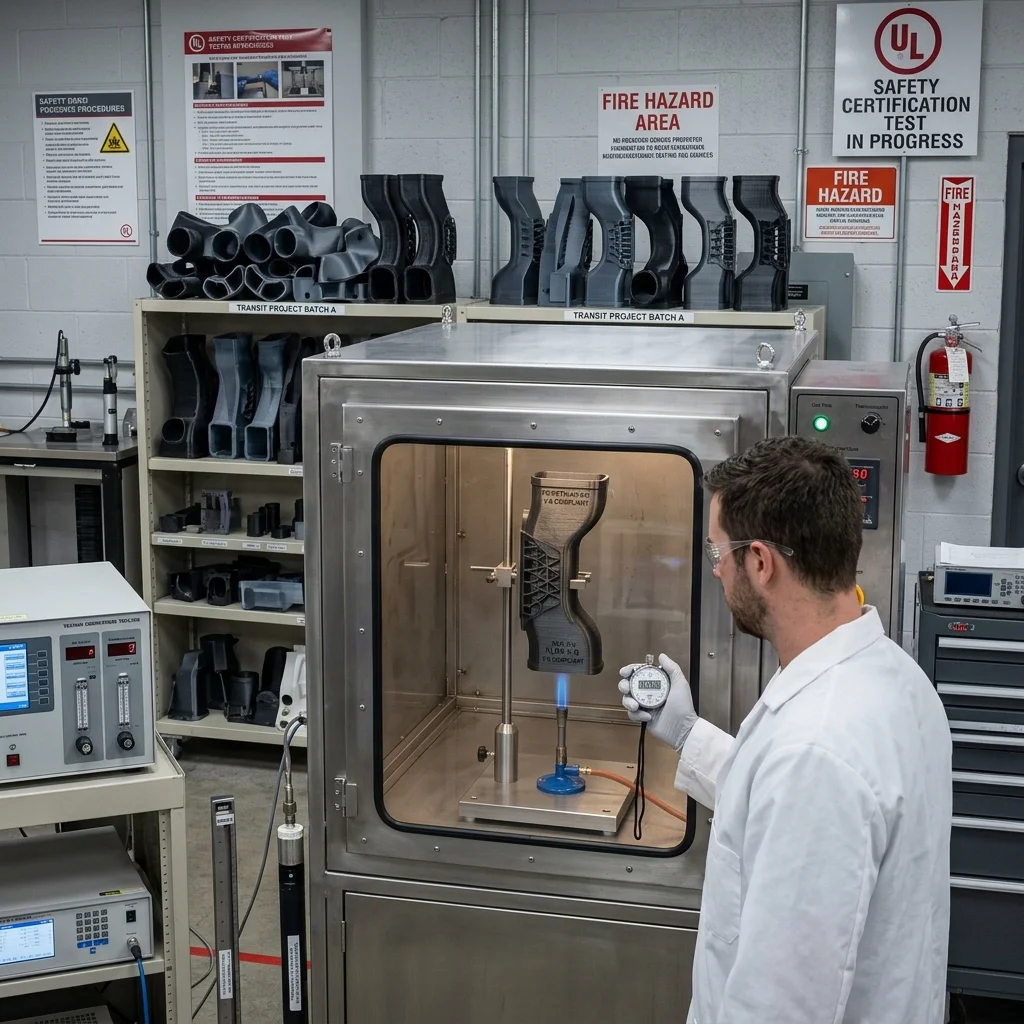
In 2025–2026, the application of additive manufacturing in transportation and public infrastructure is governed by strict safety protocols. Every 3D-printed component deployed in passenger rail, aerospace, or automotive cabins must adhere to rigorous flame, smoke, and toxicity (FST) regulations.
Flame-Retardant PETG (FR-PETG) has emerged as a crucial material, bridging the gap between ease of processing and certified fire safety.
Polymer Chemistry of Flame Retardancy
Standard Polyethylene Terephthalate Glycol (PETG) is highly flammable, burning with an open flame and producing molten, flaming droplets that propagate fires. FR-PETG prevents this through chemical modification.
1. Halogen-Free Additives
Historically, flame retardancy relied on halogenated chemicals (chlorinated or brominated agents). However, during combustion, halogens release highly toxic, corrosive gases and dense smoke, making them hazardous for enclosed spaces like rail cars or aircraft. Modern FR-PETG formulations utilize halogen-free, phosphorus-based flame retardants (typically ammonium polyphosphate or organic phosphonates).
- The Intumescent Mechanism: When exposed to high heat or flame, the phosphorus compounds react with the carbonaceous polymer matrix, promoting the formation of a stable, non-flammable charred surface layer (char barrier):
- It cuts off the oxygen supply to the underlying polymer layers.
- It blocks heat transfer, insulating the unburnt plastic underneath.
- It prevents the formation of flaming droplets, containing the localized fire.
2. Certification Standards: UL 94 and EN 45545-2
To validate fire safety for commercial public transport, materials are evaluated under standardized protocols:
- UL 94 Vertical Burning Test: The target classification is UL 94 V-0. This requires the vertical test specimen to self-extinguish within 10 seconds of flame removal, with no flaming drips that ignite the underlying cotton indicator.
- EN 45545-2 (European Railway Standard): Evaluates heat release, smoke density, and gas toxicity. Materials are classified into Hazard Levels (HL1 to HL3). Halogen-free FR-PETG is critical for achieving HL2 and HL3 compliance in internal train components.
Material Comparison: FR-PETG vs. Polycarbonate (PC) vs. Standard PETG
| Property | Standard PETG | Flame-Retardant PETG (FR-PETG) | Polycarbonate (PC) |
|---|---|---|---|
| Flammability Rating (UL 94) | HB (Highly Flammable) | V-0 (Self-Extinguishing) | V-2 to V-0 (Grade dependent) |
| Smoke Density & Toxicity | High, toxic smoke | Very Low (Halogen-Free) | Moderate to High |
| Printing Temperature | 220°C – 240°C | 240°C – 260°C | 270°C – 310°C |
| Heat Deflection Temp (HDT @0.45 MPa) | 68°C – 72°C | 75°C – 78°C | 120°C – 135°C |
| Ease of Printing | Very Easy | Easy to Moderate | Difficult (High warping risk) |
| Impact Strength (Izod Notched) | ~6-8 kJ/m² | ~5-7 kJ/m² | ~60-80 kJ/m² |
Interactive Filament Selector
Answer 3 quick questions and find the optimal material for your project.
1. What are the mechanical requirements for the part?
2. What temperature will the part operate at?
3. Are there any specific environmental requirements?
Our recommendation:
PLA filament
Ideal for easy printing, model visualization and decorative parts.
Pros and Cons of FR-PETG
Pros:
- Certified Fire Safety: Meets UL 94 V-0 and transportation safety standards for public enclosures and electronic housings.
- Easy Processing: Can be printed on standard desktop FDM systems without requiring ultra-high temperature heated chambers, unlike PC or PEI.
- Chemical & Moisture Resistance: Retains the high chemical resistance of PETG, showing resistance to acids, bases, and cleaning solvents.
- Low Shrinkage: Displays minimal warp and excellent interlayer adhesion during printing.
Cons:
- Reduced Impact Toughness: The addition of powder flame retardants introduces stress concentration points, slightly reducing tensile and impact strength compared to virgin PETG.
- Nozzle Wear: Mineral and phosphorus FR additives are abrasive, requiring hardened steel or ruby nozzles.
- Limited Thermal Threshold: With an HDT of ~75°C, FR-PETG cannot be used in high-temperature environments (e.g., engine bays) where PC or PEI is required.
Frequently Asked Questions (FAQ)
Flame-Retardant Petg (Fr-Petg): Safety In Public Transit Calculator
Interactive optimization calculator.
The full picture
This article is one page from The Big Book of 3D Printing: 704 illustrated pages covering every technology, material and fix in one reference.
Read it on Kindle →Engineer, author of The Big Book of 3D Printing and additive manufacturing expert