

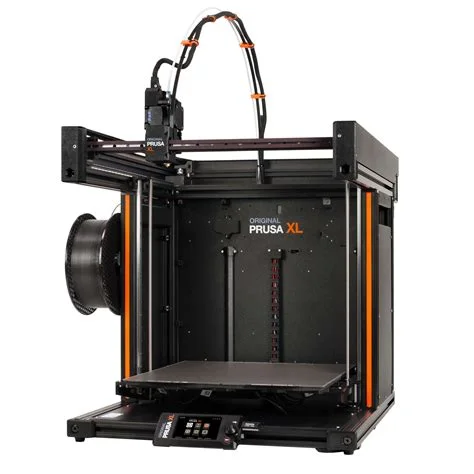
The Prusa XL with five toolchanger heads is an open prosumer CoreXY printer with a 360×360×360 mm build volume, built for genuine multi-material printing without compromise: each head is an independent extruder, eliminating purge-tower waste and enabling combinations of materials that differ in hardness, color and chemistry within a single part.
What it is
The Prusa XL is not merely a large printer: its core concept is a modular toolchanger system in which up to five independent print heads swap automatically during a print. Unlike single-nozzle solutions with passive filament mixing, each head here carries its own heater and sensor, enabling simultaneous work with materials that have radically different requirements: for example a rigid PLA body with TPU gaskets and soluble PVA supports. A segmented heatbed with 16 independent zones compensates for the thermal gradient across the large print area. The printer is fully open: any OEM or third-party filament can be used, and PrusaSlicer provides complete per-head control. It targets product designers, research teams and small workshops that need size, precision and genuine multi-material capability on a single workstation.
Technical specifications
| Technology | FDM (CoreXY, open frame) |
|---|---|
| Build volume | 360 × 360 × 360 mm |
| Toolchanger heads | up to 5 independent extruders (automatic swap) |
| Heatbed | segmented: 16 independent zones |
| Calibration | automatic leveling + per-tool XYZ offset |
| Class / Price | Prosumer · from ~€2000 (depends on head count) |
Who it’s for
- Multi-material prototyping (combining a rigid PLA body, flexible TPU gaskets and soluble PVA supports in a single automated cycle) no manual intervention between materials (Product design and R&D)
- Production jigs and fixtures: producing strong positioning tools from ASA and PLA-CF within the large build volume without need for gluing or assembly (Automotive and aerospace)
- Short-run production of functional parts: autonomous 24/7 printing of short-run engineering components in multiple materials within a single continuous job (Electronics and consumer goods)
Calibration step by step
- Clean the PEI plate with isopropyl alcohol (IPA) before every session. Oils and dust removed: maximum first-layer adhesion across the full 360×360 mm field.
- Run automatic leveling on the segmented heatbed (all 16 zones). Thermal and mechanical gradient across the large bed compensated: uniform first layer throughout.
- Calibrate the XYZ offset for each installed toolchanger head individually. Precise alignment between heads: no steps or gaps when tools swap during a print.
- Verify and adjust flow rate and Pressure Advance for each head using a test profile in PrusaSlicer. Optimized extrusion per material: no over-extrusion or gaps at transitions between heads.
Common defects and fixes
Recommended settings by material
Pick a material to see the recommended temperatures (empirical ranges from 561 OrcaSlicer/Bambu profiles) plus machine-specific tips:
Conclusion
The Prusa XL with five toolchanger heads is the only open prosumer printer where genuine multi-material printing is not a side feature but an architectural principle. The toolchanger system eliminates the purge tower, the segmented heatbed tames 360×360 mm without thermal issues, and the platform's openness allows full control over every material and every head. The right choice for those for whom size and multi-material capability matter more than speed and automation.
The full picture
This article is one page from The Big Book of 3D Printing: 704 illustrated pages covering every technology, material and fix in one reference.
Read it on Kindle →Engineer, author of The Big Book of 3D Printing and additive manufacturing expert