

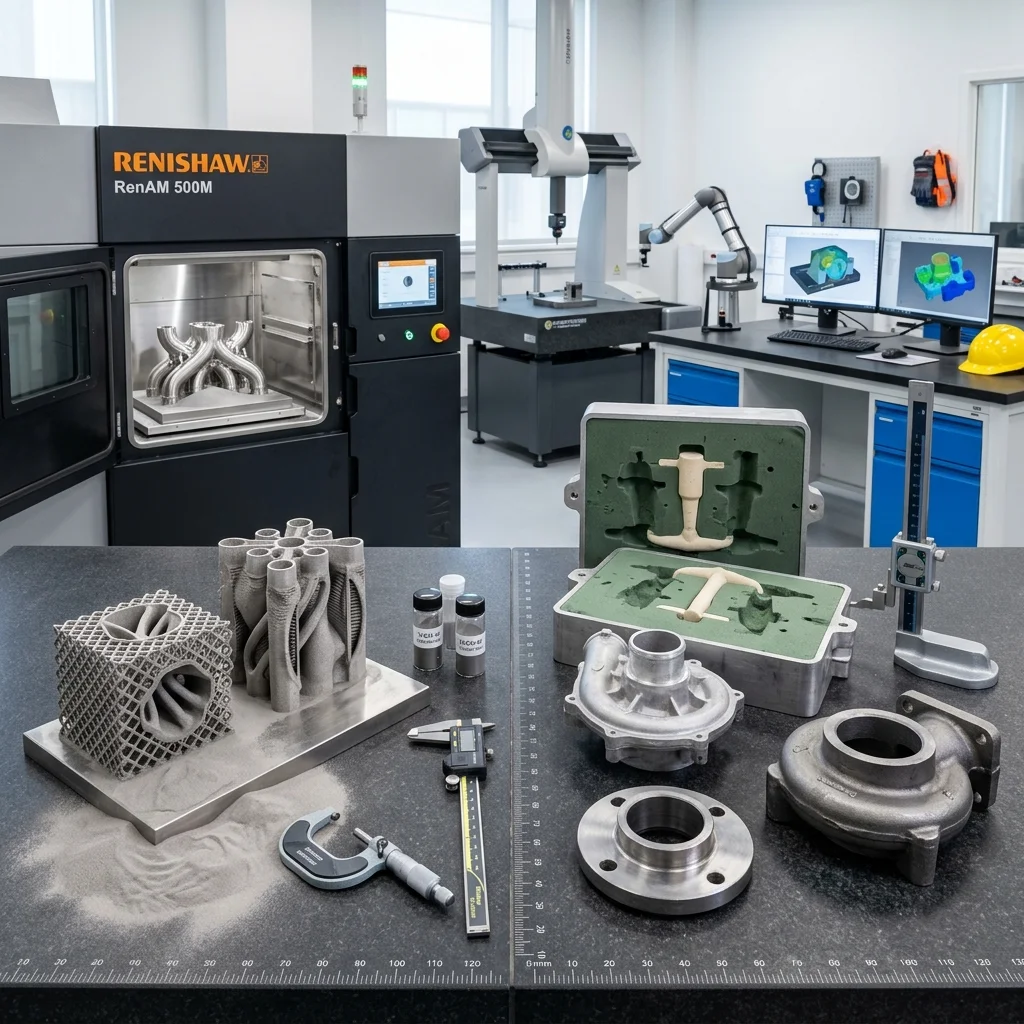
The manufacturing industry has long been defined by a fundamental trade-off: the flexibility to innovate versus the economics of scale. For decades, traditional metal casting has been the undisputed king of high-volume production, transforming molten alloys into robust components. However, the rise of metal Additive Manufacturing (AM) (such as Direct Metal Laser Sintering (DMLS) and Selective Laser Melting (SLM)) has fundamentally disrupted this paradigm. The decision of whether to print or to cast is no longer a simple binary choice; it is a complex, multi-dimensional calculation.
In modern advanced manufacturing, engineers must weigh upfront non-recurring engineering (NRE) costs against per-part production expenses. Understanding where the 'break-even point' lies is crucial for optimizing supply chains, reducing time-to-market, and unlocking geometries that were previously considered impossible. This analysis dives deep into the economic drivers, the impact of geometric complexity, and the hybrid approaches that are redefining the factory floor.
The Economics of Tooling and Upfront Costs
At the core of the cost disparity between metal 3D printing and casting is the upfront investment required for tooling. Traditional casting methods, whether die casting, sand casting, or investment casting, demand the creation of physical patterns, molds, or dies. These tools are meticulously engineered from high-grade steels to withstand immense thermal and mechanical stress, resulting in initial NRE costs that can range from $10,000 to well over $100,000.
In contrast, metal 3D printing requires zero physical tooling. The 'tool' is the digital CAD file. This allows for an immediate transition from design to production, bypassing weeks or months of tooling lead times. For prototyping and iterative design cycles, this absence of upfront costs makes AM highly attractive. If a design needs modification, it is simply updated in the software, whereas a design change in a cast part might necessitate scrapping an expensive mold entirely.
Production Volume and the Break-Even Point
The economic viability of either process is intrinsically tied to production volume. The break-even point is the specific quantity at which the amortized cost of casting tooling equals the higher per-part cost of 3D printing.
For low-volume production (typically 1 to 500 units), metal 3D printing is almost always the more economical choice due to the lack of tooling costs. As volumes enter the 'crossover zone' (roughly 500 to 10,000 units), the equation becomes highly dependent on the specific process and part design. For highly complex parts, the break-even point shifts significantly higher, sometimes favoring AM up to 20,000 units. Conversely, for high-volume production (10,000+ units), traditional casting dominates. Once the initial tooling investment is absorbed, casting delivers high throughput and exceptionally low per-part costs, maximizing the efficiency of mass production.
The 'Complexity is Free' Paradigm
Perhaps the most transformative aspect of metal 3D printing is the concept that 'complexity is free.' In traditional casting, complex geometries (such as internal cooling channels, undercuts, or intricate lattice structures) require sophisticated, multi-part molds with complex cores and sliders. Every added feature increases the cost, fragility, and failure rate of the tooling.
Metal AM builds parts layer-by-layer, making it indifferent to geometric intricacy. A solid block of titanium costs roughly the same to print as a highly optimized, topology-driven lattice structure of the same volume. In fact, complex lightweight designs often cost *less* to print because they use less raw material and require less laser melting time. When evaluating costs, engineers must account for the value-add of performance enhancements (such as consolidated assemblies or improved thermal management) which can quickly offset the higher per-part cost of AM.
Hybrid Workflows: The Best of Both Worlds
The choice between 3D printing and casting is increasingly becoming collaborative rather than competitive. Industry leaders are leveraging hybrid manufacturing workflows to merge the design freedom of AM with the economic scale of casting.
A prime example is the 3D printing of sacrificial patterns for investment casting. By using SLA (Stereolithography) or PMMA-based binder jetting to print the patterns, manufacturers can eliminate the need for expensive injection molds. This allows for the casting of highly complex geometries in quantities that would not justify traditional tooling, effectively bridging the gap between rapid prototyping and mass production. This hybrid approach delivers the precise material properties and metallurgical grain structures inherent to casting, while maintaining the agility and geometric freedom of 3D printing.
Conclusion
The cost analysis between metal 3D printing and traditional casting goes far beyond a simple comparison of price per part. It requires a holistic evaluation of tooling investments, production volumes, geometric complexity, and lifecycle performance. While casting remains the undisputed champion of mass production, metal AM is steadily pushing the break-even point higher, redefining what is economically viable for low-to-medium volume manufacturing. As hybrid workflows mature, the future of manufacturing lies not in choosing one technology over the other, but in intelligently orchestrating both to build the impossible.
The full picture
This article is one page from The Big Book of 3D Printing: 704 illustrated pages covering every technology, material and fix in one reference.
Read it on Kindle →Engineer, author of The Big Book of 3D Printing and additive manufacturing expert