

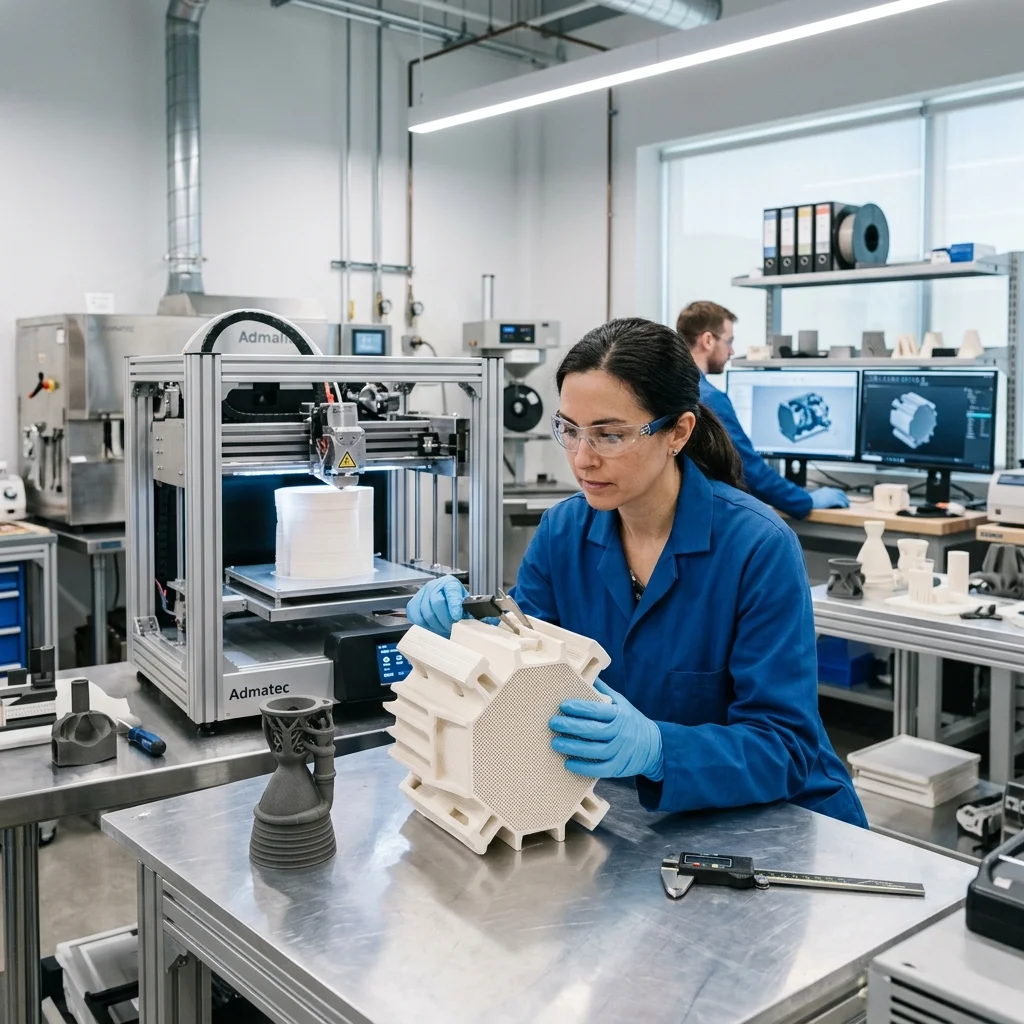
For decades, advanced ceramics have been the ultimate frontier material: prized for their unprecedented thermal resistance, biocompatibility, and chemical inertness, yet notoriously difficult to shape. Traditional manufacturing methods like pressing, molding, and machining fall drastically short when dealing with the extreme hardness and brittleness of materials like Alumina, Zirconia, and Silicon Carbide. However, the maturation of Ceramic Additive Manufacturing (AM) has shattered these historical limitations. Today, ceramic 3D printing has decisively shifted from a lab-based prototyping curiosity to a qualified, serial-production industrial process. By combining AI-driven process optimization with scalable technologies like Stereolithography (SLA) and Binder Jetting, we are now forging previously impossible geometries. This isn't just about printing shapes; it's about engineering the fundamental properties of matter to survive the most punishing environments known to science.
The Material Paradigm: AI and the Shift to Serial Production
The real breakthrough isn't just hardware; it's the convergence of materials science and artificial intelligence. Modern ceramic printers utilize sophisticated AI platforms to control the debinding and sintering processes: the highly sensitive thermal phases where printed 'green parts' consolidate into fully dense ceramics. By predicting and compensating for shrinkage, AI eliminates the costly trial-and-error that previously plagued the industry. Meanwhile, advanced formulations like Alumina-Toughened Zirconia (ATZ) are enabling massive build volumes without compromising structural integrity. This synergy has transformed ceramic AM into a reliable engine for scalable, zero-defect serial production.
Aerospace and Defense: Surviving the Inferno
In aerospace, thermal management is a matter of survival. Traditional metal alloys degrade under the extreme temperatures of rocket propulsion and hypersonic flight. Ceramic 3D printing introduces parts like monolithic silicon carbide heat exchangers, RF insulators, and complex casting cores for single-crystal turbine blades. By utilizing complex internal channels (like gyroid lattice structures that are entirely unmachinable through conventional methods) engineers can drastically reduce weight while exponentially increasing surface area for cooling. These 3D-printed ceramic components withstand atmospheric reentry and the inferno of combustion chambers, pushing the boundaries of deep space exploration.
Biomedical Engineering: Printing Life's Scaffolding
The human body is one of the most demanding operational environments. Ceramic AM has catalyzed a revolution in patient-specific implants by utilizing highly biocompatible materials like Hydroxyapatite (HA) and Tricalcium Phosphate (TCP). These materials mimic natural bone structure, and 3D printing allows for the creation of intricate, porous scaffolds that actively promote osseointegration: where the patient's own bone cells grow into the implant. Furthermore, high-purity Zirconia is now standard for bespoke dental crowns and maxillofacial reconstructions, delivering unmatched aesthetic mimicking and mechanical strength. We are literally printing the scaffolding of life.
Semiconductors and Advanced Electronics: The Thermal Bottleneck
As microchips pack more transistors into exponentially smaller spaces, the resulting thermal and chemical loads are reaching critical limits. Here, advanced technical ceramics act as the ultimate insulators and heat sinks. 3D printing allows for the fabrication of complex Atomic Layer Deposition (ALD) rings, custom insulating sleeves, and micro-fluidic cooling channels embedded directly into semiconductor manufacturing equipment. These components offer extreme resistance to plasma etching and chemical corrosion, ensuring the unyielding precision required in modern lithography and chip fabrication facilities.
Conclusion
The maturation of ceramic 3D printing represents a fundamental shift in how we engineer for extreme conditions. By mastering the intricate dance of SLA precision, AI-driven sintering, and advanced materials science, we are no longer constrained by what can be machined: only by what can be imagined. At EduFacturing, our 'picks and shovels' philosophy means giving you the knowledge to harness this exact paradigm shift. The future of manufacturing is not just about building faster; it's about building for the unyielding extremes, and advanced ceramics are leading the charge.
The full picture
This article is one page from The Big Book of 3D Printing: 704 illustrated pages covering every technology, material and fix in one reference.
Read it on Kindle →Engineer, author of The Big Book of 3D Printing and additive manufacturing expert