

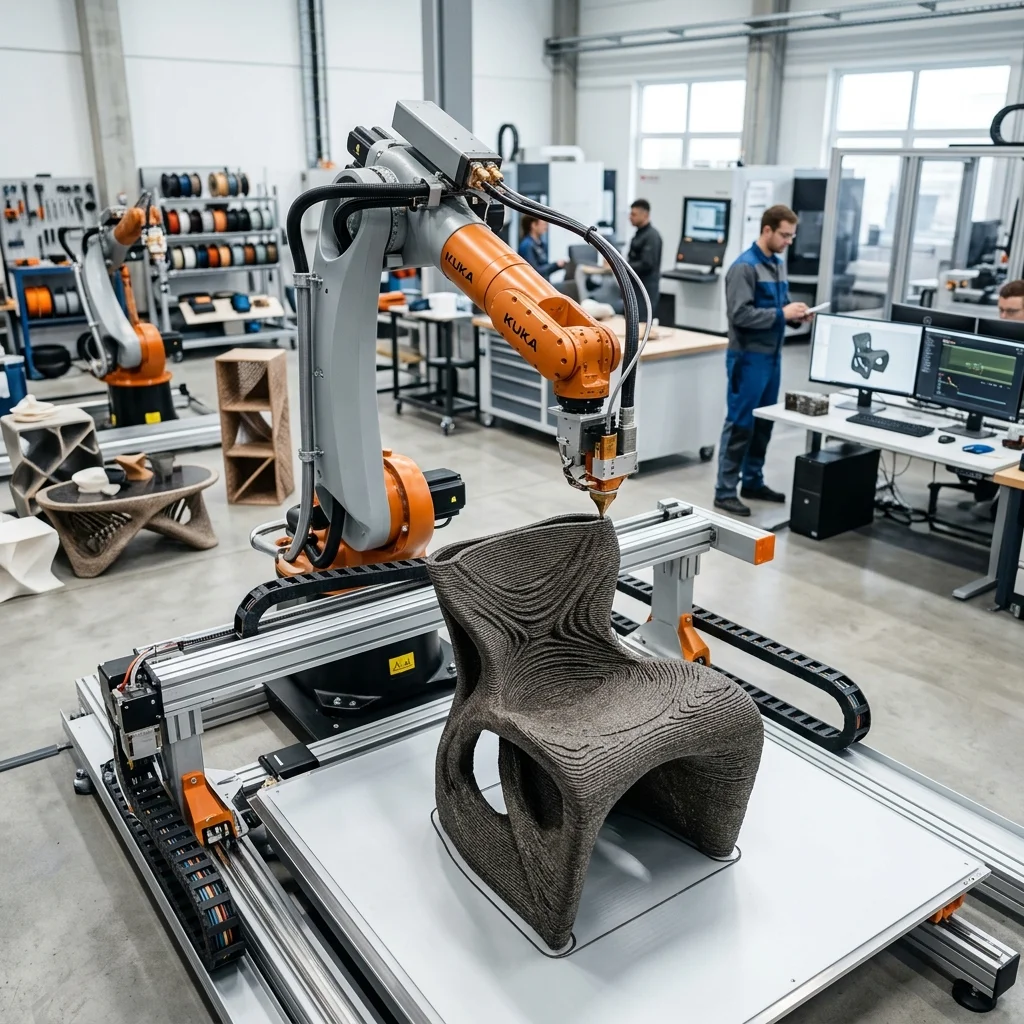
The intersection of additive manufacturing and interior design has given birth to a new era of "digital craftsmanship." Custom 3D printed furniture is no longer a futuristic concept: it is a rapidly maturing discipline that blends raw industrial capabilities with highly expressive artistry. Traditional manufacturing constraints, which for decades dictated the forms and structures of the objects we live with, are being shattered. Today, visionaries are conceptualizing fluid, organic, and complex geometries that were previously impossible to produce, fundamentally redefining our relationship with the spaces we inhabit.
At the heart of this revolution is the fusion of advanced pellet extrusion (FGF) and 6-axis robotic arm systems. This technological synergy allows designers to transcend the limitations of conventional gantry printers, moving towards large-scale, sustainable, and entirely bespoke creations. This article explores how modern 3D printing technologies are turning raw, often recycled materials into functional masterpieces of modern furniture design.
Beyond the Filament: The Power of Pellet Extrusion (FGF)
Traditional Fused Deposition Modeling (FDM) using filament is excellent for prototyping, but it struggles when scaled to the size of a lounge chair or dining table due to high material costs and agonizingly slow print times. Enter Fused Granular Fabrication (FGF), or pellet extrusion. By melting and extruding plastic pellets directly, FGF drastically lowers material costs (often by up to 60% compared to filament) while simultaneously achieving extrusion rates measured in kilograms rather than grams per hour. This high-throughput capability makes it feasible to print massive, monolithic furniture pieces in a fraction of the time. Furthermore, pellet extrusion opens the door to a vastly broader material palette, including highly durable composites mixed with carbon fiber, wood fibers, or glass. The wider extrusion paths (ranging from 3mm to 9mm) not only speed up production but also result in incredibly robust structural integrity, perfectly suited for load-bearing furniture.
Unconstrained Creativity with 6-Axis Robotics
To fully unleash the potential of pellet extrusion, the industry has turned to 6-axis robotic arms. Unlike the traditional 3-axis Cartesian printers that limit builds within a rigid cubic volume, robotic arms move with human-like freedom. This multi-directional approach allows for non-planar slicing and complex toolpaths that can print overhangs and intricate organic curves without the need for extensive support structures. Designers can now conceive forms inspired by nature: fluid lines, biomimetic structures, and intricate topological optimizations. Paired with custom software and real-time kinematic control, these robotic systems execute highly complex G-codes flawlessly. The result is single-piece production of large furniture that bridges the gap between high-tech engineering and sculptural art.
Sustainability as a Design Principle
One of the most compelling aspects of 3D printed furniture is its inherent alignment with the circular economy. Pellet extrusion is uniquely positioned to utilize recycled thermoplastics derived from industrial waste, ocean plastics, or post-consumer packaging. Designers are increasingly using these reclaimed materials to create high-end design objects, turning what was once trash into functional luxury. Additionally, the additive process inherently minimizes waste compared to subtractive manufacturing techniques like CNC milling or traditional woodworking. If a piece of printed furniture reaches the end of its life, or if a print fails, many thermoplastic pieces can simply be ground down back into pellets and reprinted into a brand new design. This closed-loop lifecycle presents a radical shift in how we consume and produce physical goods.
The Aesthetics of the Machine: A New Visual Language
Rather than attempting to hide the manufacturing process, contemporary 3D printed furniture designers celebrate it. The distinct, ribbed texture of thick extrusion layer lines has become a defining aesthetic: a digital fingerprint that authenticates the piece's origin. Artists intentionally manipulate print speeds, temperatures, and cooling rates to create striking gradient color effects, translucent finishes, and mesmerizing surface patterns. This transparency in the making process is at the core of digital craftsmanship. The "imperfections" and unique material behaviors are viewed not as flaws, but as integral components of the piece's character. By designing specifically for the machine's capabilities and quirks, creators are establishing an entirely new visual language in furniture design that is unashamedly additive.
Conclusion
Custom 3D printed furniture represents a profound paradigm shift where technology acts as an amplifier for artistic vision. By combining the speed and material versatility of pellet extrusion with the spatial freedom of robotic arms, designers are untethered from traditional limitations. We are entering an era where our environments can be tailored to our exact aesthetic desires and ergonomic needs, all while embracing sustainable, circular material flows. The future of furniture is not just manufactured; it is engineered, printed, and sculpted for a new dimension of living.
The full picture
This article is one page from The Big Book of 3D Printing: 704 illustrated pages covering every technology, material and fix in one reference.
Read it on Kindle →Engineer, author of The Big Book of 3D Printing and additive manufacturing expert