

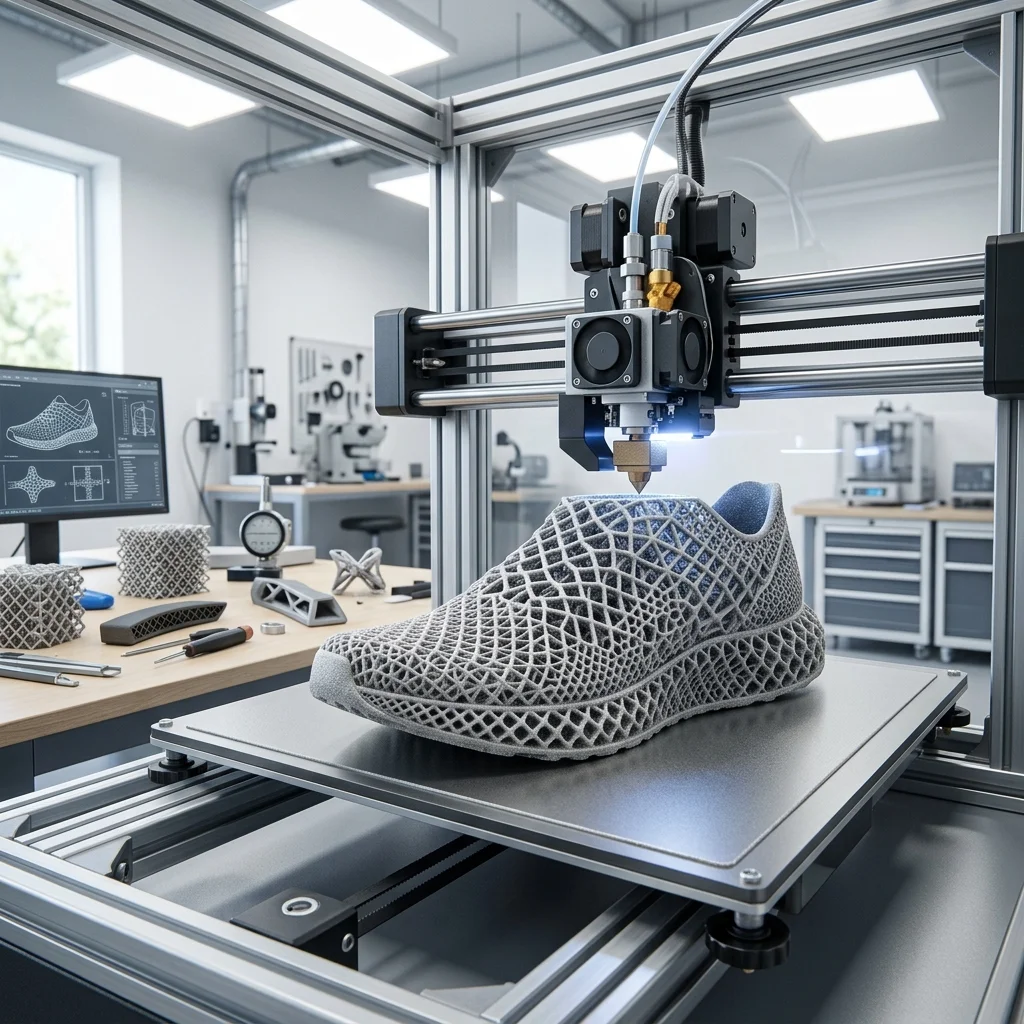
For decades, sports equipment manufacturing relied on a static set of materials: EPS foams for impact protection, EVA for cushioning, and standard carbon fiber layouts for structural stiffness. But the relentless pursuit of marginal gains has pushed traditional manufacturing to its absolute limits. We are now entering the era of additive manufacturing and metamaterials. By abandoning solid structures and embracing 3D-printed elastomeric lattices, engineers are no longer just selecting materials: they are effectively programming them.
In 2025 and 2026, 3D printing in sports equipment has definitively transcended the prototyping phase. Utilizing generative design, specialized Thermoplastic Polyurethane (TPU), and advanced photopolymer resins, industry leaders are creating complex lattice arrays that outperform traditional foams in every metric. This paradigm shift offers unprecedented "zonal tuning": the ability to micro-adjust stiffness, energy return, and impact absorption within a single, continuous geometric structure without adding unnecessary mass.
Engineering Empty Space: Lattice Structures and Zonal Tuning
At the core of this technological revolution are cellular structures. Designs such as the rhombic dodecahedron or algorithmically driven gyroids offer high strength-to-weight ratios. The true advantage of 3D printing lies not merely in forming these shapes, but in altering them computationally. By modifying the thickness of the connecting struts and the size of the unit cells across different regions of a part, manufacturers can dial in specific mechanical properties. This eliminates the need to glue discrete foam components together, reduces sheer points, and drastically enhances product durability.
Next-Generation Kinetic Protection: The Helmet Revolution
Traditional EPS (expanded polystyrene) foam used in helmets acts as an excellent insulator but suffers mechanically: it compresses linearly and permanently deforms upon heavy impact. In contact sports like American football and ice hockey (e.g., CCM's Super Tacks X helmets powered by Carbon technology), 3D-printed lattice liners make a real difference. These open-cell structures not only provide unmatched ventilation by dissipating cranial heat but also manage rotational and linear forces far more effectively. Upon impact, the lattice crumples and shears in a highly controlled, pre-calculated manner, directing kinetic energy away from the skull and significantly mitigating concussion risks.
Biomechanically Tailored Cycling Saddles
In professional cycling, power transfer and comfort have traditionally been at odds. Leading brands like Specialized (with their Mirror technology) and Fizik (Adaptive) leverage 3D printing to resolve this paradox by translating rider pressure-mapping data directly into geometric code. The result is a saddle that features a highly compliant, soft zone at the sit bones for pressure relief, while maintaining a rigid, supportive nose for aggressive pedaling stability. This smooth transition in material density, printed in a single run using liquid resin, is physically impossible to replicate via conventional injection molding.
Mass Customization and the Future of Running Midsoles
Running shoes served as the initial commercial proving ground for 3D-printed midsoles, and today, giants of the industry are moving from generalized models toward true mass customization. Printed TPU midsoles do more than provide phenomenal rebound and energy return; they unlock hyper-individualized gear. By capturing 3D foot scans and dynamic gait analysis, algorithms can generate a bespoke lattice that precisely corrects pronation, supination, or biomechanical imbalances for the individual athlete, printed and delivered on-demand.
The Horizon: 4D Smart Materials and Bio-TPUs
As the industry perfects the scalability of these processes heading into 2026, the focus is pivoting toward sustainable bio-based elastomers and “smart materials.” Researchers are exploring 4D printing applications where lattice structures dynamically alter their mechanical properties in response to real-time body heat or moisture levels. Imagine a protective pad or a shoe sole that softens in extreme cold but firms up during high-intensity, high-heat exertion, reacting like a living, breathable ecosystem around the athlete's body.
Conclusion
3D printing is no longer just an alternative fabrication method: it is an entirely new branch of material engineering. By fusing algorithmic design, advanced materials science, and individual biomechanics, this technology is forging physical hardware that acts in absolute symbiosis with the human body. The next world record may not be broken solely by the athlete, but by the perfectly engineered empty space inside their gear.
The full picture
This article is one page from The Big Book of 3D Printing: 704 illustrated pages covering every technology, material and fix in one reference.
Read it on Kindle →Engineer, author of The Big Book of 3D Printing and additive manufacturing expert