

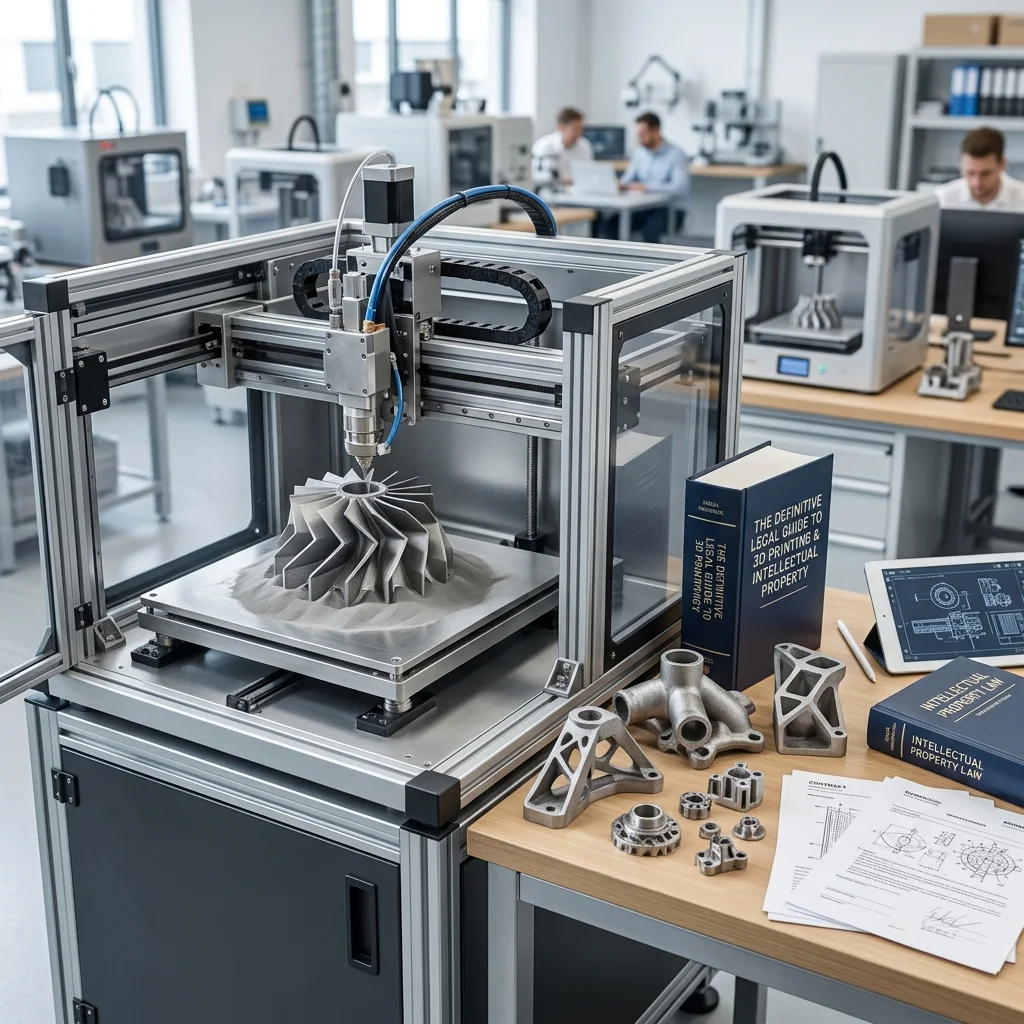
The democratization of manufacturing through 3D printing has fundamentally disrupted how we create, distribute, and consume physical objects. Much like the early days of the internet when digital audio and video files challenged copyright law, additive manufacturing is currently stress-testing the boundaries of intellectual property (IP). When a physical object can be reduced to a digital CAD file, transmitted globally in seconds, and reproduced flawlessly on a desktop machine, the lines between creator, distributor, and consumer blur.
Understanding the legal landscape is no longer just for corporate lawyers; it is essential knowledge for engineers, designers, and makers. Whether you are reverse-engineering a mechanical part, uploading a modified design to a repository, or launching a 3D printing farm, navigating patents, copyrights, and trademarks is critical to protecting your innovations and avoiding costly infringement.
The Digital Blueprint vs. The Physical Object
At the core of 3D printing IP law is the duality between the digital file (STL, OBJ, STEP) and the resulting physical object. The law treats these two entities differently. A CAD file is essentially lines of code: a digital blueprint. This file is often subject to copyright protection as a literary or software work. However, the physical object it produces might be a purely functional mechanical part, which copyright does not protect. Instead, the functional aspect falls under the purview of patent law. This separation means that distributing a digital file and printing the physical object can trigger entirely different legal implications.
Patents: Protecting Utility and Design
Patent law is the most stringent form of IP protection in the hardware space. Utility patents protect how an invention works: its functional mechanics, processes, or systems. If you 3D print a patented mechanical gear assembly, you are infringing on the utility patent, regardless of whether you sell the part or use it privately. Ignorance of the patent is not a valid legal defense.
Design patents, on the other hand, protect the unique, ornamental appearance of an object. If you print a smartphone case with a patented aesthetic design, it constitutes infringement. The challenge in additive manufacturing is that patent enforcement was historically aimed at large-scale industrial manufacturers. Today, enforcing patents against decentralized, individual makers operating in their garages is practically impossible, shifting the legal focus toward platforms that host the digital files.
Copyright: The Artistic and the Functional
Copyright law exists to protect original works of authorship, automatically applying the moment a creative work is fixed in a tangible medium. In 3D printing, copyright perfectly protects artistic sculptures, jewelry, and tabletop miniatures. If you scan and print a copyrighted tabletop figurine, you are infringing on the creator's exclusive right to reproduce their work.
However, copyright explicitly excludes 'useful articles': objects with an intrinsic utilitarian function, like a wrench or a bracket. You cannot copyright a wrench. The complexity arises when an object blends utility and art, such as a custom-designed, highly ornate lampshade. Legal doctrines like 'separability' dictate that only the artistic elements that can exist independently of the object's function are eligible for copyright. Furthermore, the CAD file itself is often protected by copyright as software code, meaning unauthorized distribution of the file is an infringement, even if the physical object it represents is purely functional.
Trademarks: Defending Brand Identity
Trademarks protect brand identifiers (names, logos, and slogans) that help consumers identify the source of goods. In the 3D printing realm, trademark infringement occurs when a printed object features a protected logo or shape, causing potential consumer confusion. For instance, printing a keychain with a famous car brand's logo without authorization is a direct trademark violation.
Trademark law is primarily concerned with commercial use. If an individual prints a branded item strictly for personal use, brand owners rarely take action, as the impact on the market is negligible. However, if that individual starts selling those 3D-printed keychains on an e-commerce platform, the brand owner has a legal obligation to defend their trademark to prevent 'genericide' and protect their reputation.
Licensing and Creative Commons
To mitigate the friction of traditional IP laws, the 3D printing community heavily relies on open-source licensing and Creative Commons (CC). These licenses allow creators to dictate how their designs can be used, modified, and shared. A standard CC license might permit free downloading and printing but explicitly prohibit commercial use (CC BY-NC) or require that any modified versions be shared under the same terms (CC BY-SA – ShareAlike).
Understanding these licenses is essential. An engineer cannot simply download a CC BY-NC structural bracket from a repository and use it in a commercial product without negotiating a separate license with the original creator. Respecting these licenses maintains the collaborative spirit of the maker community while ensuring creators retain control over their commercial interests.
Conclusion
As additive manufacturing matures into a mainstream production technology, the legal frameworks governing it will inevitably evolve. For now, the responsibility lies with the creators and operators. By understanding the distinct roles of patents, copyright, and trademarks, we can foster a culture of respect for intellectual property. This balance between protecting innovation and encouraging open collaboration is what will ultimately drive the next great leap in the EduFacturing ecosystem.
The full picture
This article is one page from The Big Book of 3D Printing: 704 illustrated pages covering every technology, material and fix in one reference.
Read it on Kindle →Engineer, author of The Big Book of 3D Printing and additive manufacturing expert