

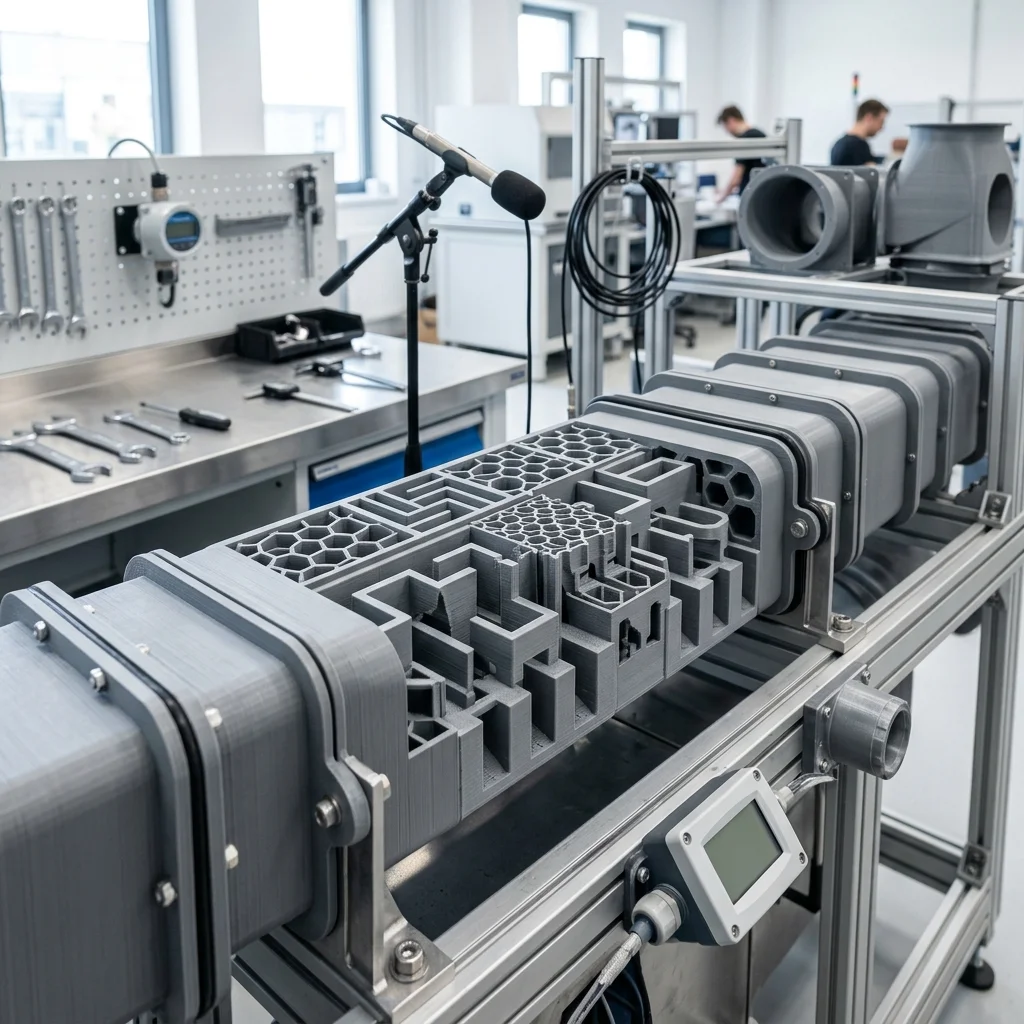
Hello, Krasy, and welcome to another deep technological dive. We all know that constant, low-frequency hum of HVAC and ventilation systems. For decades, the industry's solution was simple but flawed: line the ducts with thick fiberglass or foam. The problem? It chokes the airflow and drastically reduces system efficiency.
Enter additive manufacturing. Today, we are exploring one of the most futuristic concepts in 3D printing that literally alters the physics of sound: acoustic metamaterials in ventilation systems.
What Are Acoustic Metamaterials?
Unlike traditional sound absorbers that rely on bulk mass and density, metamaterials manipulate sound waves through their mathematically engineered **geometry**. Using 3D printing, we can create microstructures: such as complex labyrinths, spiral waveguides, and Helmholtz resonators (small cavities that 'trap' specific acoustic frequencies).
When a sound wave enters these 3D-printed structures, it reflects and phases out internally, converting acoustic energy into a negligible amount of heat. This approach allows us to precisely target the low-frequency drone that ordinary foam simply cannot stop.
Ending the Airflow vs. Silence Compromise
The biggest breakthrough of 3D-printed acoustic metamaterials is their 'open structure' capability. Imagine a ventilation duct lined with 3D-printed rings. The air flows directly through the center completely unobstructed, meaning zero pressure drop and no extra strain on the fans.
Simultaneously, the resonant cavities embedded in the duct walls act as an acoustic black hole, canceling out the fan noise. This results in less energy required to push the air and absolute silence in the room: a geometry impossible to fabricate with traditional sheet metal bending.
Printing Technologies and Material Choices
To manufacture these intricate internal channels, conventional molding or milling is out of the question. Additive manufacturing is the only viable path.
* **FDM/FFF (Fused Deposition Modeling):** An excellent starting point for large-scale duct prototyping. Tough, environment-resistant polymers like ASA or PETG ensure the parts withstand HVAC temperature fluctuations and moisture.
* **SLS (Selective Laser Sintering):** The strongest option here. Because SLS requires no support structures, we can print impossibly complex, fully enclosed internal labyrinths with perfect accuracy.
* **Industrial Materials:** For industrial settings involving extreme heat (like factory extraction systems), engineers are even utilizing 3D-printed technical ceramics and high-temp SLA/DLP resins.
Modularity and Retrofitting
We don't need to rip out a building's entire ductwork to see the benefits. Engineers are currently designing 3D-printed acoustic 'bricks' or modular inserts that can be retrofitted into existing systems.
Imagine a custom acoustic collar: we measure the specific noise frequency of a problematic duct, run a simulation, and print a bespoke acoustic filter that snaps perfectly into place. This is the essence of digital manufacturing: highly customized solutions for highly specific physical problems.
Conclusion
The 3D printing industry has long evolved past making simple plastic prototypes. By adopting acoustic metamaterials, we are providing engineers with the 'picks and shovels' needed to construct a quieter, more efficient world. At EduFacturing, we believe that mastering these complex geometries today is what will drive the hardware innovations of tomorrow.
The full picture
This article is one page from The Big Book of 3D Printing: 704 illustrated pages covering every technology, material and fix in one reference.
Read it on Kindle →Engineer, author of The Big Book of 3D Printing and additive manufacturing expert