

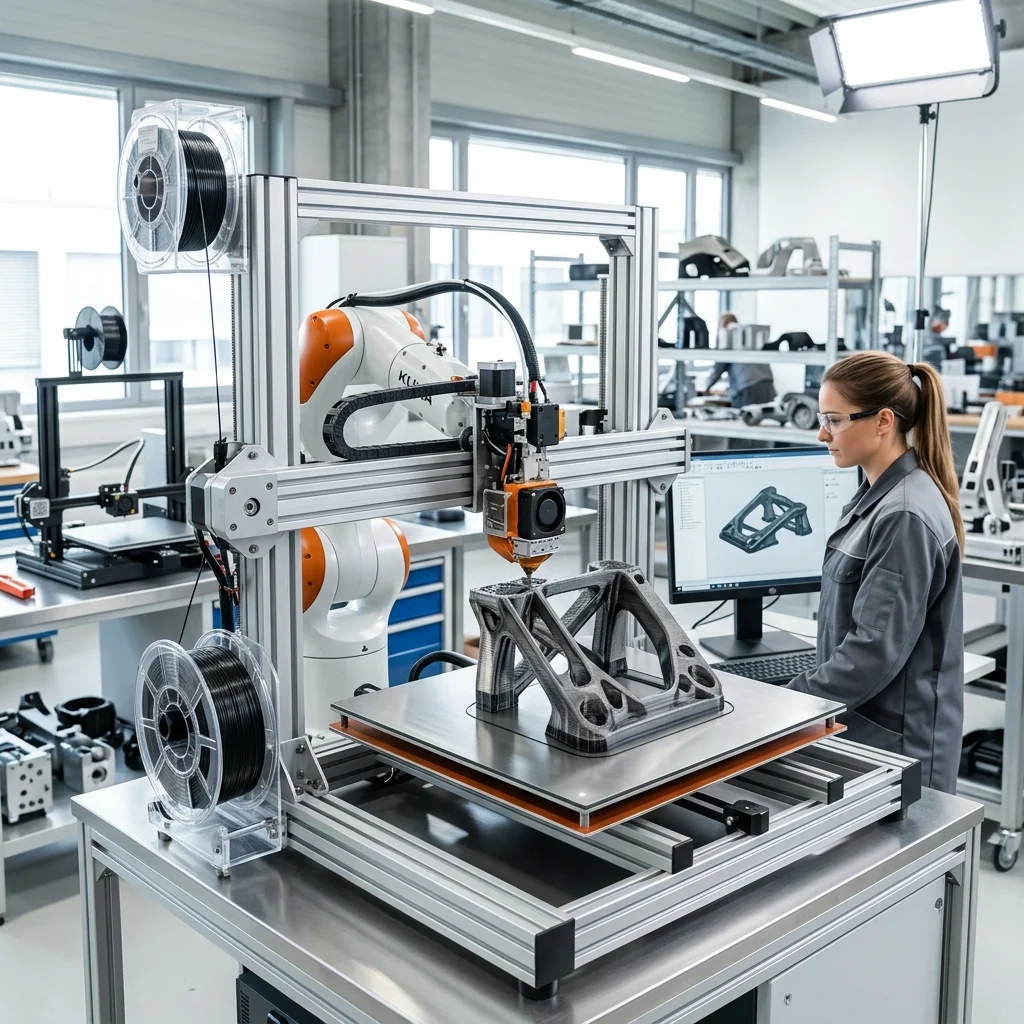
The automotive industry is no stranger to innovation, but while lightweight parts and 3D printed hypercars capture headlines, the true revolution is happening quietly on the factory floor. Additive manufacturing (AM) has fundamentally transformed automotive assembly lines, not merely by printing end-use parts, but by optimizing the very processes used to build vehicles. By creating custom tooling, ergonomic aids, and robotic components on demand, 3D printing is making assembly lines faster, safer, and infinitely more adaptable.
Custom Jigs and Fixtures: The Backbone of Assembly
Traditionally, creating custom jigs and fixtures required CNC machining out of metal, a process taking weeks and costing thousands. Today, manufacturers use Fused Deposition Modeling (FDM) and Multi Jet Fusion (MJF) to print highly complex holding aids overnight. These printed tools can conform precisely to complex body panels, preventing scratches and improving alignment accuracy during assembly. By replacing heavy metal fixtures with lightweight, topology-optimized polymer or composite parts, companies drastically reduce the physical burden on assembly workers and increase overall throughput.
Ergonomics and Human-Centric Tooling
An assembly line is only as efficient as the people operating it. Fatigue and repetitive strain injuries are major challenges in automotive manufacturing. Additive manufacturing allows engineers to rapidly design and deploy custom, lightweight hand tools tailored to specific tasks and even individual workers. From perfectly angled bolt runners to form-fitting grip covers, 3D printing enables ergonomic interventions that were previously cost-prohibitive. This human-centric approach not only boosts worker safety and satisfaction but also minimizes errors caused by operator fatigue.
Next-Generation Robotic End-of-Arm Tooling (EOAT)
Automation in automotive plants relies heavily on robotic arms, and the efficiency of these robots is dictated by their End-of-Arm Tooling (EOAT). Heavy, conventional metal grippers slow down robot speeds and consume more energy. Using advanced AM technologies like Selective Laser Sintering (SLS) and metal powder bed fusion, engineers can create complex, lightweight grippers with integrated pneumatic channels: eliminating external hoses. This weight reduction allows robots to move faster, carry heavier payloads, and operate with greater precision, directly translating to higher units per hour (UPH) on the production line.
The Digital Inventory and Zero Downtime Maintenance
When a critical tool or machine part breaks on a moving assembly line, every minute of downtime costs thousands of dollars. Instead of maintaining massive physical warehouses of spare parts, automakers are shifting to a "digital inventory" model. CAD files of critical components are stored securely on servers and printed on-demand when needed. Whether it’s a broken conveyor bracket or a specialized sensor mount, 3D printers stationed directly on the factory floor can produce replacement parts in hours, ensuring the assembly line stays operational and drastically reducing supply chain dependencies.
Conclusion
The integration of additive manufacturing into automotive assembly lines is a textbook example of "picks and shovels" innovation. It’s not just about what is being made, but how it is being made. As AM technologies become faster and material properties continue to improve, the factory of the future will be defined by its ability to print its own tools, adapt instantly to new designs, and equip its workforce with customized solutions.
The full picture
This article is one page from The Big Book of 3D Printing: 704 illustrated pages covering every technology, material and fix in one reference.
Read it on Kindle →Engineer, author of The Big Book of 3D Printing and additive manufacturing expert