

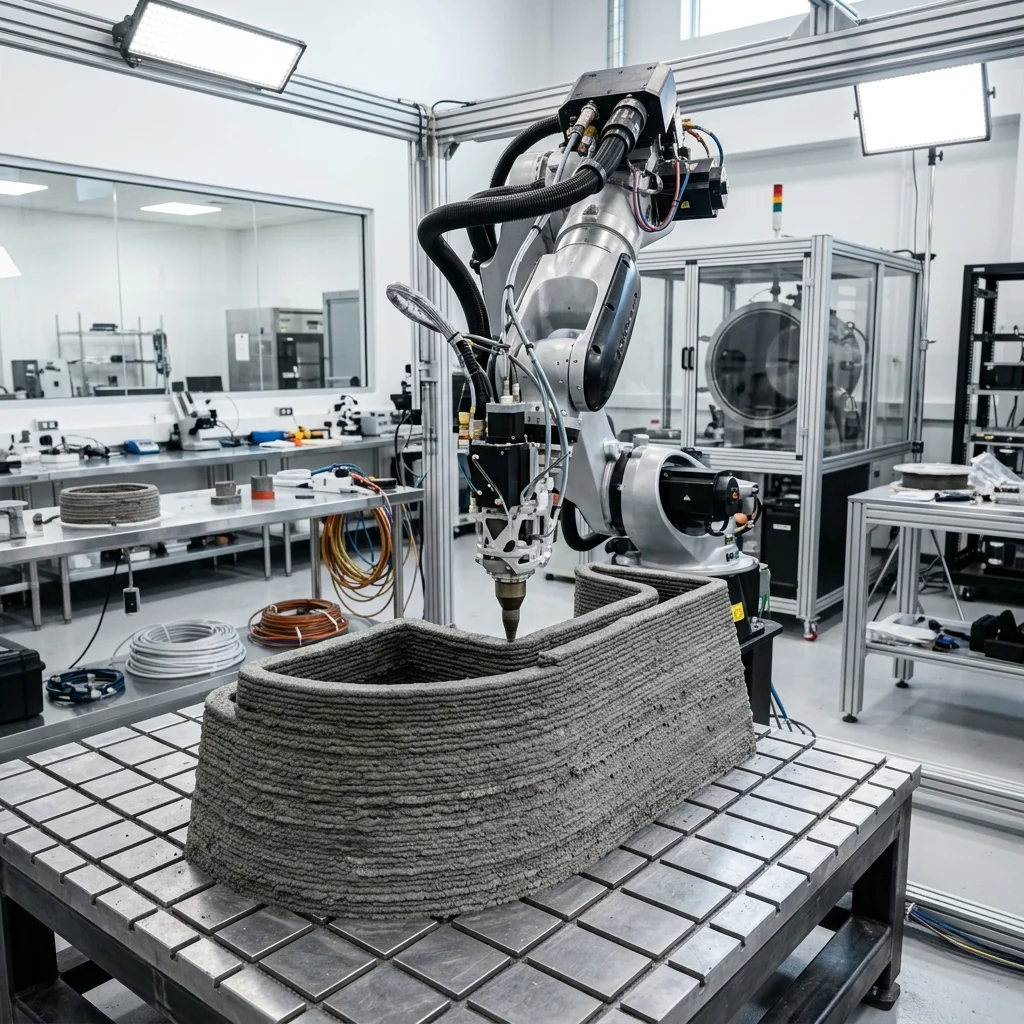
For decades, the expansion of human presence in space has been fundamentally limited by the 'tyranny of the rocket equation.' Every kilogram of payload transported to the lunar surface incurs astronomical costs, making traditional construction methods entirely unfeasible. The solution lies not in bringing our infrastructure with us, but in manufacturing it upon arrival. This paradigm shift relies heavily on In-Situ Resource Utilization (ISRU) paired with advanced Additive Manufacturing.
At EduFacturing, we believe that understanding these extreme-environment technologies is the ultimate test of engineering principles. Building a moon base isn't just about scaling up a desktop FDM printer; it requires reinventing material science, robotics, and thermal dynamics to operate autonomously in the harshest conditions imaginable.
The ISRU Paradigm: Building with Lunar Dust
The core concept of ISRU is simple in theory but extraordinarily complex in execution: utilize the ubiquitous lunar dirt, known as regolith, as the primary construction material. Regolith is a fine, abrasive powder composed largely of silicon dioxide, aluminum oxide, and iron oxides, forged over billions of years of meteorite impacts. By harnessing this local material, space agencies like NASA and ESA can drastically reduce launch weights. Projects like ICON's Project Olympus and ESA's Lunar Village concept are pioneering this approach, designing massive robotic systems capable of gathering, processing, and extruding regolith into robust architectural structures.
Material Science: Sintering and Geopolymers
Standard thermoplastics won't survive the Moon's temperature swings of -170°C to +120°C. Instead, engineers are exploring two primary pathways for regolith consolidation: thermal sintering and binder-based extrusion. Microwave and laser sintering involve heating the regolith to its melting point (around 1,200°C), fusing the abrasive grains into a solid, glass-like ceramic capable of withstanding immense loads. Alternatively, geopolymer concrete mixes raw regolith with chemical binders or even astronaut-derived biological waste (like urea) to create a workable slurry that cures in a vacuum. Each method presents unique thermodynamic challenges, especially considering the lack of an atmosphere for convective cooling.
Adapting Hardware for the Vacuum of Space
Deploying a 3D printer on the Moon requires complete hardware re-engineering. In the ultra-high vacuum of space, liquid lubricants instantly vaporize, causing moving parts like stepper motors and gantry rails to experience 'cold welding': where bare metals fuse upon contact. To combat this, lunar 3D printers utilize specialized dry lubricants, hermetically sealed actuation units, and advanced thermal shielding. Furthermore, the construction process must be entirely autonomous. Communication delays and limited crew availability mean these massive gantry-based or robotic-arm-driven printers must employ real-time machine vision, LiDAR, and AI-driven error correction to monitor layer adhesion and correct defects instantaneously.
Architectural Survival: Radiation and Micrometeorites
The geometry of a lunar habitat is dictated strictly by the physics of survival. The Moon lacks a magnetic field and an atmosphere, leaving the surface bombarded by high-energy cosmic rays, solar flares, and micrometeorites traveling at orbital velocities. To protect astronauts, 3D printed structures typically feature thick, multi-layered shells modeled after catenoid or highly optimized voronoi structures to maximize compressive strength against the lunar gravity (1/6g) and the outward pressure of the pressurized internal atmosphere. Often, the printing process involves laying down a cellular internal infill within the thick outer walls to trap micro-debris and disrupt radiation tracks, turning the habitat itself into a monolithic, localized shield.
Conclusion
The 3D printed moon base is the ultimate convergence of advanced robotics, material science, and architectural engineering. As humanity steps outward under programs like Artemis, additive manufacturing is no longer just a prototyping tool: it is the foundational technology for our multi-planetary future. By mastering ISRU and extreme-environment printing, we are not just exploring the stars; we are establishing the industrial backbone required to stay there.
The full picture
This article is one page from The Big Book of 3D Printing: 704 illustrated pages covering every technology, material and fix in one reference.
Read it on Kindle →Engineer, author of The Big Book of 3D Printing and additive manufacturing expert