

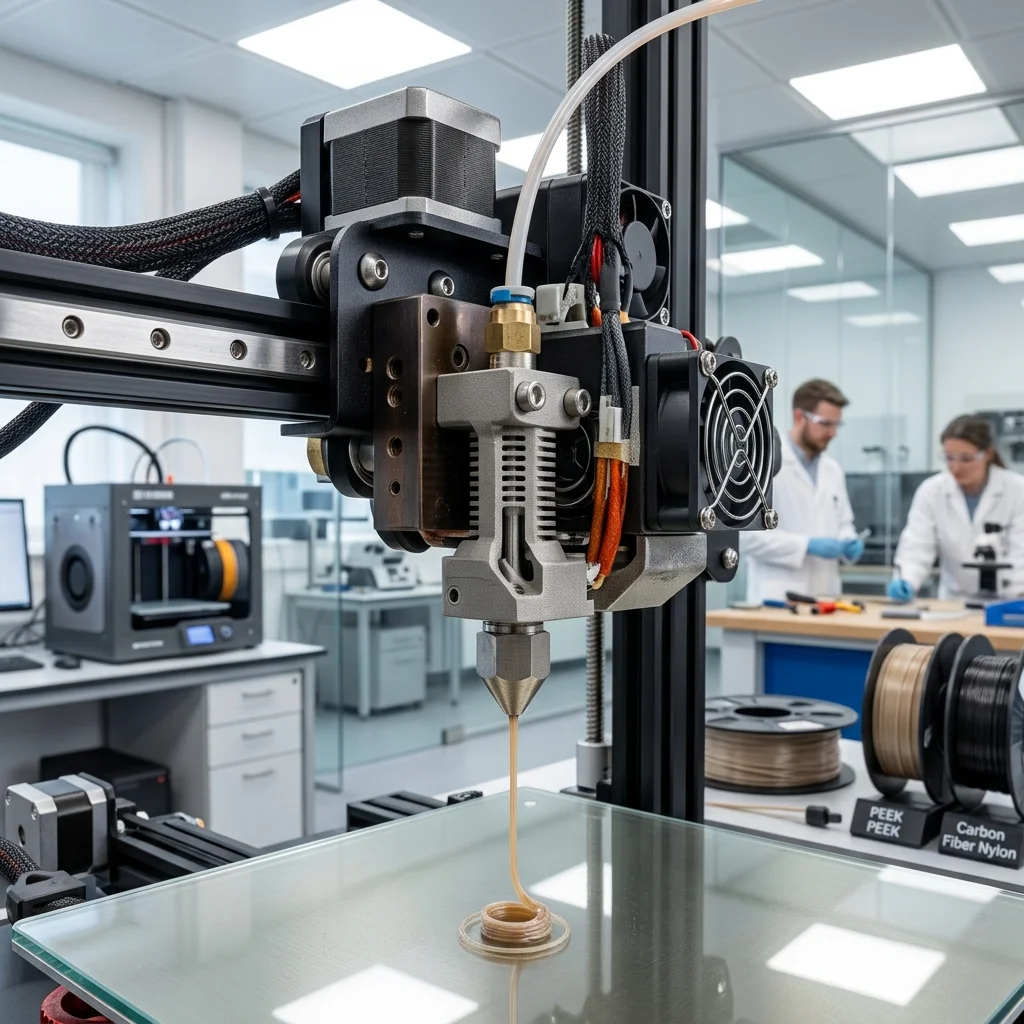
The FDM/FFF process has long faced a fundamental thermodynamic bottleneck: efficiently melting polymers at high speeds without compromising material properties. As we transition to engineering-grade polymers like PEEK, PEI, and carbon-fiber composites, the demands on the hotend have skyrocketed.
We are no longer just looking at heat-resistant alloys. We are looking at a paradigm shift where 3D printing is used to manufacture the nozzles themselves. Additively manufactured (AM) nozzles with complex internal geometries are redefining extrusion dynamics, turning a simple consumable into a high-tech thermodynamic engine.
The Evolution of Heat-Resistant Materials
Traditional brass nozzles excel in thermal conductivity but fail spectacularly against abrasive filaments. The industry's answer was hardened steel, tungsten carbide, and bi-metallic configurations with ruby or diamond tips. These materials provide the necessary wear resistance and high-temperature tolerance (up to 500°C) required for aerospace and automotive polymers.
However, simply changing the material isn't enough when pushing volumetric flow rates past 40 mm³/s. The limiting factor becomes the contact surface area in the melt zone. Heat must penetrate the filament core, and physics dictates that a standard cylindrical bore can only transfer heat so fast before the outer layer degrades while the core remains solid.
Metal AM: Printing the Printer Parts
To solve the thermodynamic limits of traditional machining, engineers turned to Metal Powder Bed Fusion (SLM/DMLS). By 3D printing the nozzles out of robust, heat-resistant alloys (like Tool Steel or Tungsten alloys), we unlock unprecedented design freedom.
Traditional subtractive manufacturing restricts internal nozzle geometry to straight bores and simple angles. Metal 3D printing allows for the creation of intricate, monolithic internal structures that actively split and guide the polymer melt flow. This means no assembly, zero risk of internal leaking between joined parts, and optimized fluid dynamics that were previously impossible to manufacture.
Advancing Core Heating Technology (CHT)
Core Heating Technology (CHT) drastically increases volumetric flow by dividing the filament into multiple smaller strands, effectively heating the polymer from the inside out. While early CHT nozzles were manufactured using specialized multi-step machining, metal 3D printing takes this concept to its logical extreme.
Additively manufactured CHT nozzles can feature mathematically optimized, curved flow splitters that reduce backpressure to an absolute minimum. Because these complex nozzles are printed from high-temperature, wear-resistant alloys, they deliver extreme flow rates without succumbing to the abrasion of carbon fiber or the intense heat required for engineering plastics.
The Ripple Effect on High-Speed 3D Printing
The integration of 3D printed heat-resistant nozzles creates a compounding effect on the entire manufacturing ecosystem. When your nozzle can effortlessly melt engineering filaments at speeds exceeding 500 mm/s, the kinematic limits of the printer hardware finally become the primary focus for innovation.
Furthermore, monolithic AM nozzles reduce the thermal mass at the toolhead while maintaining exceptional heat transfer, perfectly complementing modern lightweight extruders. This symbiotic relationship between advanced kinematics and optimized melt zones is what enables true production-level 3D printing.
Conclusion
The fusion of advanced metallurgy, internal geometry optimization, and additive manufacturing has transformed the humble 3D printer nozzle from a simple consumable into a complex thermodynamic engine. As we continue to push the boundaries of what FDM technology can achieve, 3D printed heat-resistant nozzles stand as a perfect example of the industry's ultimate meta-solution: using 3D printing to evolve 3D printing itself.
The full picture
This article is one page from The Big Book of 3D Printing: 704 illustrated pages covering every technology, material and fix in one reference.
Read it on Kindle →Engineer, author of The Big Book of 3D Printing and additive manufacturing expert