

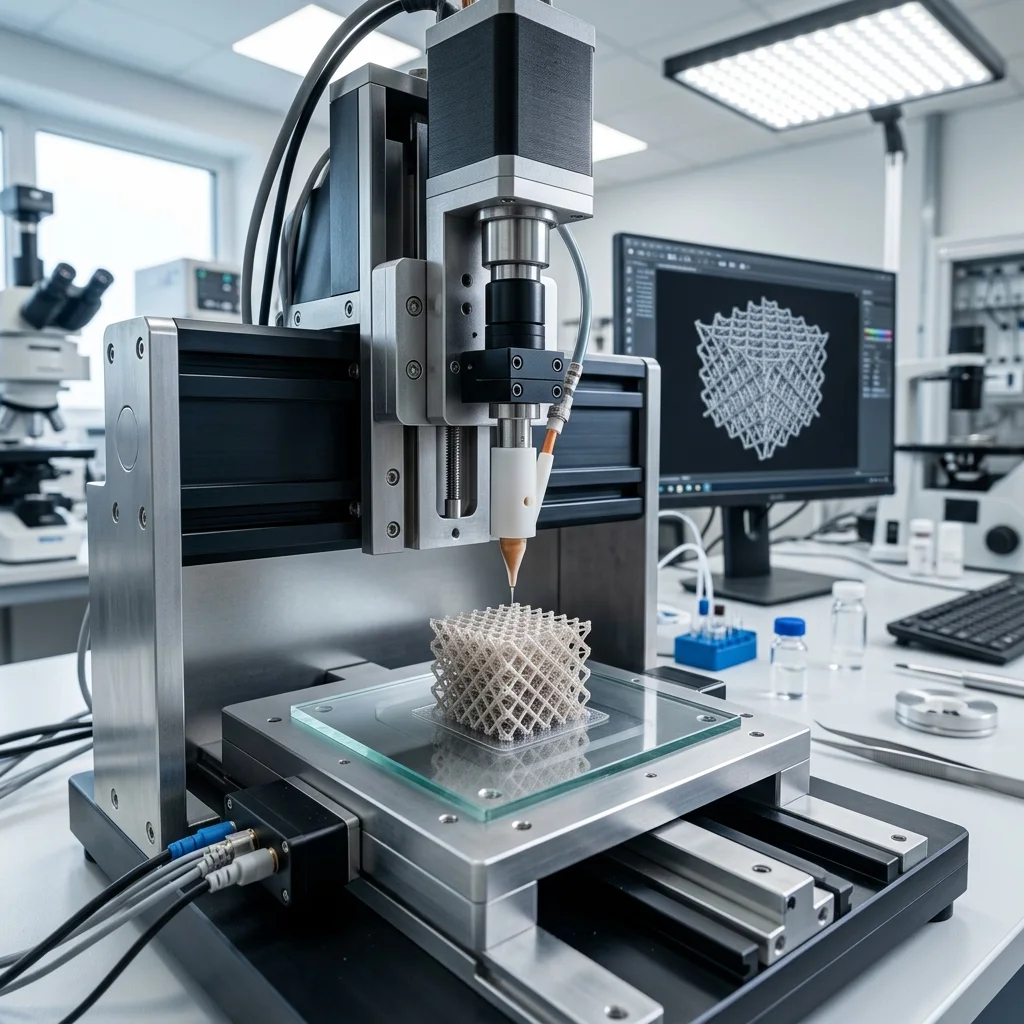
The world of technology is continuously shrinking. From smartphones to life-saving medical implants, the demand for smaller, more powerful, and increasingly complex components is stronger than ever. In this landscape, high-precision micro 3D printing emerges not just as an innovation, but as a fundamental shift in how we fabricate objects at the micro and nanoscale. Today, the limits of what is possible are measured in micrometers.
Unlike traditional methods such as injection molding or CNC machining, which often struggle with microscopic intricacies, micro-additive manufacturing allows for the creation of structures with unprecedented complexity and accuracy. This technology serves as a vital catalyst for breakthroughs in critical sectors like healthcare, electronics, photonics, and micromechanics.
Technological Pioneers: PµSL and TPP
Projection Micro Stereolithography (PµSL) and Two-Photon Polymerization (TPP) are the undisputed leaders in this domain. PµSL operates by projecting UV light through a digital micromirror array to cure photopolymer resins layer by layer. It strikes an impressive balance between resolution (down to 2 µm) and speed, making it highly suitable for both rapid prototyping and serial industrial production. On the other hand, TPP offers the absolute pinnacle of precision. By utilizing a pulsed femtosecond laser to trace 3D patterns deep within a photosensitive resin, TPP achieves sub-micron resolutions (less than 1 µm), essentially unlocking true nanofabrication capabilities.
Micro Laser Sintering: Metal at the Microscale
While resins dominate the ultra-high-resolution space, many industries require the uncompromising strength and thermal resistance of metals. Micro Laser Sintering or Melting is an advanced adaptation of traditional powder-bed fusion. This method employs exceedingly fine metal powder particles (5–10 µm) and a tiny laser spot size (≤30 µm) to produce fully dense, high-strength metallic micro-components. This is critical for manufacturing wear-resistant parts for micromechanics (MEMS) and advanced aerospace applications.
Life-Changing Applications: Healthcare and Biotech
In the medical field, micro 3D printing is nothing short of miraculous. The technology is leveraged to fabricate micro-implants, lab-on-a-chip diagnostic devices, and complex microfluidic systems. Particularly exciting are its applications in tissue engineering (where microscopic scaffolds are printed to support targeted cell growth) and the creation of dissolvable microneedles for painless, highly efficient transdermal drug delivery.
Electronics, Sensors, and Optics: The Invisible Infrastructure
The relentless miniaturization of smart devices demands components that traditional manufacturing simply cannot supply. High-precision 3D printing enables the creation of miniaturized connectors, flexible circuitry, and complex micro-sensors. In optics and photonics, the technology is responsible for producing custom microlenses, optical waveguides, and photonic crystals. These elements are the backbone of next-generation LiDAR systems, immersive AR/VR headsets, and ultra-high-performance miniature cameras.
The Future: AI and Hybrid Systems in Microfabrication
The future of micro 3D printing is intricately linked with Artificial Intelligence and hybrid manufacturing ecosystems. AI is increasingly integrated for real-time defect detection, automated dynamic calibration, and generative design, which optimizes microstructures for maximum structural integrity using minimal material. Concurrently, the rise of hybrid systems (combining additive manufacturing with subtractive processes like micro CNC milling or laser ablation) promises even tighter tolerances and pristine surface finishes.
Conclusion
High-precision micro 3D printing is no longer science fiction; it is a reality silently reshaping critical industries worldwide. The ability to manipulate matter at such a microscopic level equips us with the tools to engineer smarter sensors, more effective medical devices, and technologies previously deemed impossible. In the realm of micro-manufacturing, the future is incredibly small, yet its impact is colossal.
The full picture
This article is one page from The Big Book of 3D Printing: 704 illustrated pages covering every technology, material and fix in one reference.
Read it on Kindle →Engineer, author of The Big Book of 3D Printing and additive manufacturing expert