

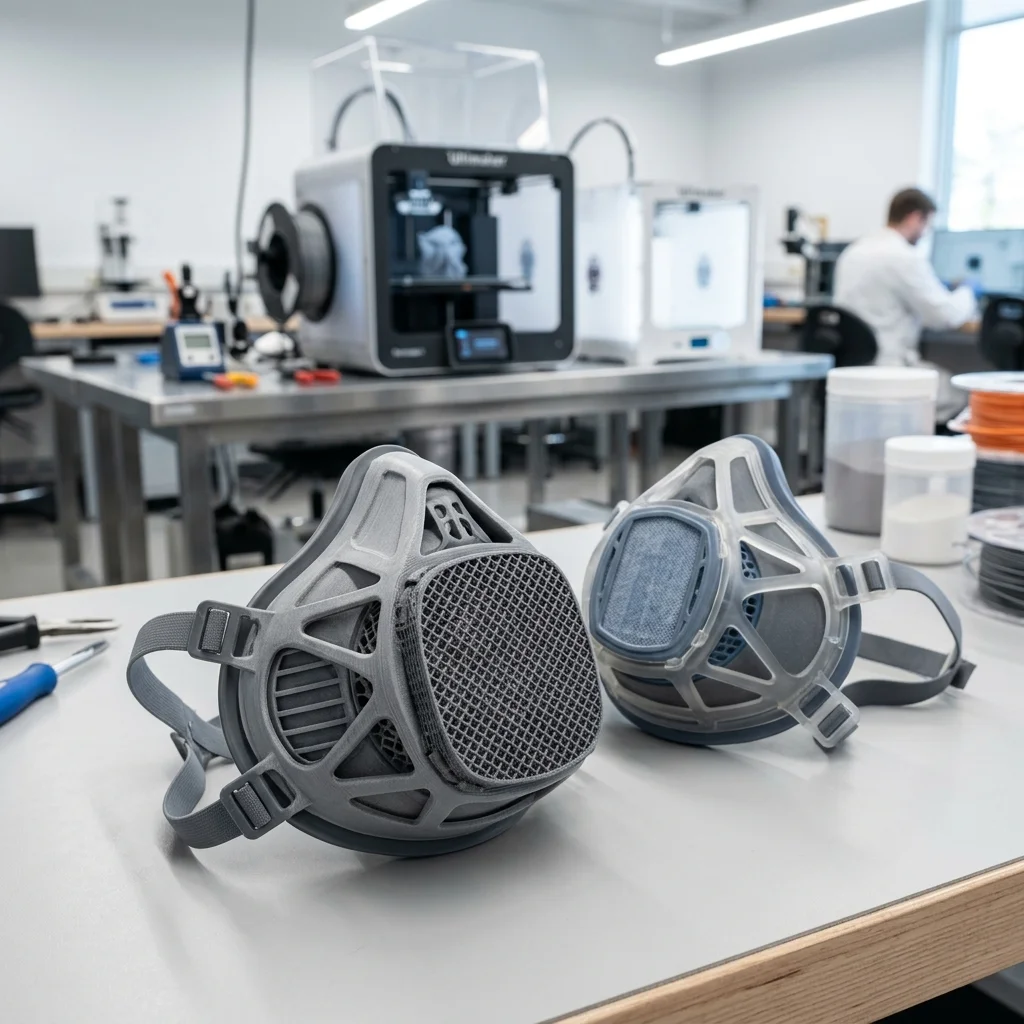
In response to global health challenges, additive manufacturing has evolved far beyond rapid prototyping. Today, 3D printing is at the forefront of creating active personal protective equipment (PPE) that doesn't just mechanically filter the air, but actively neutralizes pathogens on contact.
At EduFacturing, we believe that hardware is meaningless without the profound material science and design knowledge driving it. Let's dive deep into the engineering behind anti-viral polymers, metal nanoparticles, and advanced surface topologies that define the next generation of highly technical PPE.
Active Polymer Matrices: Nanoparticle Integration
Standard polymers like PLA, PETG, and ABS offer excellent structural integrity, but they lack inherent biological defense capabilities. The real breakthrough comes from doping these plastics with metallic nanoparticles: most commonly copper (Cu) and silver (Ag). These metals possess proven broad-spectrum antimicrobial and virucidal properties. When integrated into the filament or photopolymer resin matrix, they generate reactive oxygen species (ROS). These highly reactive molecules attack the lipid envelope of viruses, denature their proteins, and destroy viral RNA/DNA. Materials such as copper-infused PLA are already being actively used to print respirator housings that self-sterilize within minutes.
Biomimetic Micro-Architectures: Topological Control
Chemical composition is only half of the equation. The second crucial step lies in the micro-architecture of the printed surface. By leveraging high-resolution technologies like Stereolithography (SLA) or Digital Light Processing (DLP), engineers can create nature-inspired (biomimetic) surfaces: such as textures mimicking shark skin or lotus leaves. These micro- and nano-patterns prevent the adhesion of pathogens. Furthermore, through intelligent surface topology design, we can dramatically increase the surface area of the polymer exposed to the air. This significantly improves the kinetics of metal ion release, thereby accelerating the virucidal action.
Parametric Design and Adaptive Geometry
The efficacy of any respirator heavily relies on how well it seals against the user's face. This is where 3D printing shines through parametric modeling. By utilizing 3D facial scanning (via photogrammetry or smartphone LiDAR sensors), a unique topological profile can be generated for each individual. This data is then used to directly print flexible, custom face seals using Thermoplastic Polyurethane (TPU). Internally, the filter cartridges can be engineered with complex lattice structures that optimize airflow (reducing breathing resistance) while maximizing the surface area coated with active anti-viral agents.
Photocatalytic Coatings and Safety Standards
Post-printing, anti-viral properties can be further amplified by applying photocatalytic coatings like Titanium Dioxide (TiO2). When exposed to ultraviolet (UV) light, this coating triggers a potent oxidative reaction that eradicates residual organic matter and viruses. A critical medical engineering aspect of this process is managing cytotoxicity: ensuring that the released copper or silver ions destroy pathogens without harming human lung tissue upon prolonged inhalation. Striking the precise balance between nanoparticle concentration and their encapsulation within the polymer matrix is currently the subject of rigorous clinical testing and standardization.
Conclusion
Designing protective equipment is no longer just about establishing mechanical barriers; it is a complex intersection of applied material science and precise micro-architecture. With the advent of active anti-viral filaments and advanced resins, 3D printing enables us to manufacture 'smart' protection locally and on demand. At EduFacturing, we know that the deep understanding of how to manipulate these active materials is what truly transforms standard 3D printers into life-saving instruments.
The full picture
This article is one page from The Big Book of 3D Printing: 704 illustrated pages covering every technology, material and fix in one reference.
Read it on Kindle →Engineer, author of The Big Book of 3D Printing and additive manufacturing expert