

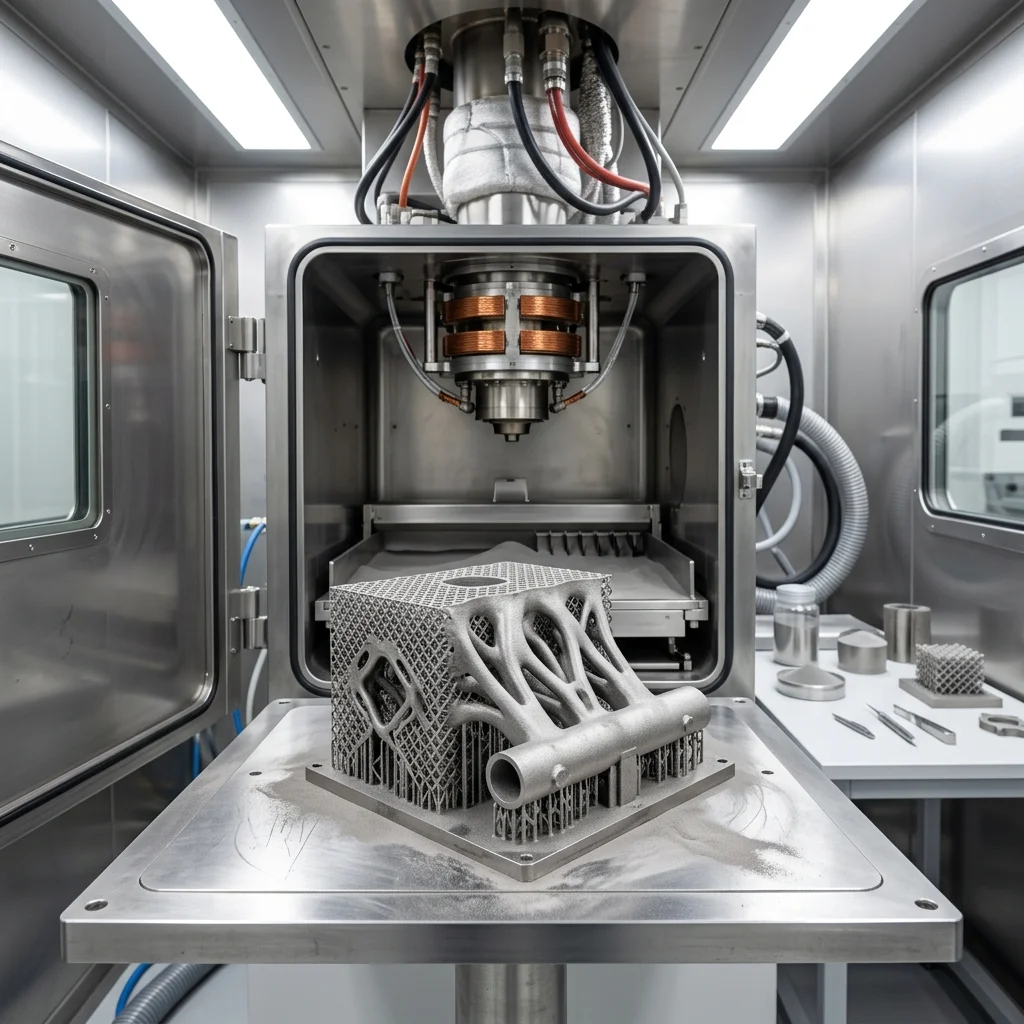
EBM is one of the most powerful technologies in the additive manufacturing (Powder Bed Fusion) arsenal. Operating in a high-vacuum environment at elevated temperatures, it uses a high-energy electron beam to selectively melt metal powder layer by layer. This unique setting not only prevents oxidation but also drastically reduces residual stresses, resulting in parts with exceptional density and structural integrity.
As engineers and visionaries, we know that the true value of a technology lies not in its hardware, but in what we can achieve with it. From titanium alloy turbine blades to custom medical implants, EBM opens doors to designs and materials that were considered impossible to manufacture until recently.
Aerospace and Defense
In the aerospace sector, material requirements are uncompromising. EBM is the preferred method for manufacturing critical engine components, such as turbine blades. The technology excels at processing difficult-to-machine materials like Titanium Aluminide (TiAl), which is both lightweight and highly resistant to extreme temperatures. Through EBM, engineers create complex structural supports and brackets with an optimal strength-to-weight ratio, which is critical for reducing the overall weight of aircraft and optimizing fuel consumption. In the defense industry, the technology ensures reliable, wear-resistant parts capable of withstanding harsh environments.
Medical and Biomedical Engineering
Medicine is perhaps the most personalized industry, and EBM fits its needs perfectly. The technology is a leader in creating patient-specific orthopedic, cranial, and dental implants from biocompatible titanium alloys. The major advantage of EBM in this field is the ability to generate precise lattice structures. These structures accurately mimic the porosity of human bone (trabecular structure), significantly improving osseointegration: the process where natural bone grows into and fuses with the implant, ensuring long-term stability and comfort for the patient.
Automotive and Motorsport
In the world of motorsport and high-performance automotive manufacturing, every fraction of a second and every gram matters. EBM is widely used to manufacture durable components for engines, gearboxes, and turbochargers where mechanical stress is extreme. The technology allows not only the creation of complex geometries with integrated cooling channels but also drastically accelerates research and development (R&D) cycles. Engineers can quickly test, validate, and implement new iterations of high-performance parts, completely bypassing the limitations and lead times of traditional casting.
Industrial Applications and Research
Beyond mainstream industries, EBM is an indispensable tool for specialized manufacturing and materials science. Because the process occurs at consistently high build chamber temperatures, it is ideal for working with brittle alloys and refractory metals (like tungsten and niobium) that are highly prone to cracking in laser-based processes due to thermal shock. EBM is also used to produce high-purity components, such as copper induction coils, which demonstrate a significantly longer service life than conventional alternatives. For researchers, the ability to create new microstructures and alloys in a controlled vacuum environment unlocks the materials of the future.
Conclusion
Understanding the applications of Electron Beam Melting shows us that 3D printing has long outgrown the prototyping phase. It is a mature industrial technology that creates end-use products for the most demanding sectors of the global economy. By providing this knowledge, we at EduFacturing arm you with the "picks and shovels" of modern engineering. The future belongs to those who can combine bold ideas with a deep understanding of manufacturing processes, materials, and geometry.
The full picture
This article is one page from The Big Book of 3D Printing: 704 illustrated pages covering every technology, material and fix in one reference.
Read it on Kindle →Engineer, author of The Big Book of 3D Printing and additive manufacturing expert