

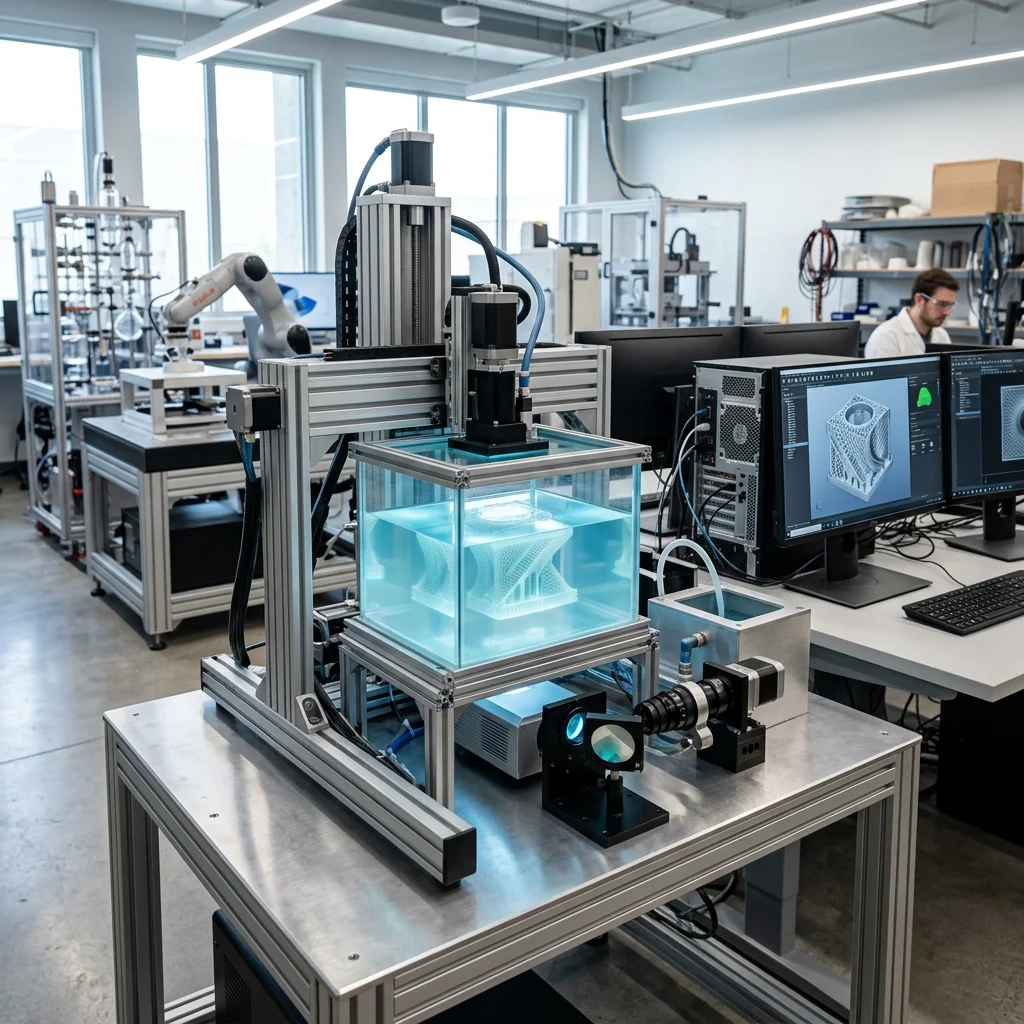
Vat Photopolymerization technologies (SLA, DLP, LCD) have long been the gold standard for high-resolution prototyping. Today, however, we are witnessing a monumental shift. As the lead technical architect at EduFacturing, I often emphasize that hardware is merely the tool: the true power lies in the knowledge of how to orchestrate it. In 2025–2026, the industry is experiencing a fundamental leap. We are no longer talking just about prototyping, but about true serial production driven by advanced chemistry, artificial intelligence, and holographic approaches that completely bypass the "layer-by-layer" paradigm.
Speed Without Compromise: The End of the Z-Axis Bottleneck
The greatest limitation of traditional VPP systems has always been the layer separation and resin recoating process. Novel engineering approaches are fundamentally changing this. The implementation of superamphiphobic interface films and dual-wavelength photoinhibition enables continuous printing processes without the detrimental peel forces. Furthermore, the advent of "Hot Lithography" (where the process operates at temperatures exceeding 55°C) not only reduces resin viscosity for faster recoating but also drastically improves monomer conversion rates, resulting in parts with excellent mechanical properties.
The Material Revolution: Engineering Polymers and Sustainability
Hardware evolution demands material innovation. Over the past year, we have seen massive progress in preceramic polymers, enabling the printing of complex ceramic structures with exceptionally high post-firing yields. Equally important is the focus on sustainability. The industry has adopted new metrics such as the Sustainable Formulation Score (SFS) to evaluate bio-based resins derived from vegetable oils and lignin. These eco-friendly materials now match the strength and thermal resistance of their petroleum-based counterparts, paving the way for sustainable mass production.
The Quantum Leap: Volumetric Additive Manufacturing (VAM)
If I had to point out one technology that is truly reshaping the landscape, it is Volumetric Additive Manufacturing. Instead of building objects layer by layer, VAM systems project holographic light fields directly into a vial of resin, curing the entire object simultaneously in mere seconds. Recent breakthroughs feature direct phase-control of the laser beam, which not only eliminates the need for vial rotation in some setups but also boosts energy efficiency by an astonishing 70-fold. This low-power precision makes the technology highly viable for bioprinting complex tissue structures containing living cells.
AI Integration: The Intelligent Production Cycle
No modern machine is truly complete without intelligent software. At EduFacturing, we believe that algorithms are the "pickaxes and shovels" of this new industrial revolution. Artificial Intelligence is deeply integrating into VPP systems through closed-loop control mechanisms. Sensors monitor the polymerization process in real time, while AI models adjust light intensity and Z-axis lift speeds millisecond by millisecond. This not only practically eliminates print failures but also enables generative design algorithms to optimize support structures dynamically based on the physical forces acting during the build.
Conclusion
Vat photopolymerization is no longer constrained by slow speeds or brittle materials. With the advent of volumetric printing and AI-driven workflows, the line between 3D printing and traditional injection molding is blurring faster than ever. For us at EduFacturing, the mission is clear: to provide the deep, high-tech knowledge required to master these innovations and to democratize access to advanced manufacturing for the next generation of engineers.
The full picture
This article is one page from The Big Book of 3D Printing: 704 illustrated pages covering every technology, material and fix in one reference.
Read it on Kindle →Engineer, author of The Big Book of 3D Printing and additive manufacturing expert