

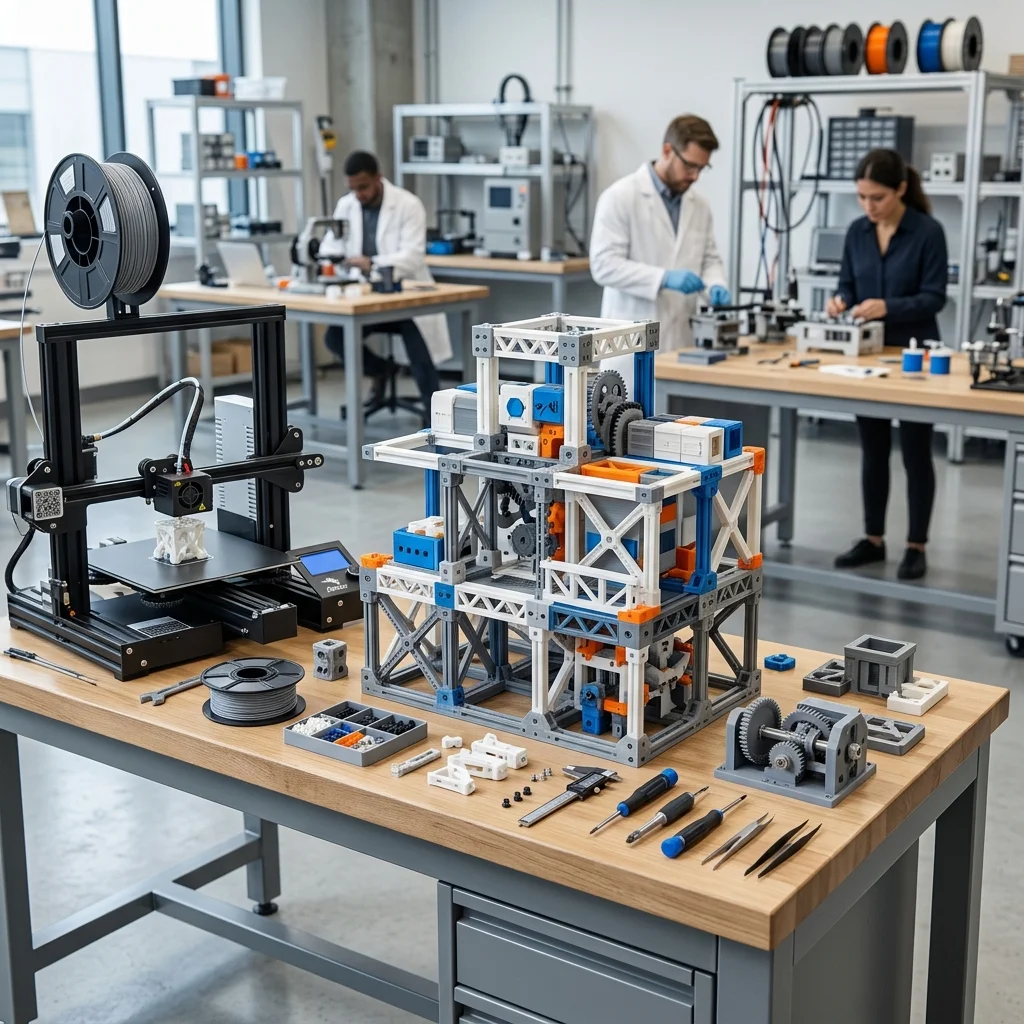
The paradigm of STEM education is shifting from passive observation to active engineering. 3D printing acts as the ultimate catalyst, transforming abstract mathematical and physical concepts into tangible, interactive learning experiences.
By decentralizing manufacturing and bringing it into the classroom, 3D printed educational kits offer an unprecedented level of modularity, rapid prototyping, and cross-disciplinary integration. This is not just about making toys; it's about building the fundamental "picks and shovels" of tomorrow's technological landscape, turning students from consumers into creators.
Modular Robotics and Mechatronic Integration
Modular robotics forms the backbone of modern STEM curricula. Instead of relying on static, pre-manufactured kits, 3D printing allows for the dynamic fabrication of mechatronic components. Students can parameterize gear structures, design custom mounting brackets for microcontrollers like the ESP32 or Raspberry Pi Pico, and iterate on robotic chassis. This intersection of CAD (Computer-Aided Design), additive manufacturing, and embedded C++ or Python programming creates a holistic engineering loop. The focus shifts from merely assembling parts to deeply understanding structural integrity, tolerances, and the mechanical properties of polymers like PETG and ABS under dynamic loads.
Applied Physics: Aerodynamics and Kinematics
Theoretical physics often struggles to maintain student engagement when confined to a whiteboard. 3D printing materializes abstract equations. By fabricating custom airfoils, students can test aerodynamic drag and lift in miniature wind tunnels. Kinematics is explored through the printing of complex planetary gearboxes and compliant mechanisms: monolithic structures that achieve movement through the elasticity of materials like TPU rather than traditional hinges. These physical proofs make mathematical relationships visceral, allowing learners to measure torque variations and optimize mechanical advantages iteratively through direct experimentation.
Open-Source Hardware and Iterative Learning
The open-source hardware movement has catalyzed a fundamental shift in pedagogical methodologies. Repositories of freely modifiable CAD models teach students the importance of version control, collaborative design, and the "fail-fast" philosophy inherent in agile engineering. When a 3D printed robotic arm fails under stress, it is not a dead end but a valuable data point. Students analyze the layer adhesion, adjust infill patterns or wall thicknesses, and reprint the optimized part within hours. This rapid iteration cycle mimics true industrial R&D processes, building resilience and critical problem-solving skills.
The EduFacturing Ecosystem: Supporting Educators
Providing the hardware without the underlying knowledge is a futile endeavor. As we say at EduFacturing, we must provide the "picks and shovels": the deep pedagogical frameworks that give the hardware purpose. A true 3D printed STEM kit is an ecosystem comprising the physical printer, the curated CAD files, the electronic bill of materials, and, crucially, a structured curriculum. By equipping educators with comprehensive, technology-agnostic teaching modules, we transform 3D printers from intimidating machinery into versatile, daily laboratory instruments that democratize high-tech knowledge.
Conclusion
3D printed educational kits represent the democratization of advanced engineering. By fusing code, electronics, and additive manufacturing, we are not just teaching STEM: we are cultivating a generation of systemic thinkers and hardware innovators ready to tackle the real-world challenges of tomorrow.
The full picture
This article is one page from The Big Book of 3D Printing: 704 illustrated pages covering every technology, material and fix in one reference.
Read it on Kindle →Engineer, author of The Big Book of 3D Printing and additive manufacturing expert