

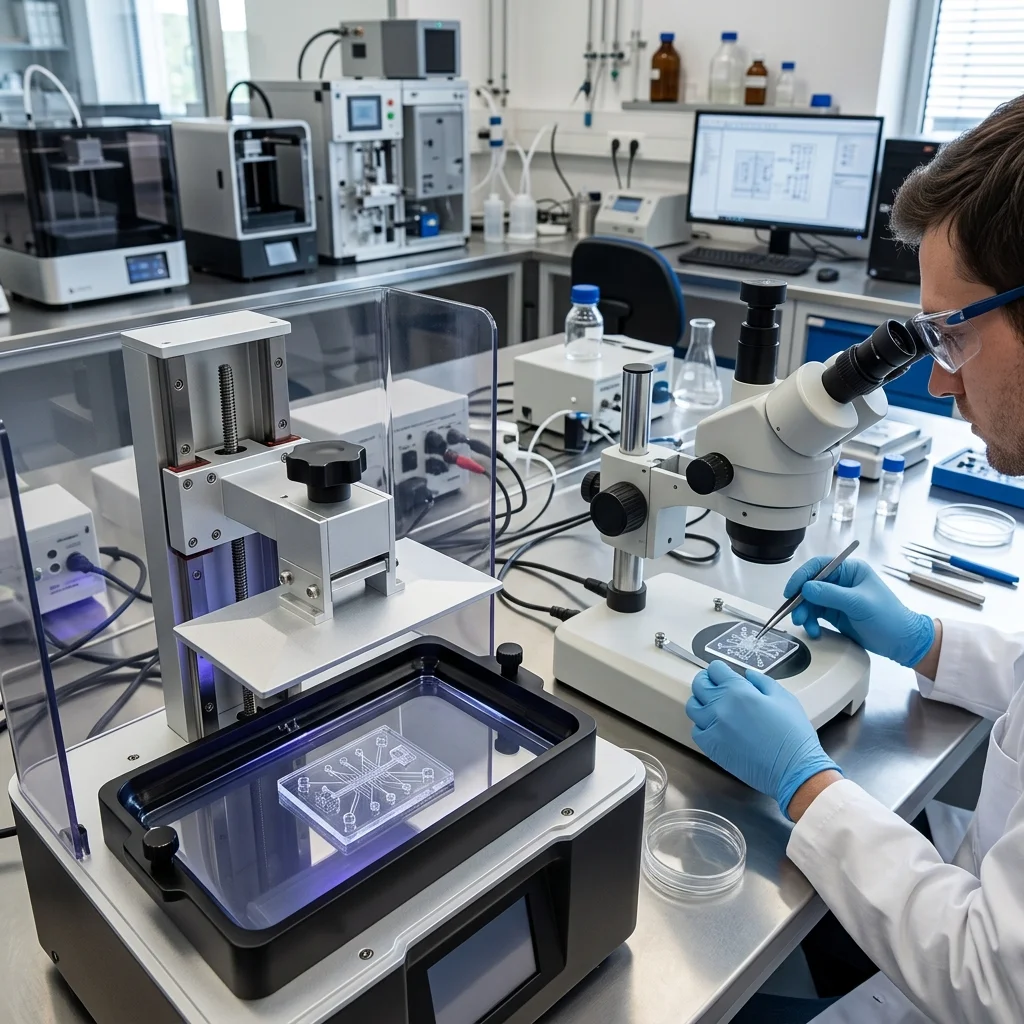
For decades, the development of microfluidic systems and Lab-on-a-Chip (LoC) devices was intrinsically tied to traditional soft lithography and complex processes inside expensive cleanrooms. Polydimethylsiloxane (PDMS) left a lasting legacy as the gold standard material, but its reliance on manual, slow prototyping cycles heavily constrained innovation.
Today, we are witnessing a true paradigm shift. Additive manufacturing is democratizing this highly specialized field. At EduFacturing, we believe in providing the 'picks and shovels': the deep engineering knowledge that gives meaning to the hardware. This enables you to build microchannels, bioreactors, and cell culture systems directly on your desktop using 3D technologies.
SLA and DLP: The New Workhorses of Microfluidics
Photopolymerization techniques like SLA (Stereolithography) and DLP (Digital Light Processing) have established themselves as the optimal balance between cost, speed, and resolution for microfluidics. While SLA utilizes a laser to precisely construct channels with a resolution of around 100 micrometers, DLP projects entire layers simultaneously. This DLP approach not only drastically accelerates fabrication but also yields exceptionally smooth internal surfaces: a critical factor for maintaining laminar fluid flow and minimizing unwanted turbulence in microchannels.
PolyJet: Mastering Multi-Material Systems
When complexity is essential, PolyJet technology offers the unique advantage of jetting multiple materials simultaneously. Imagine a microfluidic chip that combines rigid, optically clear channels with flexible, integrated pneumatic valves or pumps within a single print cycle. While removing support material from microscopic cavities remains an engineering challenge, the advent of advanced water-soluble supports is making complex, multi-functional monolithic devices a reality.
The Pinnacle of Precision: Two-Photon Polymerization (2PP)
For applications demanding sub-micron precision, Two-Photon Polymerization (2PP) stands as the absolute technological pinnacle. By employing femtosecond lasers to induce polymerization exclusively at the beam's focal point, 2PP effectively bypasses the diffraction limits of conventional lithography. This capability allows researchers to fabricate true 3D micro-vascular networks and intricate scaffolds for Organ-on-a-Chip models that closely mimic the capillary systems of the human body.
Material Evolution: Beyond PDMS to Biocompatible Resins
Hardware is only half the equation; advanced materials breathe life into the final application. While PDMS is still utilized via 3D-printed master molds, the industry is rapidly transitioning towards direct printing with advanced polymers. Transparent thermoplastics and ISO 10993-certified biocompatible resins now enable the direct fabrication of point-of-care diagnostic devices. Concurrently, the use of specialized hydrogels (such as GelMA and PEG) is unlocking the ability to print extracellular matrix (ECM) scaffolds directly for living cell cultures.
Conclusion
The integration of 3D printing into microfluidics is far more than a simple hardware upgrade; it is the foundational bedrock for the future of personalized medicine and rapid point-of-care diagnostics. We believe that mastering these processes is the key to driving the next generation of hardware innovation. The future of science is no longer locked away in cleanrooms: it is being printed right before our eyes.
The full picture
This article is one page from The Big Book of 3D Printing: 704 illustrated pages covering every technology, material and fix in one reference.
Read it on Kindle →Engineer, author of The Big Book of 3D Printing and additive manufacturing expert