

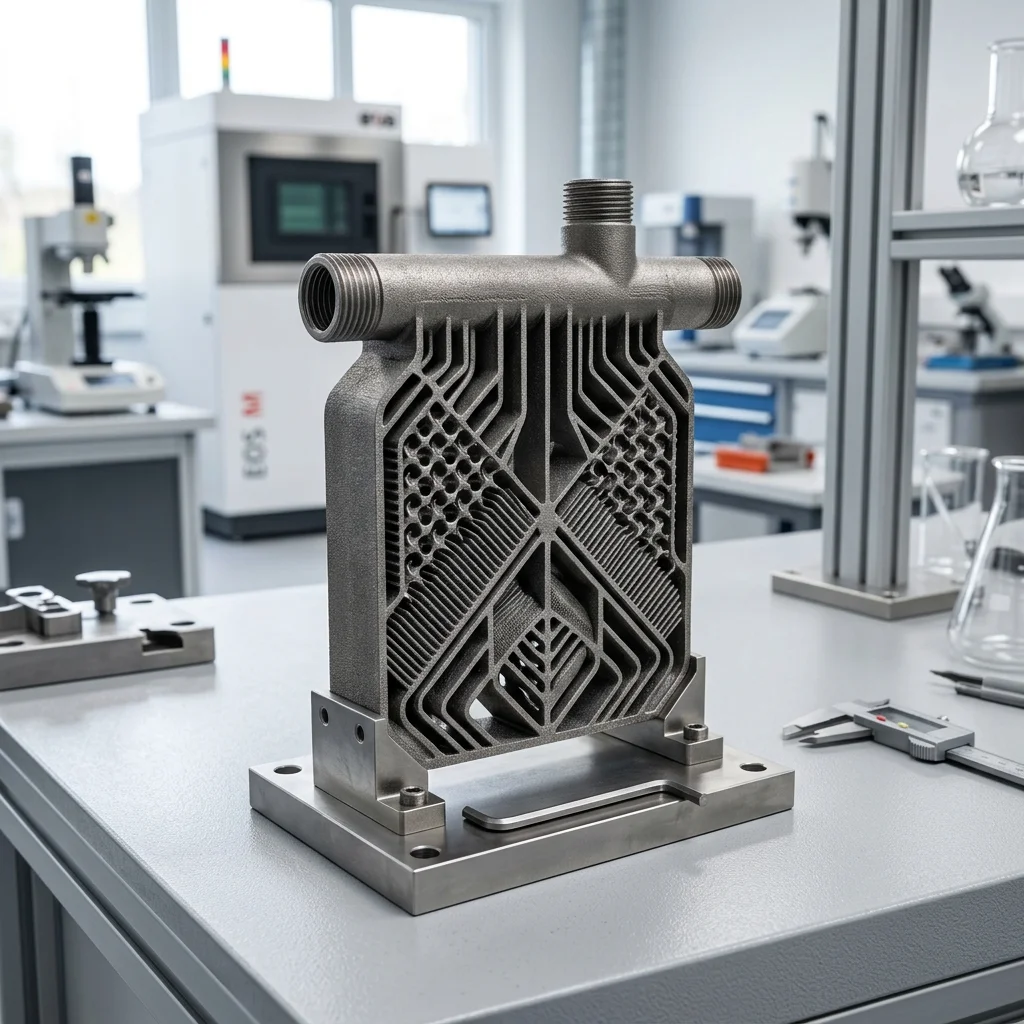
Thermal management has always been a strict boundary condition in high-performance engineering. For decades, we've relied on traditional plate-fin or tube-based heat exchangers. While effective up to a point, these legacy designs are heavily constrained by conventional manufacturing techniques like CNC machining, brazing, or welding. When pushed to the extreme limits of aerospace and electric vehicle (EV) automotive packaging, they simply hit a thermal wall.
But the paradigm has shifted. Enter Additive Manufacturing (AM) and the advent of Triply Periodic Minimal Surfaces (TPMS). By leveraging advanced 3D printing technologies (like Selective Laser Melting and Electron Beam Melting) alongside highly conductive alloys (Copper, Aluminum, and Inconel), we can now mathematically optimize fluid flow and heat transfer. We're no longer just assembling parts; we are printing continuous, complex topologies that were previously impossible to fabricate.
The Mathematical Elegance of TPMS Architectures
The secret to the extreme efficiency of 3D-printed heat exchangers lies in Triply Periodic Minimal Surface (TPMS) structures, such as gyroid, diamond, and primitive lattices. Unlike traditional straight fins, a TPMS structure consists of a continuous, non-self-intersecting surface that naturally divides space into two intertwined but physically separated fluid domains. This geometric wizardry yields an exceptionally high surface-area-to-volume ratio: the holy grail of heat exchange. Because there are no sharp corners or dead zones, boundary layer disruption is precisely controlled. The result? A staggering 15% to 120% improvement in the heat transfer coefficient for a given pumping power compared to printed circuit heat exchangers. This is not just a marginal gain; it's a structural revolution that completely rewrites the equations of thermal resistance.
Fluid Dynamics and Pressure Drop Mitigation
One of the classic trade-offs in thermal engineering is that increasing surface area (by adding more fins or turbulators) inevitably spikes the pressure drop, forcing you to use larger, heavier pumps. 3D printing elegantly solves this paradox. The smooth, sweeping curves of a TPMS internal channel act as natural flow guides. They induce a highly uniform mixing of the fluid (preventing boundary layer thickening) while drastically reducing the flow resistance normally caused by harsh 90-degree angles in conventional designs. By integrating Computational Fluid Dynamics (CFD) with generative design algorithms, we can sculpt the internal channels so they match the exact thermodynamic requirements of the application, minimizing pressure drops and optimizing the pumping power required.
Consolidation, Lightweighting, and Reliability
When we 3D print a heat exchanger, we don't just change its internal structure; we redefine its assembly. Traditional heat exchangers are notorious for requiring dozens, sometimes hundreds, of separate fins, tubes, and manifolds brazed or welded together. Every joint is a potential failure point under thermal cycling and mechanical vibration. Additive manufacturing enables part consolidation: transforming a complex assembly into a single, monolithic component. This eliminates weak seams, minimizes the risk of fluid leakage, and drastically reduces weight. In the aerospace sector, where every gram translates to fuel cost, and in the EV industry, where compact packaging dictates battery capacity, achieving volume reductions of up to 27% while boosting thermal performance is nothing short of game-changing.
Pushing Material Limits: Copper, Aluminum, and Superalloys
The geometric complexity of these heat exchangers is only half the story; the other half is the material science powering them. Today's industrial 3D printers can process highly conductive materials like pure copper and specialized aluminum alloys (such as AlSi10Mg or Scalmalloy) with densities approaching 99.9%. For extreme environments (like rocket engine cooling channels or jet engine pre-coolers) we use nickel-based superalloys like Inconel 718. The combination of high-temperature material properties with mathematically optimized thin-wall TPMS geometries means these heat exchangers can survive aggressive thermal shocks, corrosive fluids, and extreme pressures that would tear traditional assemblies apart.
Conclusion
The era of flat plates and straight tubes is coming to an end. By uniting algorithmic generative design with advanced metal 3D printing, we are forging heat exchangers that are smaller, lighter, and vastly more efficient than anything previously engineered. This is the essence of modern thermal management: not fighting against the physical limits of traditional manufacturing, but transcending them with smart, mathematically pure geometries. Whether we are cooling high-density EV batteries or managing the extreme thermodynamics of an orbital launch vehicle, 3D printed heat exchangers are the critical infrastructure of our high-performance future.
The full picture
This article is one page from The Big Book of 3D Printing: 704 illustrated pages covering every technology, material and fix in one reference.
Read it on Kindle →Engineer, author of The Big Book of 3D Printing and additive manufacturing expert