

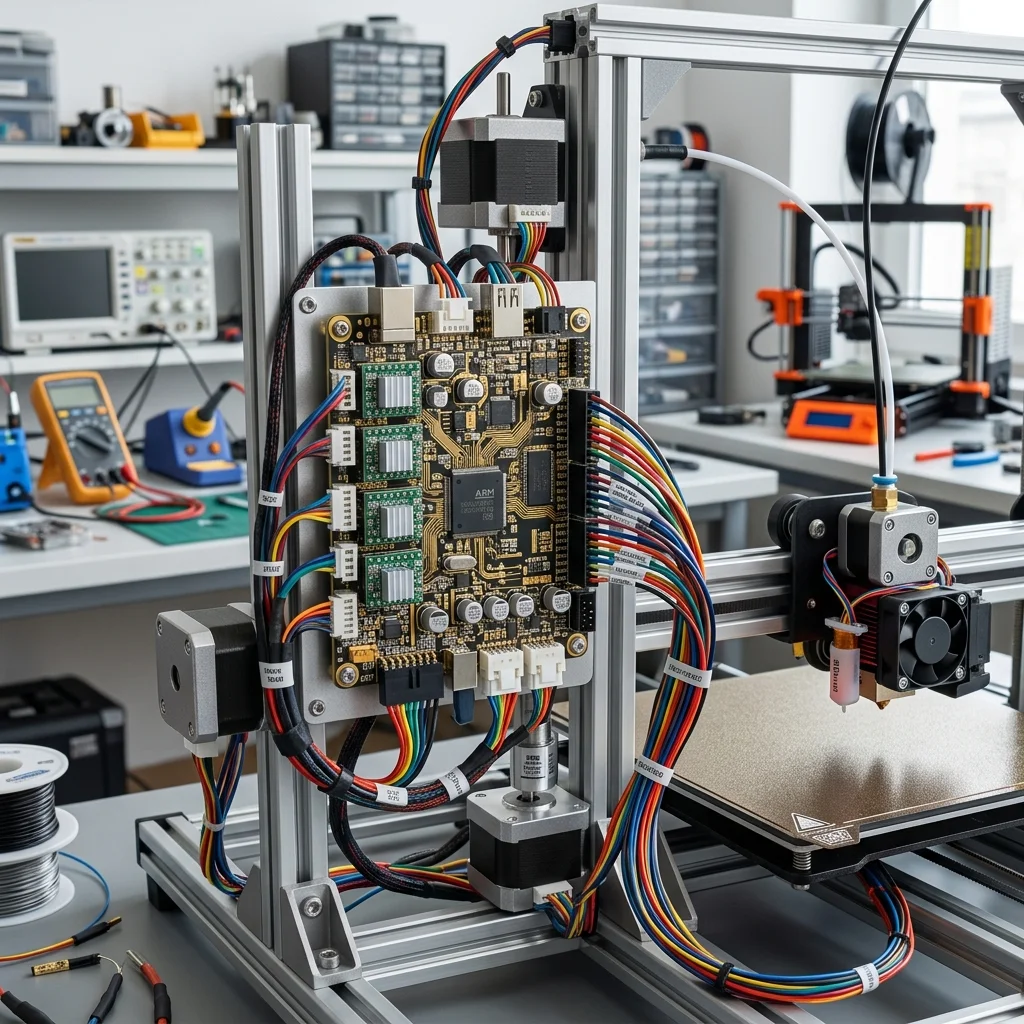
The physical hardware of a 3D printer (the stepper motors, belts, extruders, and linear rails) is only half the equation for successful manufacturing. The true magic lies in the firmware: the intelligence that translates complex G-code into precise, fluid, and high-speed physical movements.
In the rapidly evolving field of additive manufacturing, open-source software has always been the primary catalyst for innovation. Communities of engineers and enthusiasts have democratized technologies that were once reserved solely for six-figure industrial machines. From the early days of the RepRap project to the high-speed computational powerhouses and smart kinematics of 2026, firmware dictates the limits of what's possible. In this article, we explore the three main pillars of 3D printing firmware today: Marlin, Klipper, and RepRapFirmware.
Marlin: The Reliable Backbone of the Industry
Marlin is the undisputed veteran in the world of 3D printing. Developed at the dawn of desktop 3D printers, it has become an industry standard, powering millions of machines worldwide. Its primary strength lies in its monolithic architecture: the entire codebase, from G-code parsing to motion planning and stepper driver management, runs entirely on the mainboard's microcontroller (MCU).
This standalone operation makes it very reliable. You don't need an extra computer; the printer can operate independently for years. Configuring Marlin involves editing C++ header files (Configuration.h) and recompiling, providing a stable, "set-it-and-forget-it" experience. While modern alternatives have pushed boundaries, Marlin hasn't been left behind. The implementation of features like Linear Advance and Input Shaping allows the firmware to perform excellently under modern high-speed demands, maintaining its position as the most widely supported platform for any kinematic setup.
Klipper: Revolutionizing Kinematics with Compute Power
If Marlin is the reliable Swiss watch, Klipper is the modern supercomputer. Klipper's architecture fundamentally shifts how a 3D printer operates. Instead of relying solely on the MCU for complex mathematical calculations, Klipper splits the workload (Host + MCU architecture). A powerful host computer (usually a Raspberry Pi or another SBC) handles the heavy lifting of path planning and kinematics, while the printer's mainboard is relegated to a simple "executor" of precisely time-stamped steps.
This offloading of computational weight unlocked a revolution in print speeds. Klipper mainstreamed Input Shaping (a technology that compensates for hardware resonance using accelerometers (like the ADXL345)) virtually eliminating ghosting artifacts at high speeds. Furthermore, Klipper's configuration is based on easily readable text files (printer.cfg) that can be edited on the fly via web interfaces like Mainsail or Fluidd, requiring no recompilation. Klipper is the definitive choice for enthusiasts and modern high-speed CoreXY machines.
RepRapFirmware (RRF): Advanced Capabilities and Modularity
RepRapFirmware occupies a unique space, bridging the gap between industrial reliability and extreme customization. Initially developed around the Duet3D hardware ecosystem, RRF is built on an incredibly powerful Object Model. This means that every aspect of the machine's state (temperatures, axis positions, sensor statuses) can be accessed and manipulated in real-time via scripts.
Its greatest advantage is the native Web Control (DWC) and support for advanced conditional G-code macros. You can create complex logic scenarios, looping commands, and automated procedures that react dynamically to environmental changes. RRF is invaluable for complex setups: multi-tool printers (toolchangers), hybrid CNC machines, or systems requiring communication with external devices (such as RS485/Modbus). This is the firmware for engineers building machines outside conventional boundaries.
Choosing the Right Brain for Your Machine
Choosing firmware today is rarely about "which is best," but rather "which fits your workflow." If you are producing mass-market machines, aiming for long-term standalone reliability, and prefer not to invest in additional host computer hardware, Marlin remains the gold standard. For commercial appliances or users who just want their printer to work, it's flawless.
If your focus is on speed, you love tinkering with hardware, and you want to rapidly iterate configurations through a sleek web interface, Klipper is the clear winner. It's no coincidence that it's the driving force behind the modern speed revolution. Conversely, if you are designing a non-standard machine that requires intricate automation, multiple extruders, or integration with external feedback loops, the object model and flexibility of RepRapFirmware will provide the high-level control you need.
Conclusion
Open-source software is the unsung hero of the 3D printing revolution. It gives meaning to the hardware, enabling everyday users to achieve industrial-grade precision. In an era of advanced motion planning algorithms, having the choice between Marlin, Klipper, and RepRapFirmware is a privilege for modern engineers. The future of additive manufacturing doesn't just lie in faster motors and better materials, but in the intelligent code that commands them.
The full picture
This article is one page from The Big Book of 3D Printing: 704 illustrated pages covering every technology, material and fix in one reference.
Read it on Kindle →Engineer, author of The Big Book of 3D Printing and additive manufacturing expert