

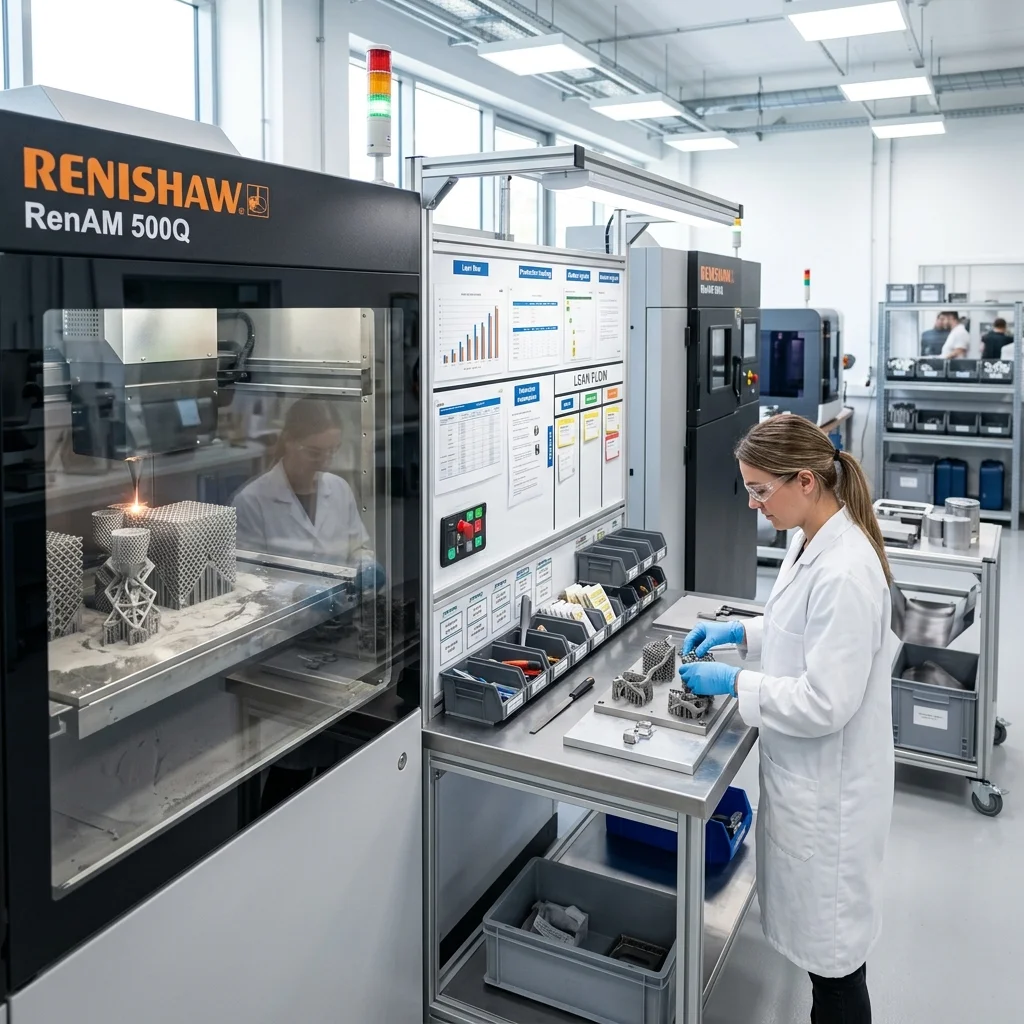
At its core, Lean Production (inspired by the Toyota Production System (TPS)) is a philosophy dedicated to the relentless elimination of waste (Muda) and the maximization of customer value. For decades, the industry has relied on process optimization, Kanban systems, and Just-in-Time (JIT) deliveries to achieve these goals. But what happens when we combine this classic philosophy with the most flexible manufacturing technology of the 21st century?
Additive Manufacturing (AM) is not just another machine on the shop floor; it is the technological catalyst that allows Lean principles to reach their full potential. By removing the physical constraints of traditional subtractive manufacturing, 3D printing transforms theoretical Lean concepts into a tangible, everyday reality.
The Digital Inventory: Redefining "Just-in-Time"
Traditional manufacturing requires maintaining massive warehouses of spare parts and components to ensure business continuity. In Lean terms, this is a classic form of waste known as 'Inventory'. Additive manufacturing offers an elegant solution: the digital warehouse. Instead of physical shelves filled with metal or plastic parts, factories maintain a secure database of 3D models. When a part is needed, it is printed locally and strictly on-demand (JIT). This drastically reduces warehousing costs, eliminates the risk of obsolete inventory, and streamlines supply chains.
Eliminating the 7 Wastes (Muda) with 3D Printing
Lean defines seven primary types of waste, and AM directly addresses most of them. First, 'Overproduction' is eliminated because parts are built layer-by-layer only when there is actual demand, requiring no Minimum Order Quantities (MOQ). Second, 'Transport' is minimized through decentralized, localized manufacturing: data travels instead of physical objects. Third, 'Defects' and material scrap are sharply reduced. Unlike machining, where a large portion of the material becomes chips, additive processes like FDM or SLM use only the exact amount of material needed for the final geometry.
Tooling and Setup Reduction (The SMED Concept)
One of the biggest enemies of manufacturing efficiency is setup time. In Lean methodology, this is managed through SMED (Single-Minute Exchange of Die). Additive manufacturing elevates SMED to an entirely new level by completely eliminating the need for specific dies, molds, or complex fixtures. A single 3D printer can produce an aerospace bracket in the morning and a custom medical implant in the afternoon without any physical 'tool' changeover. Furthermore, 3D printing is widely used to rapidly create custom jigs and fixtures for assembly lines, further accelerating traditional manufacturing workflows.
Continuous Improvement (Kaizen) and Rapid Iteration
The heartbeat of Lean is Kaizen: the philosophy of continuous improvement. In a traditional environment, changing a part's design requires weeks of delay and significant capital investment in new tooling, which often stifles innovation. With 3D printing, engineers can tweak a CAD model and hold a physical prototype in their hands within hours. This 'fail fast, learn faster' cycle enables teams to continuously optimize products and assembly processes without disrupting the overall rhythm of production.
Conclusion
The integration of Additive Manufacturing and Lean Production is more than just process optimization; it is a fundamental shift in how we approach value creation. By marrying Lean's relentless focus on waste reduction with the infinite geometric freedom and flexibility of 3D printing, we are building the smart, highly adaptable factories of the future. Understanding how to bridge these two worlds is the true 'pick and shovel' knowledge of Industry 4.0.
The full picture
This article is one page from The Big Book of 3D Printing: 704 illustrated pages covering every technology, material and fix in one reference.
Read it on Kindle →Engineer, author of The Big Book of 3D Printing and additive manufacturing expert