

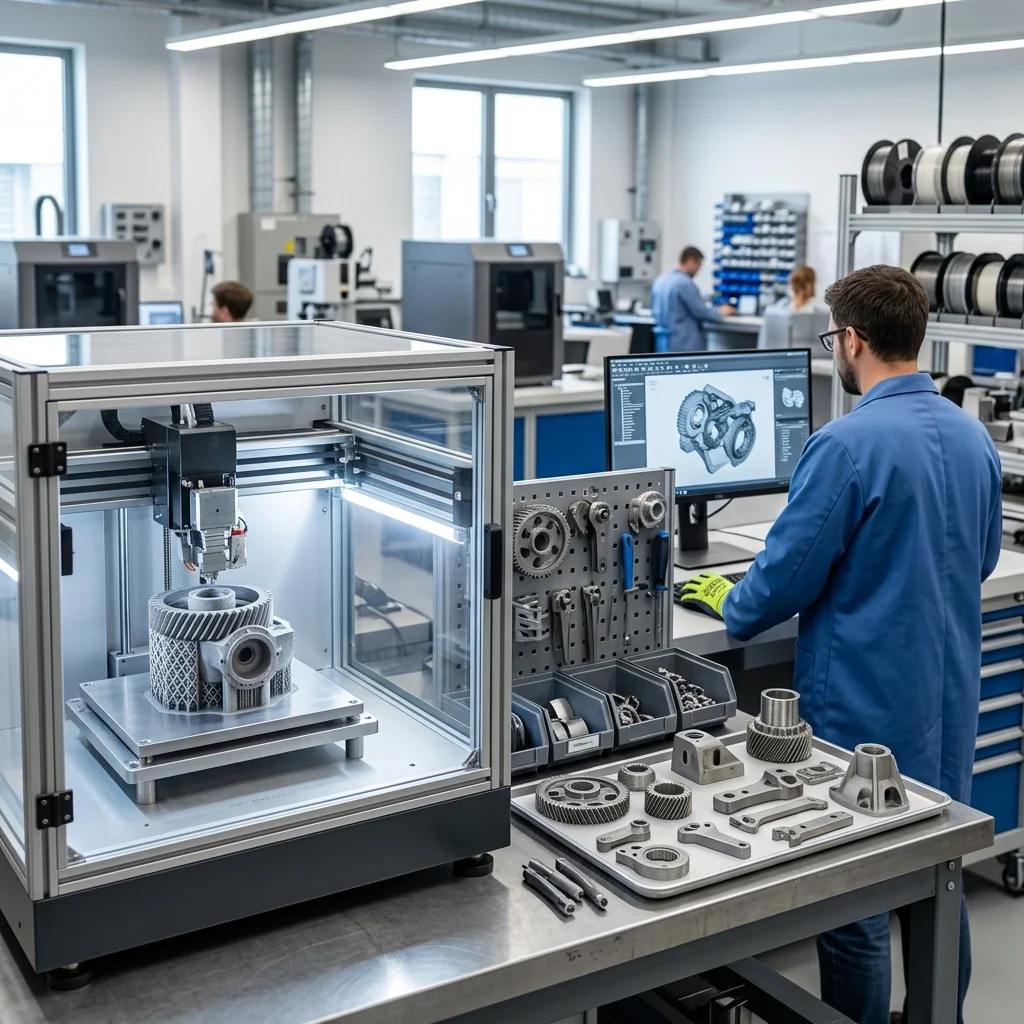
For decades, the global manufacturing industry has relied on a traditional "make-to-stock" model for spare parts management: mass-producing components and storing them in massive physical warehouses. This approach ties up substantial capital in parts that might never be used and creates severe logistical bottlenecks when supply chains are disrupted.
Today, additive manufacturing (3D printing) offers a radically different alternative. The concept of on-demand production coupled with digital inventories is transforming how companies maintain their equipment and fleets. Instead of waiting weeks for a part to be shipped halfway across the globe, engineers can simply download a secure 3D file and print the exact component they need, right at the point of failure.
The Rise of the Digital Inventory
A digital inventory (or digital warehouse) is a centralized, secure library of 3D CAD files that replaces physical storage shelves. When a machine breaks down, instead of searching for a physical replacement part through a complex logistics network, the corresponding digital file is retrieved and sent to a local 3D printer.
This transition does more than just free up physical space; it fundamentally changes maintenance philosophy. Digital files don't age, rust, or get lost. They can be updated instantly, meaning that even legacy equipment whose original parts were discontinued decades ago can remain operational without the need for prohibitively expensive custom machining runs.
Cost Reduction and the End of Obsolescence
One of the largest hidden costs in industrial maintenance involves warehousing fees and the eventual scrapping of unused spare parts. Industry data shows that a significant percentage of stored parts are never deployed before they become obsolete and are discarded.
By adopting digital inventories, companies drastically cut costs related to storage, insurance, and long-haul logistics. Only the parts that are genuinely needed are manufactured, exactly when they are needed. This eliminates the financial risk of stockpiling dead inventory and allows businesses to reallocate previously frozen capital toward innovation and growth.
Supply Chain Resilience and Localized Production
Recent global crises have starkly highlighted the fragility of extended international supply chains. A delay in shipping a critical spare part can halt entire production lines, generating millions in downtime losses.
On-demand 3D printing enables manufacturing decentralization. Companies can install industrial 3D printers near key operational hubs or leverage local networks of additive manufacturing service providers. This shrinks the supply chain from thousands of miles to mere meters, virtually eliminating freight costs, reducing the corporate carbon footprint, and ensuring true business continuity.
Overcoming Implementation Challenges
Despite its clear advantages, transitioning to a digital warehouse model presents its own set of challenges. Foremost among them is intellectual property (IP) security. Original Equipment Manufacturers (OEMs) require robust Digital Rights Management (DRM) and cybersecurity protocols to ensure their proprietary CAD files are not pirated, reverse-engineered, or modified without authorization.
Another critical factor is ensuring quality standards. 3D-printed replacement parts must meet or exceed the strength, durability, and regulatory requirements of conventionally manufactured components (e.g., injection-molded or CNC-machined parts). This demands careful material selection (utilizing advanced engineering polymers, composites, or metal powders) and often requires redesigning the part specifically for additive manufacturing (DfAM) to maximize performance.
Conclusion
The integration of on-demand 3D printing and digital inventories is not merely a technological novelty; it is a strategic supply chain revolution. While completely eliminating physical warehouses is a long-term vision, adopting a hybrid approach today yields immediate, substantial benefits. Companies that champion the digital inventory model will build highly agile, resilient, and cost-effective operations, perfectly positioned to navigate the logistics challenges of tomorrow.
The full picture
This article is one page from The Big Book of 3D Printing: 704 illustrated pages covering every technology, material and fix in one reference.
Read it on Kindle →Engineer, author of The Big Book of 3D Printing and additive manufacturing expert