

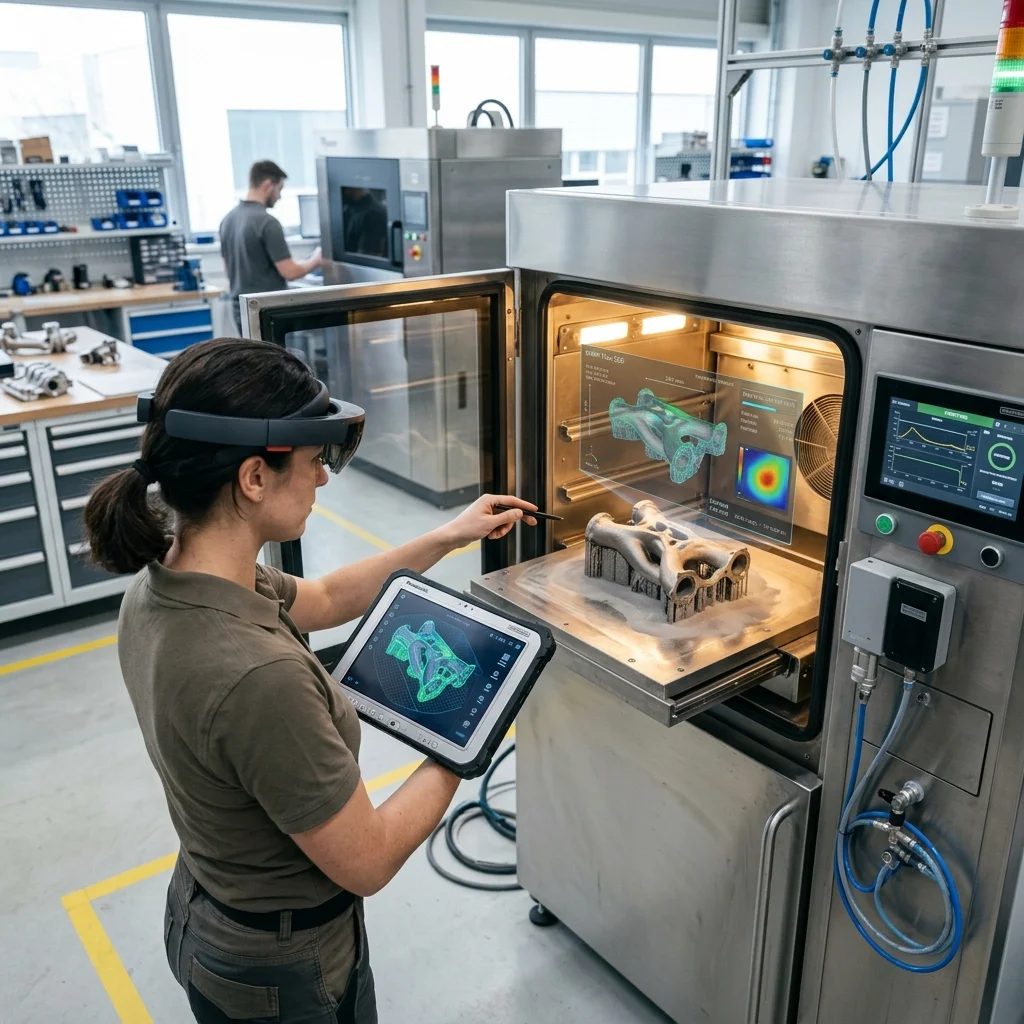
The chasm between digital models and physical objects has always been bridged by 3D printing. However, the conceptualization phase has historically remained trapped behind the 2D plane of traditional monitors. The integration of Augmented Reality (AR) and Spatial Computing into the Additive Manufacturing (AM) workflow is fundamentally changing this dynamic.
We are no longer just sending CAD files to a machine; we are immersing ourselves in a smooth feedback loop where digital twins, holographic toolpaths, and physical extrusion coexist. This convergence is not merely a visual gimmick: it is a critical evolution in prototyping speed, print monitoring, and complex assembly logic.
Pre-Fabrication Spatial Prototyping
Before a single drop of resin is cured or a millimeter of filament is extruded, AR enables engineers to instantiate a 1:1 scale holographic model in its intended physical environment. Spatial computing headsets allow design teams to evaluate ergonomics, mechanical clearances, and aesthetic integration in the real world. This 'zero-waste prototyping' phase drastically reduces iteration cycles. Interferences in complex assemblies can be detected via holographic superposition, allowing immediate adjustments in the CAD environment before committing to a multi-day print.
Holographic In-Situ Monitoring & Digital Twins
The concept of the Digital Twin reaches its ultimate form when AR is applied to active 3D printers. By anchoring a digital overlay onto the physical kinematics of an FDM or SLA machine, operators can visualize invisible data. Imagine looking at your printer and seeing a real-time thermal map of the hotend, layer-adhesion stress vectors, and the predicted G-code path extending seconds into the future. Sensor fusion from modern architectures like Klipper or Duet can pipe telemetry directly into the AR environment, allowing for instant detection of anomalies like under-extrusion, warping, or layer shifts before they visibly ruin the part.
Interactive Assembly and Hardware Maintenance
Modern 3D printing often involves multi-part assemblies with complex post-processing steps or intricate hardware maintenance (e.g., tuning a CoreXY gantry or assembling a custom toolhead). AR overlays can project step-by-step, exploded-view instructions directly onto the workbench. Instead of glancing back and forth at a PDF manual, the user sees exactly where an M3 heat-set insert must be placed or how a specific belt routing should look perfectly aligned with the physical frame. This drastically flattens the learning curve for building open-source machines and assembling complex printed projects.
The Next Frontier: Generative Design in Mixed Reality
The workflow of the future eliminates the desktop computer entirely. Using advanced hand tracking and haptic feedback, designers can sculpt topological optimizations directly in 3D space. Once a part is mathematically refined by AI algorithms for load-bearing efficiency, the user simply 'pushes' the holographic object to the adjacent physical printer. The slicer operates invisibly in the cloud, computing slice parameters based on the spatial orientation established by the user's hands. This is the zenith of human-machine interface for additive manufacturing.
Conclusion
Augmented Reality is not just an accessory to 3D printing; it is the ultimate translation layer. By blending bits and atoms, AR bridges the imagination gap, ensuring that what we conceptualize in the digital ether translates flawlessly into physical reality. As spatial computing hardware becomes ubiquitous, the workshop of tomorrow will be a hybridized environment where light and matter are sculpted simultaneously.
The full picture
This article is one page from The Big Book of 3D Printing: 704 illustrated pages covering every technology, material and fix in one reference.
Read it on Kindle →Engineer, author of The Big Book of 3D Printing and additive manufacturing expert