

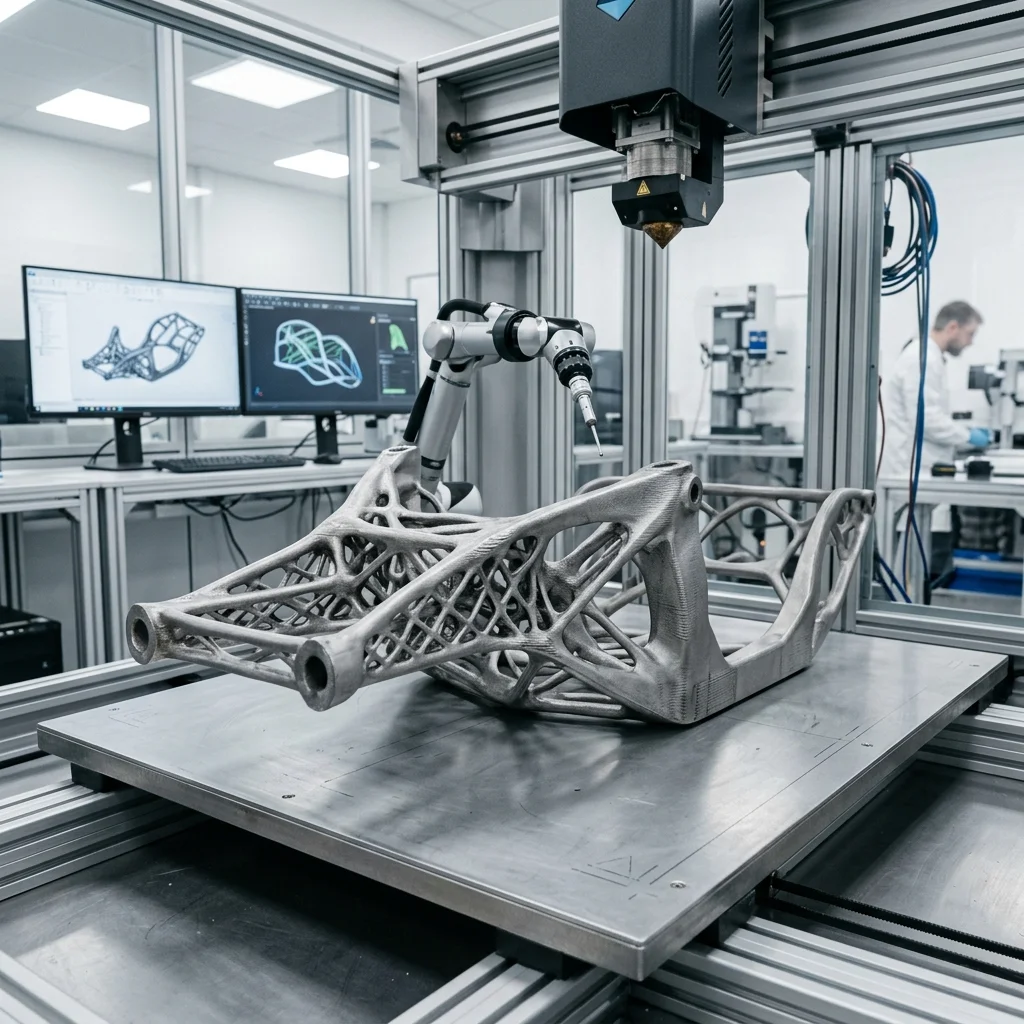
In the relentless pursuit of automotive performance and efficiency, weight has always been the ultimate enemy. As the industry pivots towards electric vehicles (EVs) and ultra-high-performance hypercars, traditional manufacturing methods like metal stamping and casting are reaching their physical limits. Enter the convergence of Additive Manufacturing (3D printing) and AI-driven Generative Design. This technological synergy is completely rewriting the rulebook on how car chassis and frames are engineered, enabling structures that are radically lighter, significantly stronger, and visually reminiscent of organic, biological forms.
Generative Design: The AI-Driven Musculoskeletal Approach
At the heart of this revolution is Generative Design. Instead of human engineers manually drawing every strut and bracket, they input specific constraints into sophisticated computational software: parameters like mounting points, spatial limitations, and the exact load and stress vectors the frame will endure. The AI algorithms then run thousands of iterations to find the optimal geometry, strategically placing material strictly where it is needed for structural integrity and removing it where it is not. The result is a highly organic, "musculoskeletal" lattice structure that looks more like alien bone than a traditional car part. This bio-mimetic approach maximizes the strength-to-weight ratio in ways that conventional engineering could never achieve.
The Divergent Revolution: Metal Nodes and Tool-less Assembly
A prime example of this paradigm shift is the Divergent Adaptive Production System (DAPS), utilized brilliantly in the Czinger 21C hypercar. Instead of attempting to 3D print an entire car chassis in one massive piece, the system prints highly complex, optimized structural joints called "nodes" using Direct Metal Laser Sintering (DMLS) with advanced aluminum and titanium alloys. These printed metal nodes are then connected via standard carbon fiber tubes. What makes this process truly disruptive is the assembly: a fixtureless, automated robotic cell uses high-accuracy laser tracking and aerospace-grade adhesives to bond the frame together in minutes. This eliminates the need for millions of dollars in permanent, model-specific factory tooling and allows for rapid design iteration.
Materials Matter: From Superalloys to Carbon Composites
The success of 3D printed car frames heavily relies on the evolution of material science. In the high-end hypercar sector, DMLS utilizes proprietary aluminum alloys (like AlSi10Mg) and titanium (Ti6Al4V) to create isotropic, high-strength metal components that can withstand immense dynamic loads. Meanwhile, other approaches focus on Large Scale Additive Manufacturing (LSAM). Pioneers like Local Motors successfully printed entire structural bodies using thermoplastic composites, typically a robust blend of ABS plastic reinforced with 20% chopped carbon fiber. Even boutique manufacturers like BAC Mono are leveraging 3D printing for complex components and integrating graphene-enhanced carbon fiber to trim every possible gram, proving that the material palette for 3D printed automotive structures is both diverse and highly adaptable.
Unlocking Peak Performance and True Sustainability
The benefits of 3D printed lightweight frames extend far beyond aesthetics. In hypercars, shaving off hundreds of kilograms translates directly to blistering acceleration, sharper cornering, and record-breaking track times. For mass-market electric vehicles, a lighter chassis means significantly extended battery range and efficiency. Furthermore, this localized "micro-factory" approach offers profound sustainability benefits. By moving away from massive, centralized stamping plants, automakers drastically reduce capital expenditure, logistics emissions, and material waste. The process essentially dematerializes automotive manufacturing, allowing parts to be eventually re-atomized and reprinted in a circular lifecycle.
Conclusion
The days of relying solely on heavy steel stampings and rigid assembly lines are coming to an end for the vanguard of the automotive industry. By combining the limitless geometric freedom of 3D printing with the immense computational power of AI generative design, we are entering an era of bespoke, ultra-lightweight, and incredibly strong vehicles. As these technologies scale, the innovations pioneered on the hypercar track today will inevitably shape the efficient, sustainable passenger cars of tomorrow.
The full picture
This article is one page from The Big Book of 3D Printing: 704 illustrated pages covering every technology, material and fix in one reference.
Read it on Kindle →Engineer, author of The Big Book of 3D Printing and additive manufacturing expert