

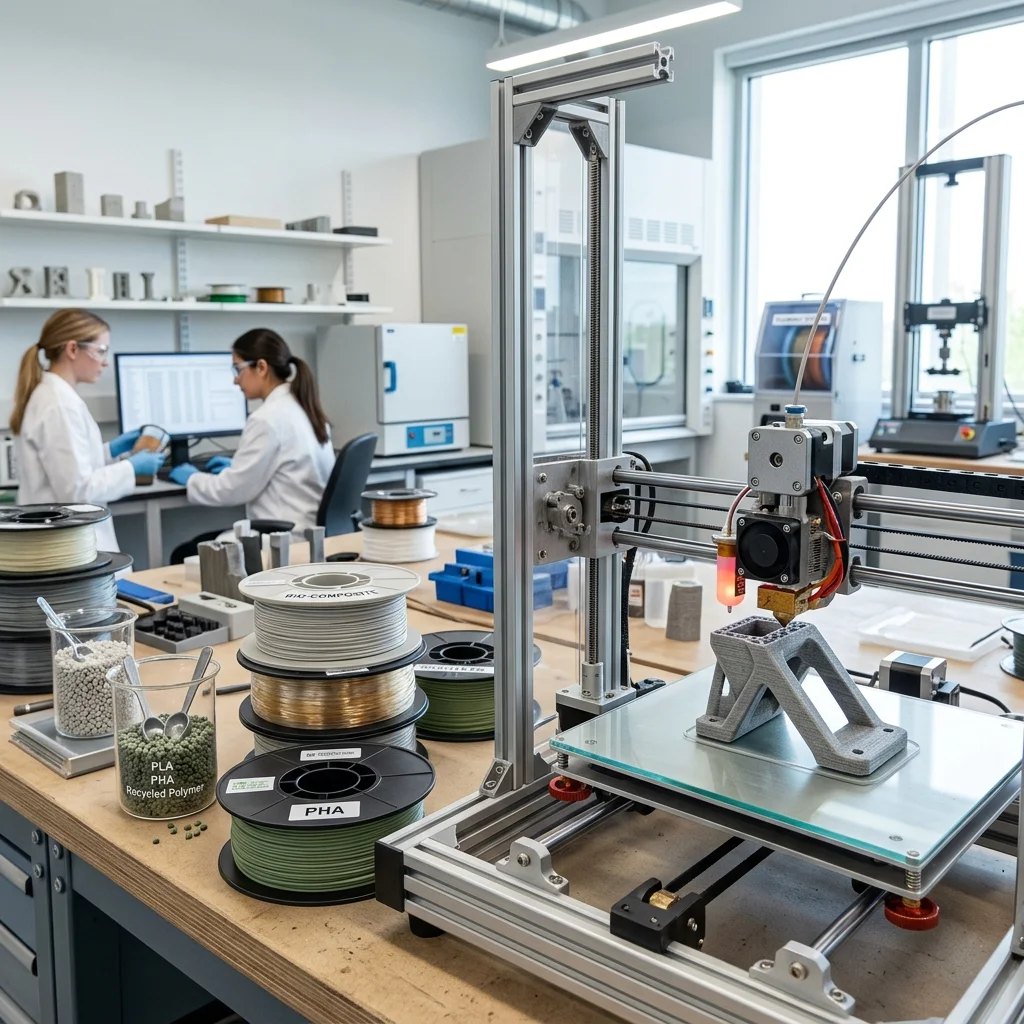
For a long time, 3D printing was synonymous with rapid prototyping… and plastic waste. While additive manufacturing inherently generates less scrap than subtractive methods, the exponential growth of the industry has brought the environmental footprint of its materials into sharp focus.
Today, simply printing with "biodegradable" PLA is no longer enough. The real revolution is happening at the molecular level, from bio-polymers that degrade safely in marine environments to photopolymer resins engineered with dynamic bonds for true infinite recycling. In this article, we look deep into the latest material science innovations that are paving the way for a genuine circular economy in additive manufacturing.
The Evolution of Biopolymers: The Rise of PHA
Polylactic Acid (PLA) has long been the poster child for "green" printing, but its critical flaw is that it requires high-temperature industrial composting facilities to break down. Enter PHA (Polyhydroxyalkanoates): polymers synthesized entirely through bacterial fermentation. PHA is not just home-compostable; it is fully biodegradable in marine environments without leaving microplastics behind. Recent advancements in extrusion tech have enabled hybrid PHA/PLA composites that solve standard PLA’s brittleness, increase thermal resistance, and allow for "cold-bed" printing, which drastically slashes the energy consumption of the printer itself.
Circular Photopolymers (Resins)
Vat polymerization technologies like SLA and DLP deliver incredible detail, but their thermosetting resins traditionally form irreversible chemical bonds. Once cured, they cannot be melted or recycled. Contemporary innovations are introducing photopolymers built with dynamic covalent bonds (often derived from lipoic acid or plant-based epoxies). Under specific chemical or thermal triggers, these bonds can be "unlocked," depolymerizing the printed part back into its raw monomers. This breakthrough means we can now print, dissolve, and reprint resins, fully closing the loop on a previously wasteful process.
Chemical Recycling and Computational Disassembly
Mechanical recycling (shredding and re-extruding) of old prints into new filament inevitably leads to polymer chain degradation over repeated cycles. The future lies in chemical recycling, where materials like PETG and ABS are broken down into their fundamental chemical building blocks. Furthermore, thanks to innovations in slicing software (Computational Disassembly), engineers can now generate dissolvable interface layers (e.g., using PVA) within multi-material parts. When submerged in water, the assembly automatically disassembles into its constituent plastics, making automated sorting and recycling remarkably efficient.
Sustainability in Metal AM: Powder Rejuvenation
In metal 3D printing (PBF, DED), the primary ecological and financial challenge is the degradation of unfused metal powder. Over multiple build cycles, the powder oxidizes, loses its sphericity, and absorbs moisture. Emerging powder recycling technologies rely on processes like plasma spheroidization and localized re-atomization. These methods "rejuvenate" degraded scrap, restoring its perfect morphology and flowability. This allows manufacturers to reclaim up to 95% of unused material without compromising the stringent mechanical properties required for certified aerospace or medical components.
Conclusion
Sustainable 3D printing is no longer just a marketing buzzword: it is a profound engineering challenge requiring breakthroughs in both material science and software. The transition from a linear to a circular manufacturing economy depends on our ability to integrate these novel materials into everyday production. At EduFacturing, we believe knowledge is the catalyst for this transformation. By providing you with the "picks and shovels" of advanced technology, we enable you to engineer products that are not only high-performing but environmentally responsible.
The full picture
This article is one page from The Big Book of 3D Printing: 704 illustrated pages covering every technology, material and fix in one reference.
Read it on Kindle →Engineer, author of The Big Book of 3D Printing and additive manufacturing expert