

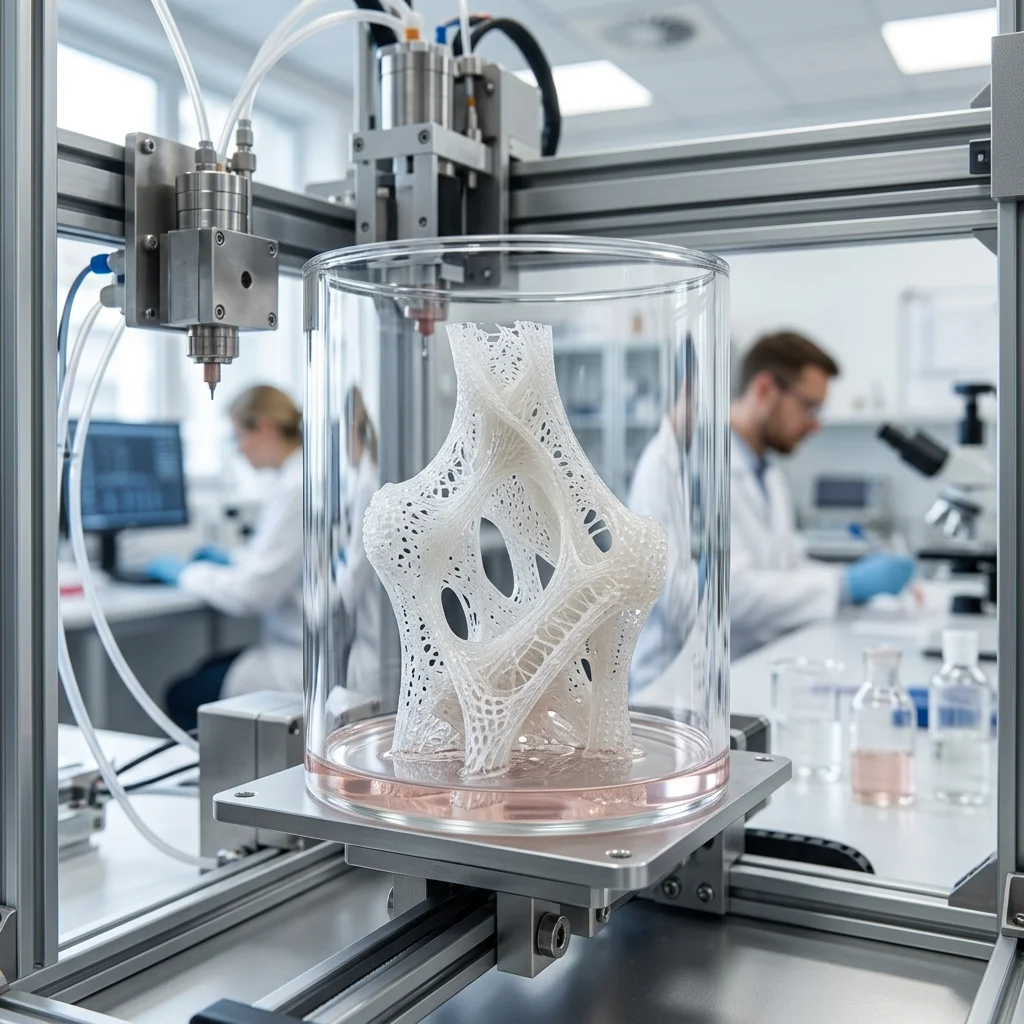
Bioprinting has moved from laboratory curiosity to a strategic manufacturing capability, enabling the layer‑by‑layer deposition of living cells, extracellular matrices, and functional biomaterials. By merging additive manufacturing precision with tissue engineering, companies can fabricate vascularized organoids, custom implants, and bio‑hybrid robots. This article dissects the underlying physics, material science, high‑impact use cases, and the financial calculus that executives need to assess before committing to a bioprinting line.
Fundamentals of Bioprinting
The core principle mirrors conventional extrusion‑based 3D printing, but the printhead handles viscoelastic bio‑inks under sterile conditions. Droplet‑based inkjet and laser‑assisted stereolithography add resolution down to 10 µm, crucial for mimicking capillary networks. Real‑time rheology monitoring and closed‑loop feedback loops ensure cell viability above 90 % during deposition. Pros/Cons:
– Pros: Precise spatial control of multiple cell types; scalable from millimeter to organ size; reduced animal testing.
– Cons: High sensitivity to temperature and shear stress; limited printable volume per batch; regulatory uncertainty.
Understanding these trade‑offs is the first step toward a viable production workflow.
Materials and Bio‑inks
Modern bio‑inks combine natural polymers (alginate, gelatin methacrylate, collagen) with synthetic carriers (PEG‑diacrylate) to balance printability and mechanical integrity. Cross‑linking strategies (ionic, photo‑polymerization, or enzymatic) dictate post‑print stiffness, ranging from soft brain tissue (~0.1 kPa) to load‑bearing cartilage (~1 MPa). Recent advances incorporate growth factor‑laden nanoparticles and sacrificial fugitive inks, enabling perfusable channels that self‑assemble into functional vasculature within 48 hours of culture.
Innovative Applications
Medical: Patient‑specific cardiac patches printed with induced pluripotent stem cells have entered Phase I trials, promising reduced rejection rates. Orthopedics: Gradient‑stiffness bone‑ligament interfaces are fabricated in a single print, cutting surgical assembly time by 60 %. Robotics: Soft actuators infused with living muscle fibers generate bio‑hybrid locomotion, opening pathways for minimally invasive devices. Aerospace: Lightweight, self‑healing composites embed micro‑vascular networks that deliver repair agents, extending service life of satellite components.
Economic Considerations
A realistic ROI model hinges on upfront capital, recurring consumables, and value‑added revenue streams. Cost Breakdown:
Equipment depreciation: $150,000
Software licensing (CAD/bioprint suite): $30,000
Material consumables (bio‑ink, cross‑linker per batch): $20,000
Labor (R&D, validation, 200 hrs): $40,000
Regulatory compliance (ISO 13485, FDA filing): $25,000
Total:
Implementation Timeline & Best Practices
Step 1: Feasibility study and target market definition (0‑2 months).
Step 2: Selection of printer platform and bio‑ink formulation (2‑4 months).
Step 3: Prototype development, including cell sourcing and bioreactor integration (4‑8 months).
Step 4: Validation against mechanical, biological, and regulatory benchmarks (8‑12 months).
Step 5: Scale‑up pilot run, cost‑per‑unit analysis, and supply‑chain lock‑in (12‑18 months).
Step 6: Full‑scale production launch with post‑market surveillance (18‑24 months).
Adhering to this phased approach minimizes sunk costs and aligns technical milestones with commercial go‑to‑market strategies.
The full picture
This article is one page from The Big Book of 3D Printing: 704 illustrated pages covering every technology, material and fix in one reference.
Read it on Kindle →Engineer, author of The Big Book of 3D Printing and additive manufacturing expert