

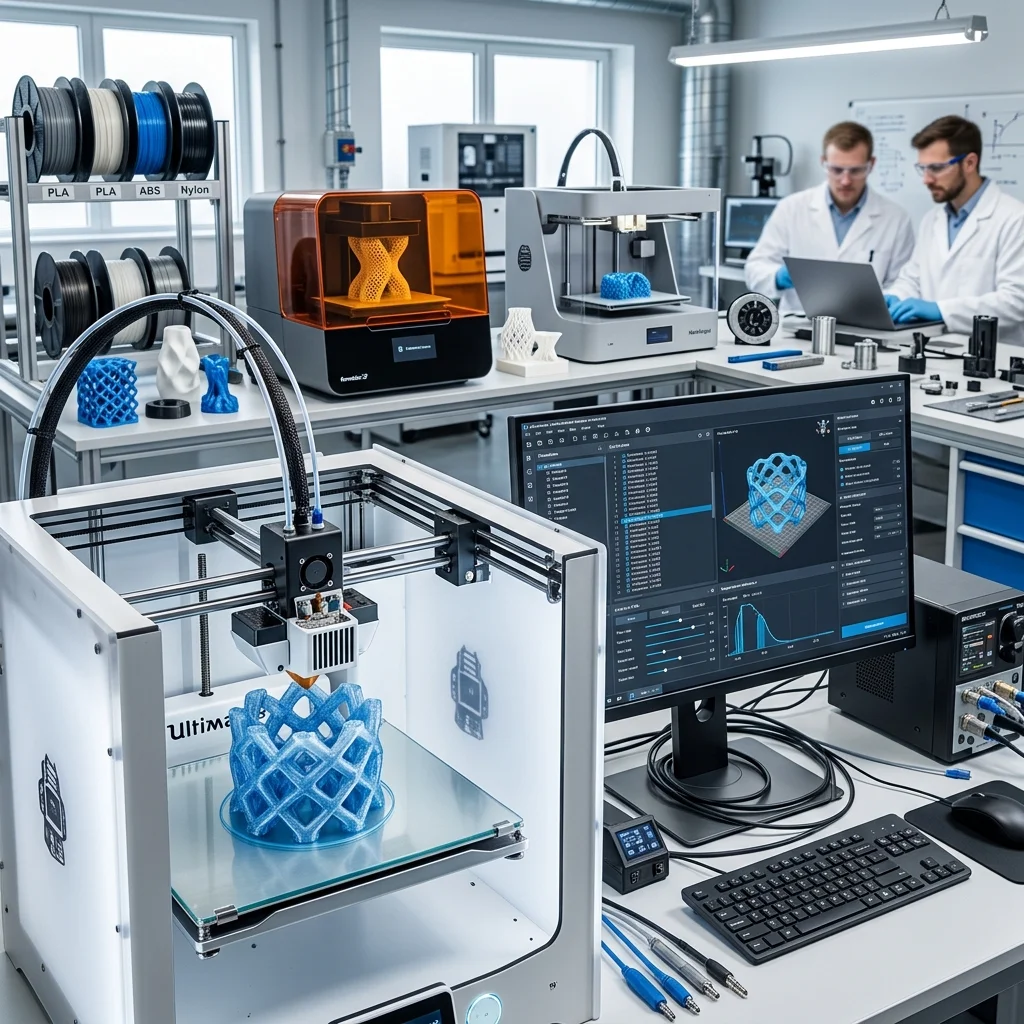
For years, the slicer has acted merely as a "translator": a rigid piece of software that converts 3D geometry into G-code commands, relying entirely on the operator’s intuition and trial-and-error. Today, we are at the epicenter of a software revolution. Artificial Intelligence (AI) is penetrating the print preparation process, shifting the paradigm from manually tweaking hundreds of parameters to Intent-Based Manufacturing. In this article, we explore how AI-driven optimization is transforming slicers into true engineering partners that think alongside you.
The Evolution of Slicing: From Manual Tweaks to Dynamic Control
Until recently, optimizing a part required deep tribal knowledge: selecting the right layer height, infill density, and extrusion multipliers. Today, AI algorithms analyze the part's topology in real time to apply Dynamic Parameter Adjustments. Instead of forcing static speeds or fixed layer heights across an entire model, machine learning models compute the optimal values for every specific region of the geometry. The result? Flawless surface finishes, minimized print times, and maximized mechanical strength, without spending hours hunting for the perfect profile.
Intelligent Support Generation and Auto-Orientation
One of the most persistent bottlenecks in additive manufacturing is support generation. Traditional heuristic algorithms often waste material, increase print time, and leave scarring on the final part. Modern AI-powered slicers analyze the center of gravity, thermal stresses, and critical overhang angles. They autonomously determine the optimal spatial orientation of the part and generate generative, organic tree supports precisely where needed. This drastically reduces waste and simplifies post-processing operations.
Predictive Defect Detection: Simulating Success
What if we could predict a print failure before the hotend even begins to heat up? Using Predictive Defect Detection and thermodynamic simulations, AI modules analyze G-code instructions to flag potential weaknesses. These algorithms identify high-risk zones for warping, delamination, or structural instability. When combined with real-time Computer Vision during the print (like the systems developed by Obico) the slicer and the 3D printer close the feedback loop, creating intelligent data streams that refine future optimizations.
The EduFacturing Vision: Intent-Based Manufacturing
Within the EduFacturing ecosystem, we don't look at machines simply as hardware; we are building the "picks and shovels" of digital manufacturing: the knowledge and software that give it meaning. Our vision centers on the leap toward Intent-Based Manufacturing. In the near future, users won't manually input "0.2mm layer height and 20% grid infill." Instead, they will declare: "I need this part to withstand 50kg of compressive load on the Z-axis, and I need it fast." The AI engine within our HUB platform will autonomously evaluate the material, select the optimal additive technology (from FDM to PBF), and generate the perfect machine code.
Conclusion
AI-optimized slicers are not here to replace the engineer. They are here to eliminate the tedious micro-management of print parameters, freeing the human mind to focus on what it does best: innovation and conceptual design. We are entering an era where software doesn't just execute commands: it understands our engineering intent.
The full picture
This article is one page from The Big Book of 3D Printing: 704 illustrated pages covering every technology, material and fix in one reference.
Read it on Kindle →Engineer, author of The Big Book of 3D Printing and additive manufacturing expert