

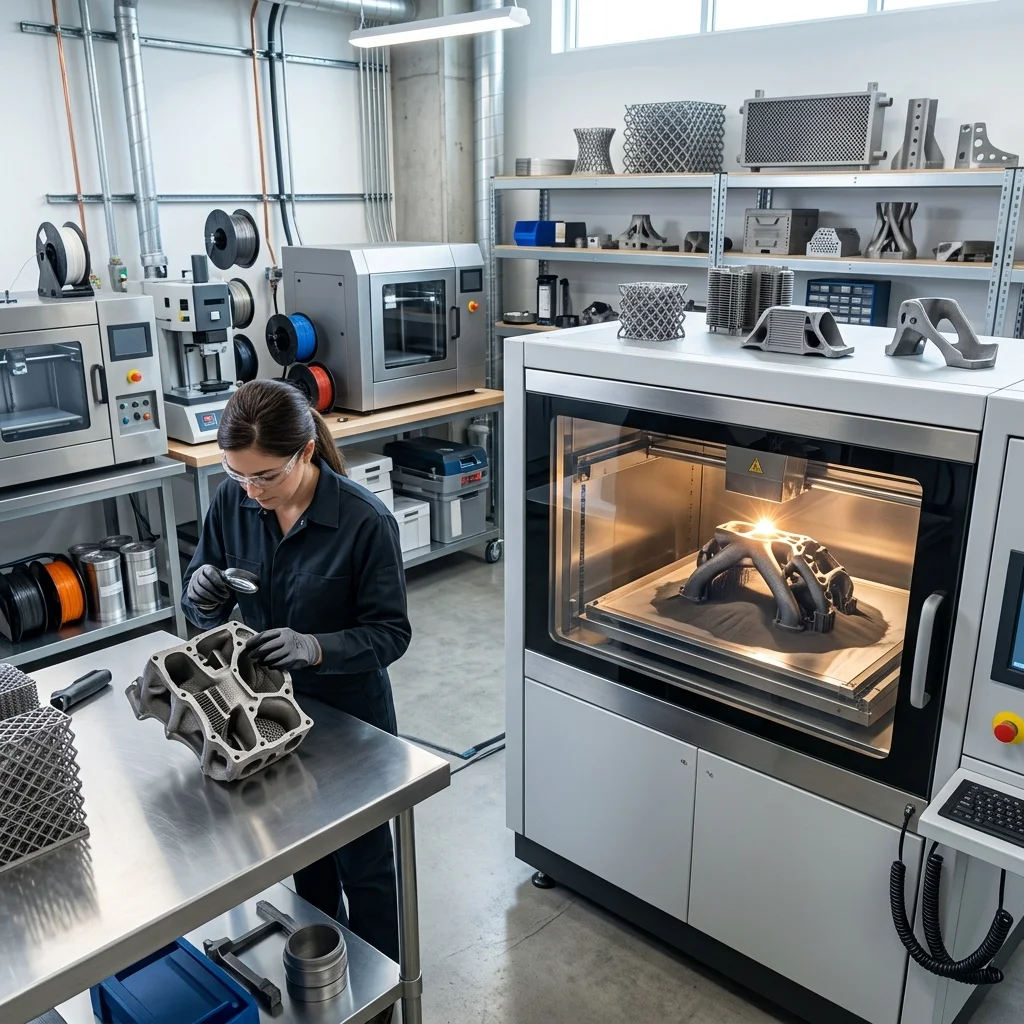
In an era defined by geopolitical instability, localized disruptions, and logistical bottlenecks, the fragility of traditional, centralized supply chains has never been more apparent. Mass production and just-in-time logistics, once the gold standards of industrial efficiency, are now exposed as highly vulnerable to systemic shocks. Enter Additive Manufacturing (AM): a transformative force that is moving production from rigid, linear supply chains to agile, networked ecosystems. By untethering manufacturing from massive, capital-intensive tooling and shifting to a model of data-driven physical generation, we are witnessing the birth of "Just-in-Time 2.0".
This isn't merely about printing a part; it's about fundamentally rethinking where, when, and how value is created. Through the strategic deployment of AM, enterprises are bridging critical production gaps, slashing lead times, and replacing physical warehouses with secure digital repositories.
The Paradigm of Digital Inventory
The most profound impact of AM on supply chain logistics is the transition from physical to digital inventory. Storing millions of spare parts in massive warehouses incurs exorbitant holding costs and carries a high risk of obsolescence. With AM, physical stock is replaced by a digital thread: a secure repository of CAD files, simulation data, and print parameters. When a part is needed, the digital twin is transmitted to the nearest additive node and manufactured on demand. This virtually eliminates capital tied up in slow-moving inventory and ensures that legacy parts can be reproduced indefinitely without preserving physical tooling.
Decentralization and Distributed Micro-Factories
Traditional manufacturing relies on massive, centralized facilities to achieve economies of scale, necessitating complex global shipping networks. Additive manufacturing enables a distributed approach via localized micro-factories or "print farms." By situating production capabilities near the point of consumption, companies can bypass global shipping delays, reduce transportation costs, and sidestep international tariffs. This decentralized model provides agility; a design updated in a central hub can be instantly deployed to dozens of localized nodes, ensuring uniform quality and immediate market responsiveness globally.
Mitigating Risk and Enhancing Operational Agility
Resilience is the ability to absorb shocks and rapidly recover. Additive manufacturing acts as an operational shock absorber. During severe supply chain disruptions, AM systems can rapidly produce critical tooling, jigs, fixtures, and end-use bridge parts that would otherwise stall production lines. Furthermore, because a single 3D printer can produce an infinite variety of geometries without specialized molds, the cost of pivoting production is practically zero. This ultimate flexibility means manufacturers are no longer held hostage by single-source overseas suppliers for critical, low-volume components.
Sustainability and the Circular Economy
Beyond logistical efficiency, AM is a powerful catalyst for sustainable manufacturing. Subtractive methods generate significant waste, whereas additive processes deposit material exactly where it is needed, drastically improving the buy-to-fly ratio. Additionally, localized production inherently reduces the carbon footprint associated with global freight. As advanced polymer and metal powders become more recyclable, AM is steering supply chains toward a true circular economy, allowing obsolete parts to be melted down and repurposed into next-generation components directly at the localized production site.
Conclusion
Additive manufacturing is no longer just a prototyping tool; it is a strategic imperative for supply chain resilience. By adopting digital inventories, embracing distributed manufacturing networks, and leveraging the inherent flexibility of 3D printing, visionary companies are inoculating themselves against future disruptions. The future of manufacturing is not shipped in a container: it is transmitted via a data stream and materialized exactly when and where it is needed.
The full picture
This article is one page from The Big Book of 3D Printing: 704 illustrated pages covering every technology, material and fix in one reference.
Read it on Kindle →Engineer, author of The Big Book of 3D Printing and additive manufacturing expert