

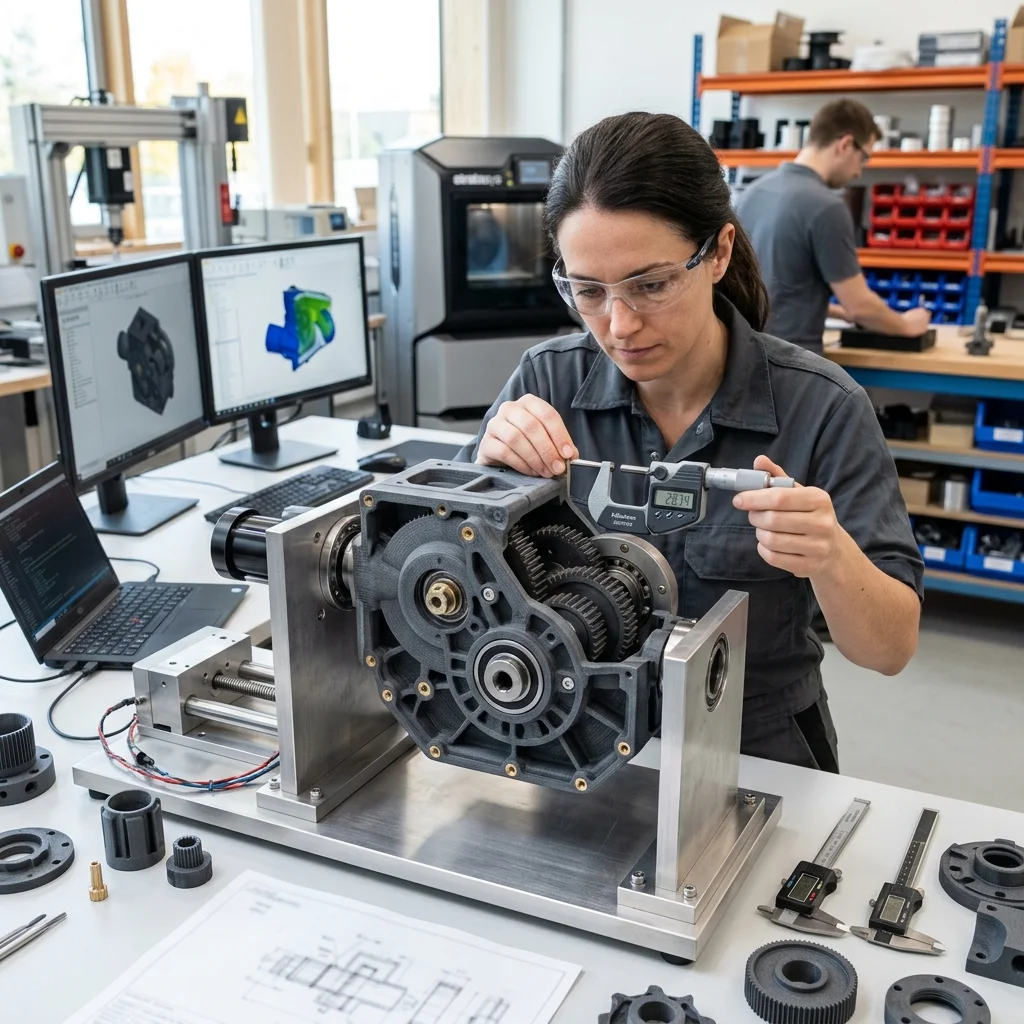
In modern industry, speed and agility are no longer just advantages: they are prerequisites for survival. As engineers and innovators, we know the transition from a digital concept to a physical prototype is often the slowest and most expensive phase of product development. But what happens when you bring 3D printing (Additive Manufacturing) directly into your lab? The Return on Investment (ROI) isn't measured solely in dollars saved from external vendors, but in radically shortened iteration cycles and the elimination of costly downstream errors. At EduFacturing, we believe that understanding how to calculate and optimize this ROI is the "picks and shovels" knowledge that truly unlocks hardware potential.
The Math Behind 3D Printing: Time vs. Money
Traditional prototyping methods, like CNC machining or injection molding, involve steep initial tooling costs and long lead times: often spanning weeks. Industry data reveals that shifting to in-house 3D printing (using technologies like FDM, SLA, or PBF) can slash these costs by up to 70-80%. Let's look at time as a currency: replacing a 35-day outsourcing cycle with a 4-day in-house print job doesn't just save money; it allows an engineering team to execute 8 to 9 additional design iterations in the same timeframe. This compounding effect drastically mitigates the risk of defects in the final production run.
Real-World Payback Periods and Tangible Savings
One of the primary concerns when investing in industrial 3D printing is the payback period. According to recent surveys, over 82% of companies adopting the technology report substantial cost savings. In many scenarios, equipment pays for itself in less than four months. For instance, in the automotive sector, companies like Volkswagen Autoeuropa have documented savings of nearly €475,000 in just two years by utilizing in-house printed tools, jigs, and fixtures. Even for smaller design firms, shifting from outsourced bureaus to in-house machines can result in full ROI after as few as 37 printed parts.
The Hidden ROI: Iteration, Innovation, and Zero Defect
Direct financial savings are merely the tip of the iceberg. The true, hidden ROI lies in design freedom. When the cost of failure approaches zero (reduced to just the price of a little filament or resin) engineers are free to be bolder. Testing multiple geometric variations in parallel (rapid iteration) inevitably leads to superior end-products. This aligns perfectly with our "Zero Defect" philosophy at EduFacturing: prevention through early, economical physical validation. By eliminating expensive soft tooling from the validation phase, you aren't just preserving your budget; you are buying engineering confidence.
Maximizing Your Additive Manufacturing ROI
To extract maximum value from AM technologies, a strategic approach is essential. First, identify the bottlenecks in your R&D pipeline. Which components consistently delay your projects? Second, match the right technology to the application (e.g., FDM for structural iterations, SLA for fine detail, SLS/MJF for functional end-use testing). Finally, invest deeply in knowledge. Hardware is useless without expertise in DfAM (Design for Additive Manufacturing). Training your team to design specifically for 3D printing ensures faster print times, reduced material waste, and vastly superior prototype performance.
Conclusion
The ROI of 3D printed prototyping is undeniable, from direct reductions in manufacturing costs to unprecedented acceleration of the development cycle. At EduFacturing, our mission is to arm you with the deep technical knowledge required to turn this technology into a formidable strategic asset. Start small, iterate rapidly, and let innovation drive your manufacturing future.
The full picture
This article is one page from The Big Book of 3D Printing: 704 illustrated pages covering every technology, material and fix in one reference.
Read it on Kindle →Engineer, author of The Big Book of 3D Printing and additive manufacturing expert