

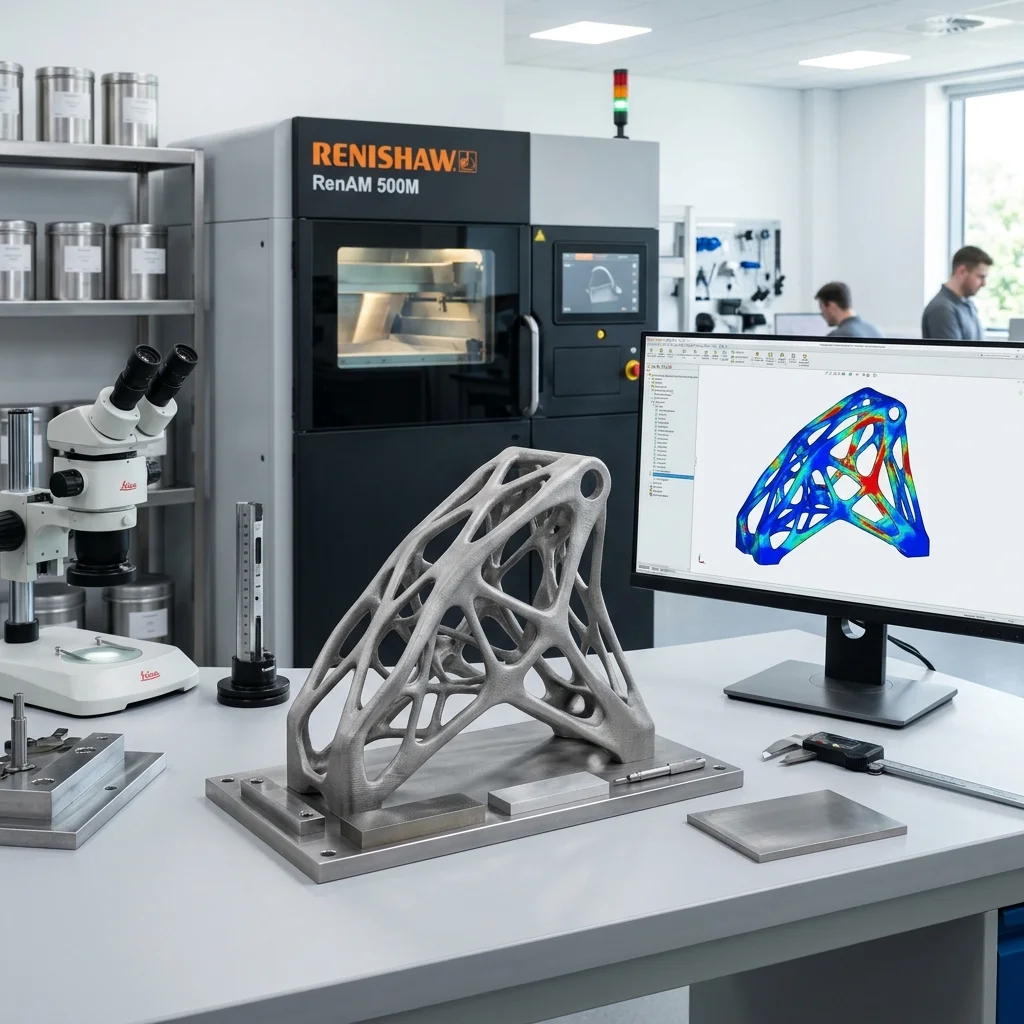
For decades, traditional manufacturing methods have forced engineers into a corner of compromises. We designed parts not necessarily for optimal performance, but for manufacturability: bound by the limitations of milling machines, lathes, and casting molds. Additive Manufacturing (AM) shattered those physical boundaries, but to truly unlock its potential, we needed a paradigm shift in how we approach design itself. Enter Topology Optimization (TO).
At its core, topology optimization is a mathematical approach that optimizes material layout within a given design space, for a given set of loads, boundary conditions, and constraints. When paired with the geometric freedom of 3D printing, it transforms the role of the engineer from a draftsman of shapes into a curator of constraints. We tell the algorithm what the part must *do*, and the mathematics dictate what the part must *look like*. The result is often an organic, bio-inspired structure that maximizes performance while stripping away every unnecessary gram of material.
The Algorithms Driving the Revolution
The magic of topology optimization lies under the hood, driven by sophisticated numerical methods. The most widely adopted algorithm is SIMP (Solid Isotropic Material with Penalization). SIMP predicts an optimal material distribution by continuously varying the density of each element in a finite element mesh between 0 (void) and 1 (solid). By penalizing intermediate densities, the algorithm forces the model to resolve into a distinct, printable geometry, making it incredibly effective for maximizing stiffness-to-weight ratios.
Another powerful approach is BESO (Bidirectional Evolutionary Structural Optimization). Unlike SIMP's continuous density gradients, BESO operates discretely, adding and removing solid material iteratively based on stress distribution. This results in highly defined boundaries that are inherently well-suited for AM.
For complex shape changes and smoother boundary resolution, the Level Set Method (LSM) is increasingly favored. Instead of looking at element densities, LSM tracks the evolution of the structural boundaries dynamically, often leading to structurally superior and aesthetically striking organic topologies.
Manufacturing-Aware Design: Bridging Theory and Reality
Early topology optimization tools were "manufacturing blind," generating complex shapes that, while mathematically perfect, were physically impossible to produce without excessive support structures or risking thermal distortion. The modern era is defined by Manufacturing-Aware Optimization, a critical pillar of Design for Additive Manufacturing (DfAM).
Today's algorithms incorporate AM-specific constraints directly into the optimization loop. For example, overhang angle controls force the software to generate self-supporting structures, drastically reducing the need for sacrificial supports. Minimum feature size parameters prevent the generation of impossibly thin struts that would fail during printing or post-processing. Furthermore, multi-physics simulations now predict thermal gradients and residual stresses during the print process (especially in metal PBF like SLM or DMLS), allowing the algorithm to pre-compensate for thermal distortion before the laser ever touches the powder bed.
Industry Applications: From Aerospace to Patient-Specific Medicine
The synergy between TO and AM is already redefining high-stakes industries. In aerospace and automotive engineering, the driving force is weight reduction. Every gram saved translates to reduced fuel consumption, higher payloads, and lower emissions. Structural brackets, landing gear components, and engine mounts are being reimagined through generative design, often achieving weight reductions of 30% to 50% without sacrificing structural integrity.
In the medical field, the impact is even more profound. Topology optimization is used to design patient-specific orthopedic implants, such as hip stems or cranial plates. By integrating lattice structures into the optimized design, engineers can precisely tune the implant's modulus of elasticity to match the surrounding human bone. This prevents "stress shielding" (a condition where the bone degrades because the implant takes too much of the load) and promotes active osseointegration, fundamentally improving patient outcomes.
The Software Ecosystem Powering the Future
The democratization of these technologies is fueled by an evolving software landscape. Stand-alone generative design tools like nTopology are leading the charge, offering implicit modeling capabilities that effortlessly handle the massive computational loads of complex lattice structures and multi-scale optimization.
Meanwhile, integrated platforms such as Altair Inspire/OptiStruct and Ansys provide FEA-integrated workflows, favored by the aerospace and automotive sectors for their deep simulation capabilities. For more accessible applications, cloud-based tools like Autodesk Fusion 360 have brought generative design and topology optimization to a broader audience, allowing engineers to explore hundreds of design permutations simultaneously via cloud computing.
Future Horizons: AI, Lattices, and Multi-Material Optimization
As we look to the future, Artificial Intelligence and Machine Learning are set to supercharge topology optimization. Neural networks are being trained to predict stress fields and propose initial optimized geometries in fractions of a second, bypassing hours of computationally expensive FEA iterations.
Furthermore, the frontier of optimization is expanding beyond single-material, macro-scale designs. We are moving toward multi-scale optimization, where the algorithm dictates not just the macro-shape, but the micro-architecture of the internal infill using spatially varying lattices. Coupled with emerging multi-material AM technologies, tomorrow's algorithms will place different materials exactly where they are needed: optimizing for thermal conductivity in one region while prioritizing tensile strength in another.
Conclusion
Topology optimization is no longer just a niche academic concept; it is the fundamental design language of additive manufacturing. By combining mathematical rigor with the infinite geometric freedom of 3D printing, we are transitioning from making things that look engineered to creating things that look evolved. For engineers, designers, and visionaries, the challenge is no longer how to manufacture complex shapes, but how to imagine them.
The full picture
This article is one page from The Big Book of 3D Printing: 704 illustrated pages covering every technology, material and fix in one reference.
Read it on Kindle →Engineer, author of The Big Book of 3D Printing and additive manufacturing expert