

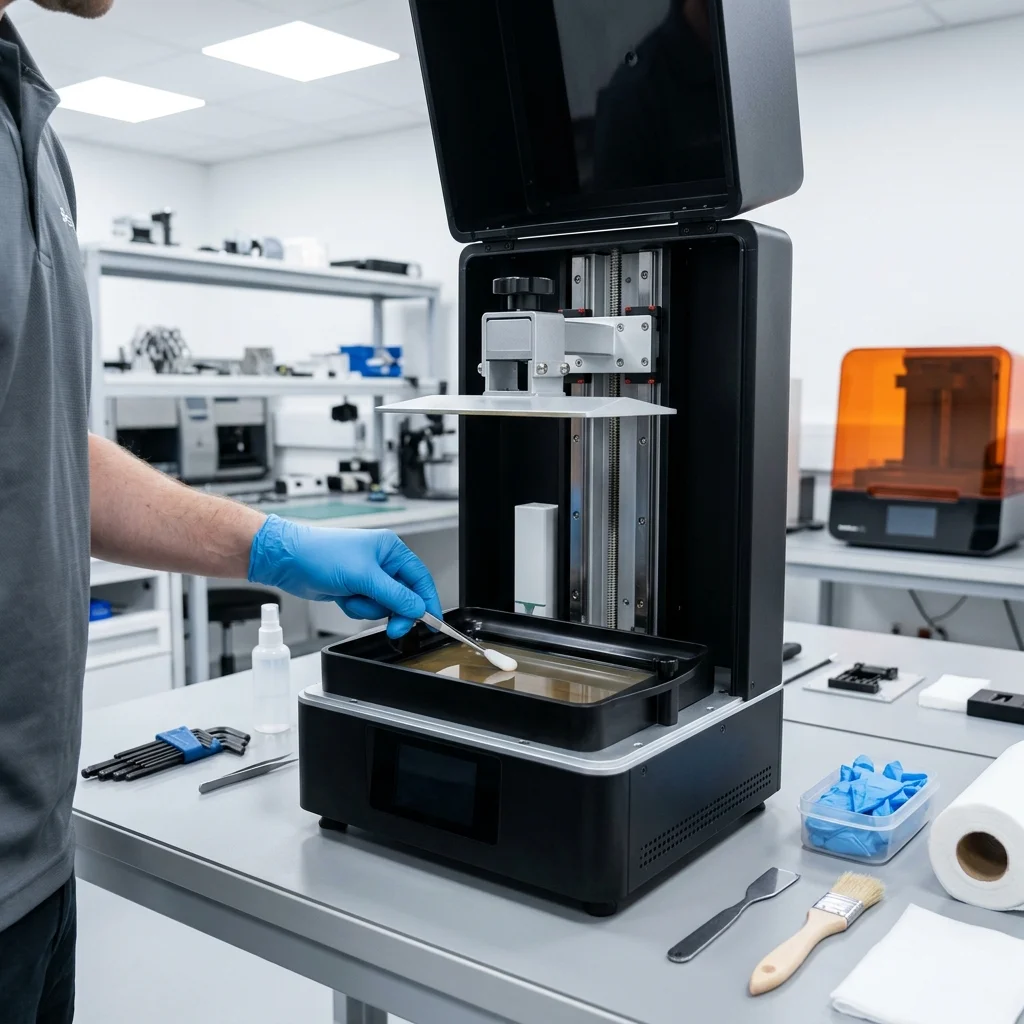
In the realm of VAT photopolymerization (SLA, MSLA, DLP), perfection is not merely achieved through optimal slicing parameters: it is dictated by the physical harmony of your hardware. At EduFacturing, we view the 3D printer not just as a tool, but as a precision laboratory instrument. Every micron of Z-axis deviation and every photon of UV bleed impacts your final yield.
To move beyond the basics of 'clean your build plate' and truly master resin 3D printing, you must understand the underlying physics, kinematics, and chemistry of your machine. This guide looks at advanced maintenance protocols designed to extend the lifespan of your critical components, from optimizing ACF film release forces to mitigating thermal degradation of monochrome LCD screens. Let's engineer a zero-defect environment.
Optical Engine Preservation: LCD Longevity and Thermal Management
The monochrome LCD masking screen is the heart of any MSLA printer, but it operates under extreme stress. UV light degrades organic compounds, and the polarizing layers of your LCD are no exception. To maximize the typical 2,000-hour lifespan, you must implement strict thermal and exposure management. First, utilize 'Wait Before Cure' (or 'Light-off Delay') settings. A 1.5 to 2.5-second delay not only allows viscous resins to settle (preventing 'elephant's foot') but also gives the LED matrix a brief cooling window, reducing thermal fatigue on the LCD. Furthermore, always install a sacrificial tempered glass or high-clarity PET screen protector. A microscopic resin breach from the VAT can permanently fuse to an unprotected screen, turning a $5 protector replacement into a $150 hardware repair.
Fluid Dynamics and Film Physics: FEP, nFEP, and ACF
The release film at the bottom of your VAT is where the magic (and the failure) happens. Modern printers utilize standard FEP, nFEP (PFA), or ACF (Advanced Composite Film). ACF dramatically lowers the peel force, allowing for rapid lift speeds and extending film life up to 30,000 layers. However, regardless of the polymer type, physical damage is its greatest enemy. Never use a metal or hard plastic scraper to remove failed prints. Instead, utilize the 'VAT Clean' function: cure a 15-second full-screen layer, and gently peel the resulting solid sheet. This acts as a microscopic lint roller, lifting semi-cured floaters and debris without inducing micro-scratches on your film. Check the acoustic resonance (tension) of the film regularly: a loose film creates a suction cup effect that leads to delamination, while an over-tightened film will prematurely fatigue.
Kinematic Precision: Z-Axis Lubrication and Mechanical Stability
Sub-millimeter accuracy relies entirely on the mechanical integrity of your Z-axis lead screw and linear rails. As resin printing involves thousands of repetitive micro-movements, dry or dirty kinematics will introduce Z-banding and microscopic layer shifts. Avoid WD-40 or wet chain lubes, as they attract airborne dust and micro-cured resin particles. Instead, use a high-quality PTFE-based synthetic grease (like Super Lube) on the lead screw and lithium grease on the linear rail carriages. Every 100 print hours, wipe the lead screw completely clean with a lint-free cloth and apply a fresh, thin layer of grease. Ensure the anti-backlash nut is functioning correctly and its spring retains proper tension; this guarantees the build plate returns to absolute zero with true repeatability.
Chemical Hygiene: VAT Care and Solvent Optimization
Resin is a highly reactive photopolymer that degrades under prolonged ambient light and temperature fluctuations. If you plan to leave the printer idle for more than a few days, do not leave resin in the VAT. When draining, always pour the resin through a 190-micron paint filter back into an opaque, UV-blocking bottle. This critical step captures microscopic cured shards that are the number one cause of sudden FEP punctures. Additionally, consider transitioning your cleaning workflow from Isopropyl Alcohol (IPA) to Tripropylene Glycol Monomethyl Ether (TPM). TPM has a lower evaporation rate, is non-flammable, and breaks down uncured resin more effectively without clouding acrylic components or degrading the VAT seals over time.
Conclusion
Ultimately, a well-maintained resin printer transforms from a mere consumer device into a reliable, industrial-grade instrument. By treating the optics, kinematics, and fluid interfaces with engineering respect, you eliminate the variables that cause print failures. Remember, in advanced manufacturing, maintenance is not a chore: it is the foundational step of precision engineering. Stay sharp, and keep innovating.
The full picture
This article is one page from The Big Book of 3D Printing: 704 illustrated pages covering every technology, material and fix in one reference.
Read it on Kindle →Engineer, author of The Big Book of 3D Printing and additive manufacturing expert