

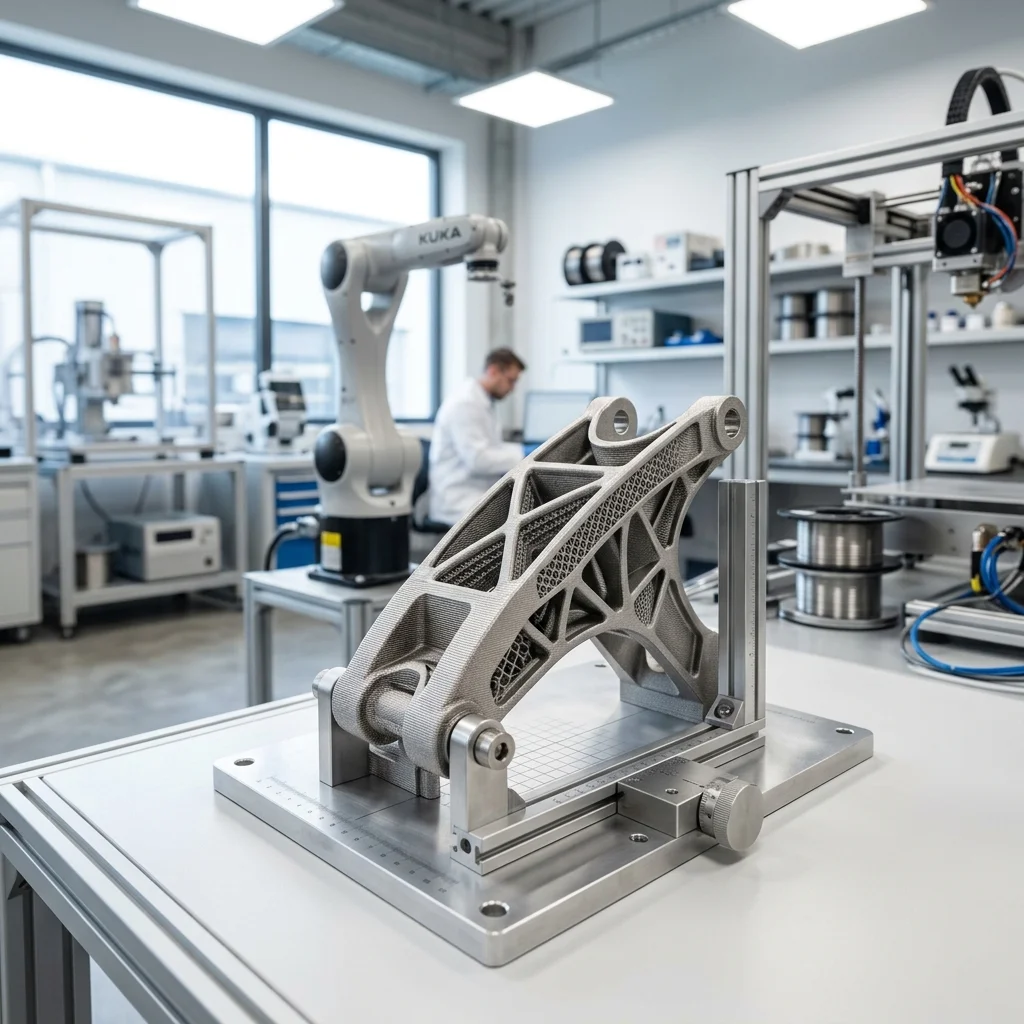
The aerospace industry is locked in a constant battle against gravity, where every single gram of weight saved translates directly into reduced fuel consumption, lower emissions, and increased payload capacity. For decades, engineers relied on subtractive manufacturing to shave ounces off critical parts. Today, however, Additive Manufacturing (AM) (commonly known as 3D printing) is flipping the script. Instead of carving parts out of massive metal billets, we are now growing them layer by layer.
This paradigm shift isn't just about changing how we make things; it's about fundamentally rethinking what can be made. By combining advanced industrial 3D printing with design algorithms, the aerospace sector is unlocking unprecedented levels of lightweighting without compromising structural integrity or safety.
Topology Optimization and Generative Design
The true power of aerospace 3D printing lies in the software that drives it. Topology optimization and generative design use AI-driven algorithms to calculate load paths and stress distributions. The software then removes material where it isn't needed, resulting in organic, bionic-looking structures that resemble bone or tree branches. These lattice and cellular designs are virtually impossible to produce using traditional CNC machining or casting, yet they offer equal or superior strength at a fraction of the weight.
Part Consolidation: Eliminating Weak Links
Traditional aerospace assemblies often consist of dozens, if not hundreds, of individual components joined by fasteners, welds, or rivets. Each connection is a potential point of failure and adds unnecessary weight. Additive manufacturing enables "part consolidation": the ability to print complex, multi-part assemblies as a single, continuous unit. A famous example is GE Aviation's LEAP engine fuel nozzle, which consolidated 20 different parts into one 3D printed component, reducing its weight by 25% and making it five times more durable.
Advanced Aerospace Materials
Lightweighting is heavily dependent on material science. Modern industrial 3D printers can process highly advanced superalloys and high-performance polymers. Titanium alloys like Ti-6Al-4V are prized for their exceptional strength-to-weight ratio and corrosion resistance. For extreme heat environments, such as turbine blades, nickel-based superalloys like Inconel 718 are used. On the polymer side, high-performance thermoplastics like PEEK and ULTEM are increasingly replacing metal brackets, air ducts, and interior cabin components, slashing weight significantly while meeting strict flame, smoke, and toxicity (FST) standards.
Transforming the "Buy-to-Fly" Ratio
In traditional aerospace manufacturing, the "buy-to-fly" ratio (the amount of raw material purchased compared to the weight of the final flying part) can be shockingly high, sometimes reaching 20:1. This means 95% of an expensive aerospace-grade alloy is machined away as scrap. Additive manufacturing dramatically improves this ratio, bringing it closer to 1:1. The process only uses the exact amount of powder or filament needed to build the part, drastically reducing material waste, lowering costs, and minimizing the environmental footprint of production.
Conclusion
As we push towards more sustainable aviation and the next era of space exploration, 3D printed lightweight components will be at the forefront of engineering innovation. By merging advanced materials, generative design, and layer-by-layer fabrication, additive manufacturing is doing more than just reducing weight: it is entirely redefining the geometry of flight.
The full picture
This article is one page from The Big Book of 3D Printing: 704 illustrated pages covering every technology, material and fix in one reference.
Read it on Kindle →Engineer, author of The Big Book of 3D Printing and additive manufacturing expert