

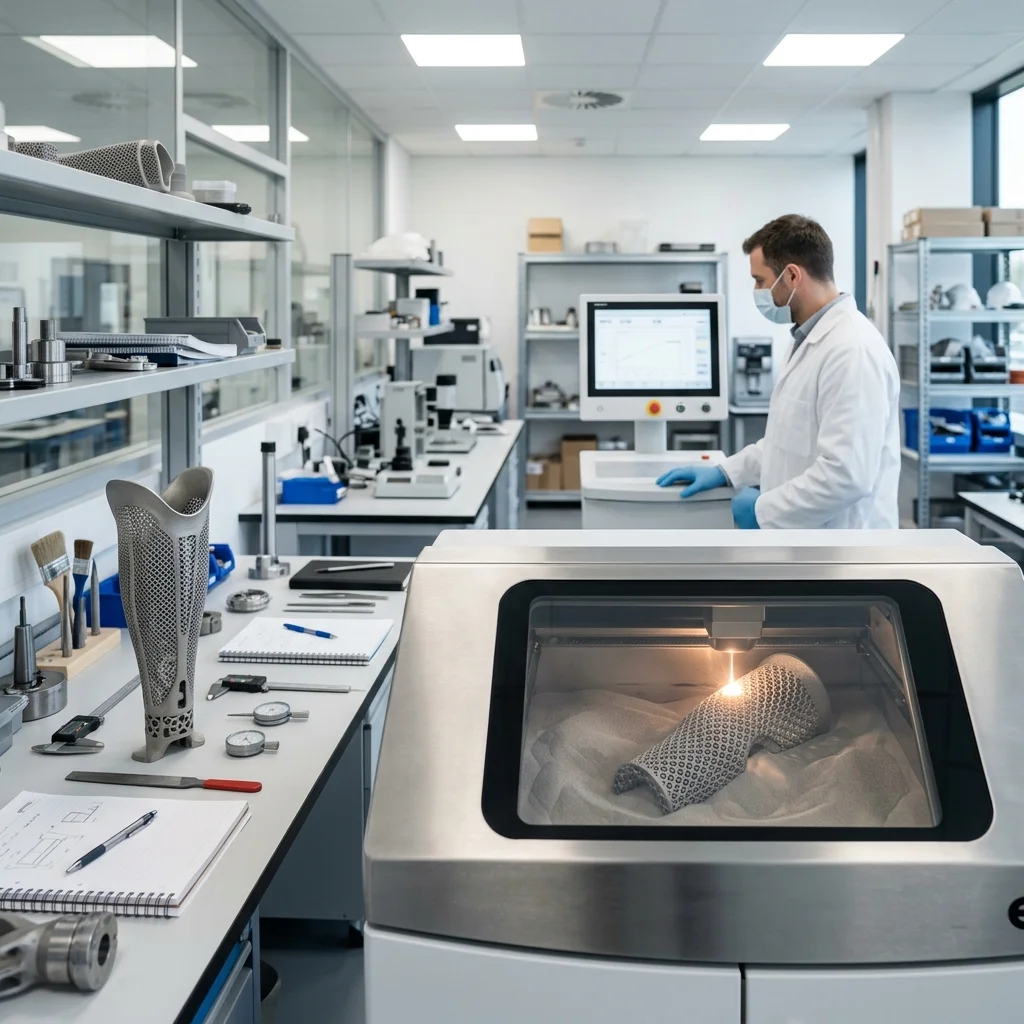
Additive manufacturing (AM) has evolved far beyond rapid prototyping to become the defining technology of modern orthopedics and prosthetics. In 2024 and 2025, the industry witnessed a seismic shift towards true personalization, driven by AI-optimized designs and advanced material science.
For engineers and clinicians alike, this represents the ultimate intersection of our "picks and shovels" philosophy: applying deep technical knowledge to hardware to restore and enhance human mobility. This approach is already transforming the lives of thousands of patients worldwide.
AI-Driven Design and Generative Topologies
Artificial intelligence is now an integral part of the orthopedic design workflow. AI algorithms analyze patient-specific anatomy, gait biomechanics, and pressure distribution data to generate topologically optimized, lightweight, and incredibly strong components. The implementation of complex lattice structures solves one of the most significant challenges in orthopedics: stress shielding. By utilizing 3D-printed porous surfaces, implants achieve mechanical behavior nearly identical to natural human bone, promoting osseointegration and ensuring long-term success.
Advanced Materials: From Titanium Lattices to Bioresorbables
The maturation of AM technologies like Powder Bed Fusion (SLS/DMLS/EBM) has made titanium alloys and cobalt-chrome the gold standard for load-bearing implants, prized for their biocompatibility and fatigue resistance. Concurrently, high-performance polymers like PEEK and carbon-fiber-reinforced composites are dominating lightweight prosthetic applications via extrusion (FDM/FFF) processes. However, the most visionary leap is the development of bioresorbable materials. Magnesium alloys and specialized polymers provide structural support during the healing phase and then dissolve safely within the body, eliminating the need for removal surgeries.
Multi-Material Printing and Hybrid Manufacturing
Over the past year, there has been a surge in multi-material AM systems. These advanced platforms allow for the simultaneous printing of rigid load-bearing structures integrated with soft, elastomeric interfaces (such as prosthetic socket liners) in a single build cycle. To achieve the flawless surface finishes mandated by strict medical standards (like ISO 13485), hybrid manufacturing approaches are increasingly utilized. These processes combine the design freedom of 3D printing with the uncompromising precision of subtractive CNC machining.
Point-of-Care Production and the 'Scan-to-Socket' Workflow
The digital "scan-to-socket" workflow has radically reduced production lead times from several weeks to just a few hours. Thanks to highly precise structured-light 3D scanning and photogrammetry, hospitals are successfully integrating their own on-site 3D printing hubs at the Point-of-Care (PoC). This model not only minimizes logistical delays but also opens the door to the next frontier in medicine: "smart" implants featuring embedded sensors designed to monitor inflammation and bone healing in real time.
Conclusion
Additive manufacturing in orthopedics is no longer a futuristic concept: it is the current standard of care for complex clinical cases. By democratizing access to high-tech manufacturing knowledge, we at EduFacturing are enabling a new generation of engineers and medical professionals to literally rebuild lives. The future of healthcare is undeniably personalized, and we are providing the knowledge to engineer it.
The full picture
This article is one page from The Big Book of 3D Printing: 704 illustrated pages covering every technology, material and fix in one reference.
Read it on Kindle →Engineer, author of The Big Book of 3D Printing and additive manufacturing expert