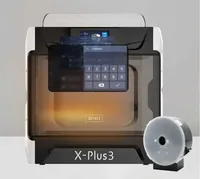
The QIDI X-Plus 3 is an enclosed CoreXY FDM printer in the prosumer class with active chamber heating up to 65°C: a feature found almost exclusively on industrial machines. With a 280×280×270 mm build volume and speeds up to 600 mm/s, the X-Plus 3 targets engineers and small workshops for whom ABS, CF-Nylon and PC are everyday materials.
What it is
The X-Plus 3 is QIDI Tech's engineering workhorse. The actively heated chamber maintains a constant temperature up to 65°C, suppressing warping in ABS, ASA, PC and CF-Nylon almost entirely: regardless of part size. The firmware is built on Klipper, giving full access to Pressure Advance, Input Shaper and advanced macros. The machine ships with a hardened nozzle as standard and is ready for abrasive materials out of the box. There is no AMS system: the X-Plus 3 is designed for reliable single-material printing with engineering polymers, not multi-color workflows.
Technical specifications
| Technology | FDM (CoreXY, enclosed chamber with active heating) |
|---|---|
| Build volume | 280 × 280 × 270 mm |
| Chamber temperature | active, up to 65°C |
| Maximum speed | up to 600 mm/s |
| Nozzle | hardened steel (stock) |
| Firmware | Klipper |
| Multi-material | no (single extrusion) |
| Class / Price | Prosumer · ~€900 |
Who it’s for
- Automotive jigs and fixtures: producing high-strength alignment tools and jigs from CF-Nylon with abrasion resistance suitable for the production line (Automotive)
- Rapid functional prototyping (durable, dimensionally accurate prototypes for fit, form and functional testing) hours instead of days (Product development and engineering)
- Low-volume casings and enclosures: batches of 1–100 custom enclosures for electronics from ABS or PC with chamber-assisted stability (Consumer electronics)
Calibration step by step
- Clean the flexible PEI build plate thoroughly with isopropyl alcohol (IPA). All oils and debris removed: maximum first-layer adhesion.
- Execute the automatic bed leveling sequence. The printer maps the bed surface and computationally compensates for any minor mechanical unevenness.
- Fine-tune the Z-offset dynamically during the first layer. Optimal squish for bonding: no elephant's foot and no delamination.
- Calibrate E-steps (M92) and print a Flow Tower to verify extrusion. The extrusion system delivers the exact required polymer volume: no dimensional overlaps or structural gaps.
Common defects and fixes
Recommended settings by material
Pick a material to see the recommended temperatures (empirical ranges from 561 OrcaSlicer/Bambu profiles) plus machine-specific tips:
Conclusion
The QIDI X-Plus 3 is a rare combination: actively heated chamber up to 65°C and Klipper firmware at a prosumer price. For an engineer who regularly works with ABS, PC or CF-Nylon, this machine eliminates the main barriers to engineering printing: warping, heat creep and incompatibility with abrasive materials. It offers no multi-color capability, but instead offers something more important: predictability.
The full picture
This article is one page from The Big Book of 3D Printing: 704 illustrated pages covering every technology, material and fix in one reference.
Read it on Kindle →Engineer, author of The Big Book of 3D Printing and additive manufacturing expert
Updated on 11 September 2026
This article was written with AI assistance; the facts were checked against the sources on 11 September 2026.