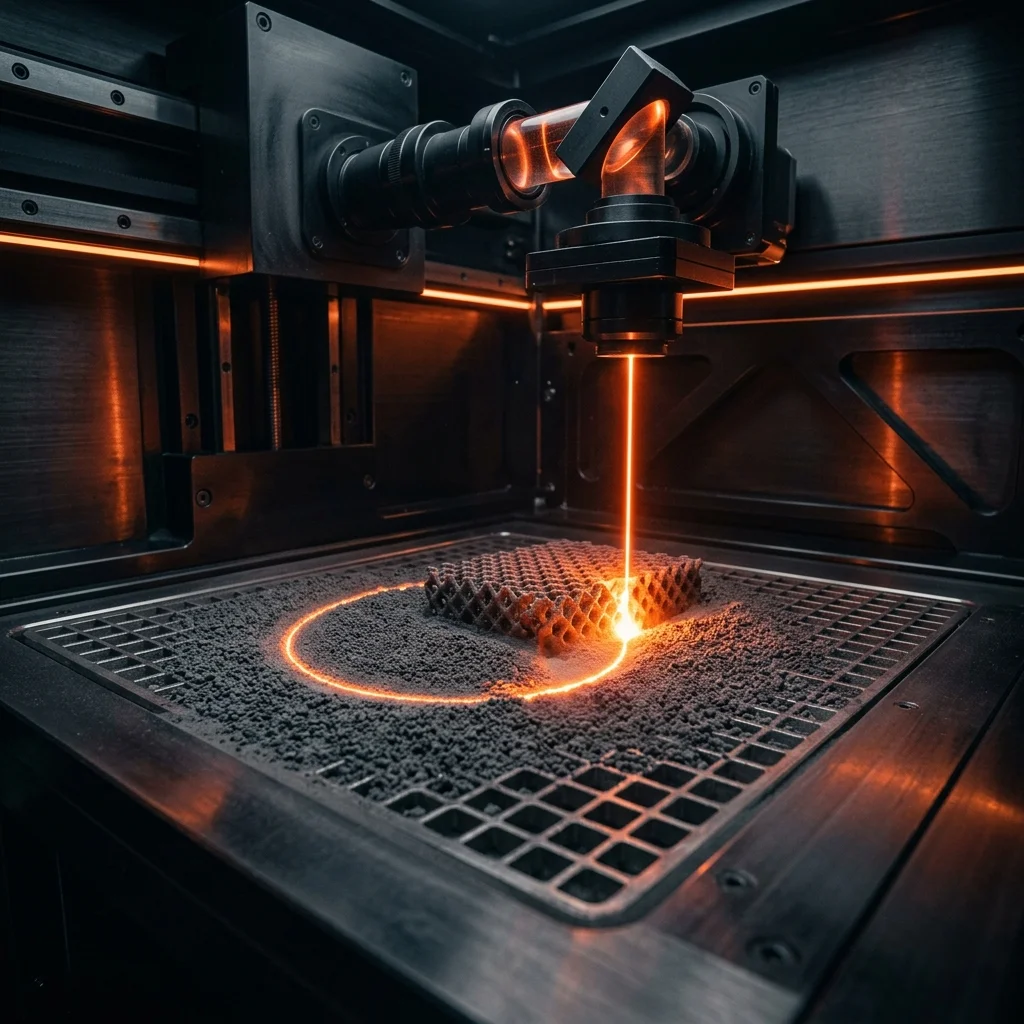
SLS (Selective Laser Sintering) is an industrial 3D printing technology that uses a high-power laser to fuse nylon powder, layer by layer. No support structures required (surrounding powder supports overhangs): enabling complex geometry impossible for FDM or SLA. PA12 (polyamide 12) is the workhorse SLS material: production-ready tensile strength 48-55 MPa, isotropic strength in every direction, and regulatory compatibility with medical (ISO 10993), food (when required), and aerospace. SLS hardware (€30,000-€500,000) is typically outsourced to bureaus. This guide shows when SLS is the right call, which EU bureaus we recommend, and what to expect on cost.
Why SLS vs FDM Nylon
FDM Nylon (Bambu X1-Carbon + PA12) is accessible (€1500 hardware) but has limitations:
- Layers visible: finish needed
- Anisotropic strength (weaker in Z direction)
- Warping risk for large parts
- Filament moisture sensitivity requires active drying
SLS PA12 solves all of this:
- Isotropic strength: equal in every direction
- No layer adhesion issues: laser fully fuses powder
- Surface texture matte but uniform (no clear layer lines)
- No warping: powder bed at 165-170°C constantly
- Material dry by design (closed powder system)
BUT cost:
- SLS hardware €30K-€500K → outsource to bureau
- Per-part cost €15-€80 (vs FDM €5-€15)
- Lead time 3-7 days (vs in-house FDM same day)
When SLS wins:
- Production runs 50-500 units (cost-efficient batch)
- Strict tolerances ±0.15 mm consistent
- Complex geometry impossible without supports
- Medical/aerospace regulatory requirements
- Need consistent material properties batch-to-batch
When FDM wins:
- Single prototypes, iteration phase
- <50 unit production runs
- Cost-critical (sub-€20/part)
- In-house design iteration
EU SLS bureau recommendations
Sculpteo (France): best-in-class EU SLS service. Auto-quote uploader, 5-7 day lead time, €15-€80 per part typical. PA12 standard, support for PA11, TPU powders, PEEK. Multilingual support.
Shapeways (Netherlands): established platform. Slightly lower quality than Sculpteo for industrial parts, but better for consumer (online storefronts integrated).
3D Hubs / Hubs.com (Netherlands): marketplace model. Quality depends on selected supplier. Cost competitive.
iGo3D (Germany): local German service, faster shipping to Bulgaria. SLS bureau plus desktop printers.
Materialise (Belgium): industry leader for engineering/medical SLS. Higher minimum order (€100+ per part), but unmatched quality control + material certification.
Protolabs (UK/Germany): fast-turnaround production SLS. Premium pricing, but 24-48 hour delivery for urgent.
Bulgaria-direct: limited domestic SLS bureaus. ART PRINTING 3D LTD (Sofia, EduFacturing parent): small batch SLS service via partnership. Bulgaria 3D (Sofia): primarily FDM but offers SLS via Sculpteo partnership.
For most BG companies: Sculpteo direct gives best cost/quality combination.
PA12 properties and applications
PA12 (Nylon 12) properties (averaged across SLS bureaus):
- Tensile strength: 48-55 MPa
- Tensile modulus: 1700-1900 MPa
- Elongation at break: 20-50%
- Heat deflection: 175-180°C (lower) | 240-250°C (under load)
- Density: 0.95-1.00 g/cm³
- Color: natural off-white/grey (dye-able after print)
Typical applications:
Automotive: under-hood brackets, sensor housings, custom fluid manifolds. Replaces injection-molded ABS in small-batch automotive aftermarket.
Medical: surgical instrument cases, custom orthoses (with biocompatible PA12 certification), prosthetic sockets.
Aerospace: cable routing brackets, interior trim brackets, hand-held tooling. Lightweight + repeatable.
Industrial: pneumatic manifolds, custom robot end-effectors, jigs & fixtures for assembly lines.
Consumer: durable goods replacement parts (kitchen appliances, vacuum attachments), specialty enclosures, drone parts (where Markforged Onyx not available).
Electronics: connector housings, sensor enclosures, robotic prototyping.
Food-related (with food-safe PA12 grade): containers, fixtures for food production lines.
Cost calculation for SLS PA12
Bureau pricing structure:
Material cost: SLS bureaus charge by cm³ of part volume PLUS bounding box. PA12 typical €0.10-€0.30 per cm³ part volume.
Minimum charge: €15-€30 per part (covers handling, post-process).
Volume discounts: 10+ identical parts → 20% off. 50+ → 30% off.
Example calculations:
Small part (50×50×30 mm, 30% infill in CAD): actual volume ~25 cm³:
- Material: 25 × €0.20 = €5
- Handling: €15
- Total: €20 per part
- Batch of 10: €15 each = €150 total
Medium part (150×100×80 mm, complex geometry): ~400 cm³:
- Material: 400 × €0.15 = €60
- Handling: €20
- Total: €80 per part
- Batch of 10: €60 each = €600 total
Large part (300×200×150 mm, 30% infill): ~3000 cm³:
- Material: 3000 × €0.10 = €300
- Handling: €50
- Total: €350 per part
- Probably better CNC machining at this scale
Lead time: 5-7 working days from quote acceptance for most EU bureaus. Express (24-48 hours) +50-100% premium.
Shipping: €10-€30 EU shipping. €50-€100 outside EU.
Budget tip: combine multiple designs in one order for shipping savings.
Workflow from design to delivery
Step-by-step SLS workflow with Sculpteo (representative EU bureau):
-
Design in CAD. SLS allows complex geometry impossible for FDM: internal channels, lattices, organic forms, hollow with breathing holes.
-
Export STL.
-
Upload to Sculpteo’s online tool. Auto-checks for printability (walls too thin, isolated parts).
-
Select material: PA12 Nylon standard. Color: white (default) or dye black/red/blue (small premium).
-
Select finish:
- Standard (matte texture, natural surface)
- Sanded (smoother, slight cost premium)
- Polished (high-gloss, +30% cost)
-
Dyed (custom color, +€2-€5 per part)
-
Quote auto-generated. Pay via card.
-
Sculpteo prints in batch with other orders (efficient bed utilization).
-
5-7 working days from order: shipped via DHL/UPS to Bulgaria.
-
Receive parts: inspect for defects (rare), apply optional post-processing (paint, glue, assembly).
-
Production ready.
For recurring orders: Sculpteo has API integration for designers shipping multiple iterations weekly.
Quality expectations: SLS PA12 from established EU bureau is production-grade. Dimensional accuracy ±0.15-0.30 mm consistently. Surface finish slightly matte (sandable to smooth).
Frequently Asked Questions (FAQ)
Sls With Nylon Pa12, Industrial-Grade 3D Printing Calculator
Interactive optimization calculator.
The full picture
This article is one page from The Big Book of 3D Printing: 704 illustrated pages covering every technology, material and fix in one reference.
Read it on Kindle →Engineer, author of The Big Book of 3D Printing and additive manufacturing expert
Updated on 11 September 2026
This article was written with AI assistance; the facts were checked against the sources on 11 September 2026.