COURSES FOR EXPERIMENTERS
Step beyond the basics
Resin · Engineering polymers · IoT · Compliant mechanisms · Robotics. Six courses for the next level.
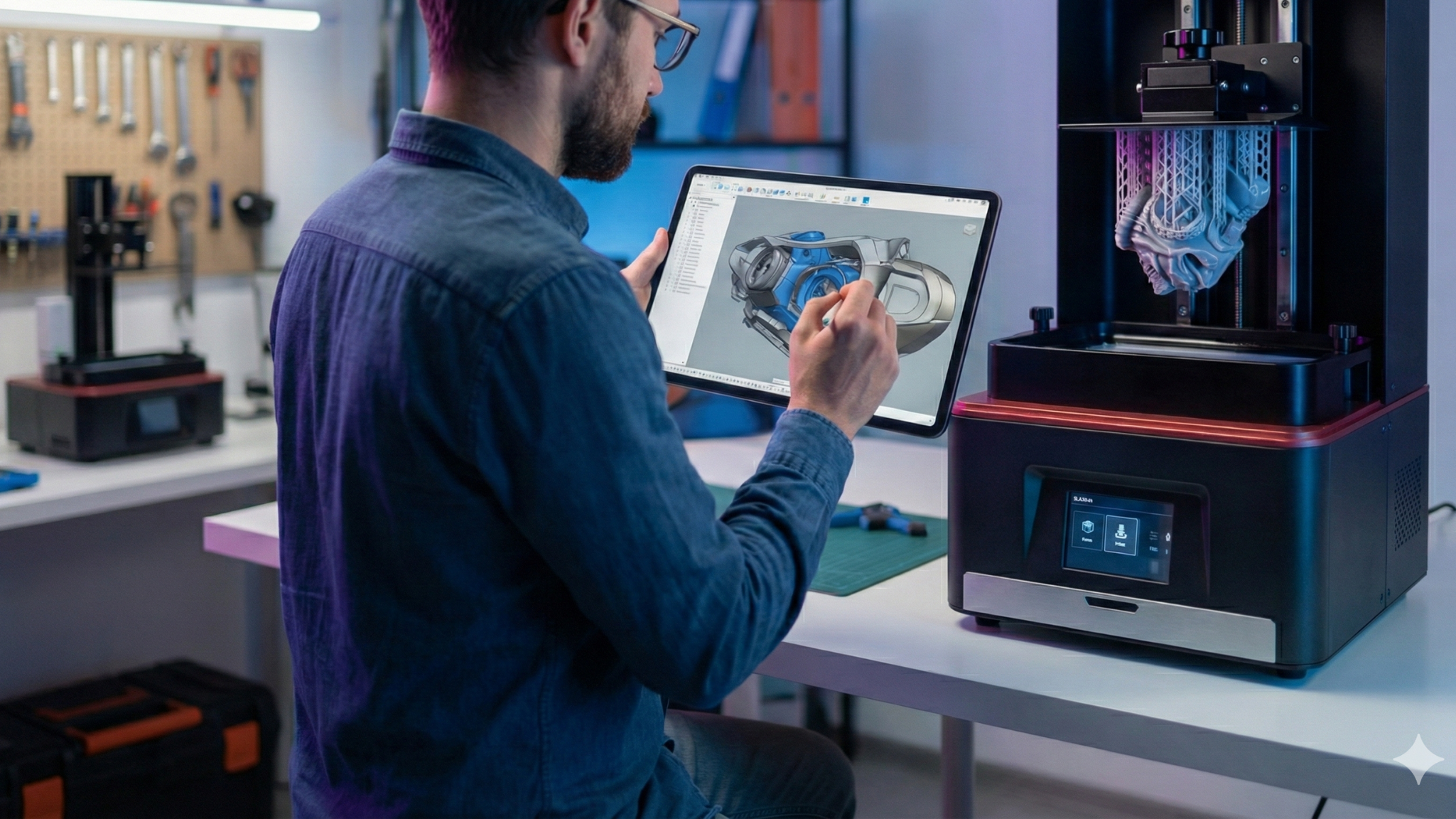
VAT 201: Photopolymerization
Printing with resin, the highest resolution in additive manufacturing (25 µm). From laser SLA through projector DLP to consumer LCD and continuous CLIP. You will learn the chemistry, the equipment, the materials, the workflow and the mandatory safety protocols.
5 modules
10 lessons
20 exercises
What you will learn ↓
- ✓Photopolymerization: the crosslinking reaction initiated by ultraviolet light
- ✓The 4 vat technologies: SLA, DLP, LCD/mSLA, CLIP, and when to use each
- ✓Resin materials: standard, tough, flexible, dental, castable, high-temperature
- ✓The workflow: orientation, supports, slicing, printing, washing, curing
- ✓Safety protocols: gloves, eye protection, ventilation, handling isopropyl alcohol
- ✓Post-processing: washing in isopropyl alcohol, UV curing, support removal, finishing
- ✓Troubleshooting: failed prints, FEP film problems, delamination
This course is taught in Bulgarian. The lesson preview, the exercise and the quiz are available in the Bulgarian version.
See the whole course →
Free preview · buy with the book or a subscription
MAT 201: Engineering polymers
Going beyond PLA and PETG. The course covers the engineering thermoplastics: ABS, ASA, polycarbonate (PC), nylon (PA), flexible TPU and high-performance PEEK. You will learn the physics of thermal warping, how an enclosed chamber tames it, why moisture destroys nylon, and when you need a 400 °C hotend.
5 modules
10 lessons
20 exercises
What you will learn ↓
- ✓Understanding the difference between standard and engineering thermoplastics by glass transition temperature (Tg) and coefficient of thermal expansion
- ✓Mastering ABS and ASA: when to use which, the chemistry, UV resistance and acetone vapor smoothing
- ✓Explaining the physics of warping through temperature gradients and residual stress
- ✓Designing a thermal regime with an enclosed chamber, bed temperature and a draft shield
- ✓Printing polycarbonate (PC) and nylon (PA): high temperatures, hygroscopicity, drying
- ✓Printing flexible TPU: the Shore scale, direct drive, slow speeds, pressure advance
- ✓Working with PEEK and PEI/ULTEM: a 400 °C hotend, an actively heated chamber, annealing for crystallinity
- ✓Diagnosing the 10 most common problems with engineering polymers (wet filament, delamination, warping)
This course is taught in Bulgarian. The lesson preview, the exercise and the quiz are available in the Bulgarian version.
See the whole course →
Free preview · buy with the book or a subscription
IOT 201: Microcontrollers and sensing
Putting a brain into physical objects. From scratch: what a microcontroller is, how to read a sensor and drive a motor, the electrical laws behind GPIO pins, the communication buses (I2C, SPI, UART), and how an ESP32 uploads data to the cloud over Wi-Fi. It ends with a real connected IoT project.
5 modules
10 lessons
20 exercises
What you will learn ↓
- ✓Understanding what a microcontroller is and how it differs from a processor and a single-board computer
- ✓Choosing between Arduino (UNO/Nano) and ESP32 for the project, and why logic level (5 V against 3.3 V) is critical
- ✓Applying Ohm's law to size a resistor and protect the pins
- ✓Working with digital and analog pins, PWM and ADC
- ✓Wiring sensors and actuators with a common ground and an external supply
- ✓Writing non-blocking code with millis() instead of delay(), and state machines
- ✓Choosing a communication bus (UART, I2C, SPI) to suit the device
- ✓Building a connected IoT project (ESP32 to Wi-Fi to MQTT) and diagnosing the 10 common problems
This course is taught in Bulgarian. The lesson preview, the exercise and the quiz are available in the Bulgarian version.
See the whole course →
Free preview · buy with the book or a subscription
ROBO 201: The anatomy of actuation
Breathing life into 3D printed parts. Deep into motors: DC, servo, stepper and brushless (BLDC), and when to use which. Drivers (A4988, DRV8825, TMC2209), the physics of torque and speed, 3D printed gearboxes, open against closed loop, and how to size a drive that does not skip steps.
5 modules
10 lessons
20 exercises
What you will learn ↓
- ✓Choosing between DC, servo, stepper and BLDC motors for the application
- ✓Understanding the stepper motor: phases, microsteps, the NEMA standard and holding torque
- ✓Configuring drivers (A4988/DRV8825/TMC2209) and setting the current limit (Vref)
- ✓Applying torque-speed physics and reading a torque-speed curve
- ✓Calculating gear ratios with 3D printed gearboxes, and understanding backlash
- ✓Telling open loop from closed loop, and the role of encoders
- ✓Designing an acceleration profile so that steps are not lost
- ✓Sizing the motor, driver and power supply for a real drive mechanism, plus the 10 common problems
This course is taught in Bulgarian. The lesson preview, the exercise and the quiz are available in the Bulgarian version.
See the whole course →
Free preview · buy with the book or a subscription
MECH 201: Compliant mechanisms
Machines that move through elasticity rather than bearings and hinges. From living hinges and flexure joints to monolithic springs and bistable snap mechanisms. The physics of elastic deformation, designing against fatigue, the pseudo-rigid-body model, and a real monolithic project: no assembly, no friction, no backlash.
5 modules
10 lessons
20 exercises
What you will learn ↓
- ✓Understanding compliant mechanisms and the decisive difference between elastic and plastic deformation
- ✓Telling lumped compliance (a living hinge) apart from distributed compliance
- ✓Designing living hinges and flexure joints with the right geometry and material
- ✓Calculating stiffness from Hooke's law and controlling it through geometry
- ✓Designing bistable mechanisms and understanding snap-through
- ✓Applying fillets and controlling stress concentration against fatigue
- ✓Using the pseudo-rigid-body model (PRBM) to calculate force and displacement
- ✓Choosing the material and print orientation, plus diagnosing the 10 common problems
This course is taught in Bulgarian. The lesson preview, the exercise and the quiz are available in the Bulgarian version.
See the whole course →
Free preview · buy with the book or a subscription
ENC 201: Designing smart enclosures
The perfect house for your electronics. Environmental protection and IP ratings, thermal management (passive and active cooling), designing an enclosure for 3D printing, cable glands and board mounting, integrating an ESP32 with a controlled fan, and a real smart enclosure project from end to end.
5 modules
10 lessons
20 exercises
What you will learn ↓
- ✓Understanding what an enclosure does: protection, thermal control, safety, access
- ✓Reading IP ratings and what water and dust protection realistically means in 3D printing
- ✓Designing thermal management: passive and active cooling, airflow
- ✓Building an enclosure for FDM: walls, mounting bosses, ribs, tolerances
- ✓Choosing closures and cable glands with strain relief and threaded inserts
- ✓Integrating the electronics with correct placement and grounding (links to IOT201)
- ✓Implementing smart features: a controlled fan with hysteresis, and monitoring
- ✓Designing a real smart enclosure, plus diagnosing the 10 common problems
This course is taught in Bulgarian. The lesson preview, the exercise and the quiz are available in the Bulgarian version.
See the whole course →
Free preview · buy with the book or a subscription