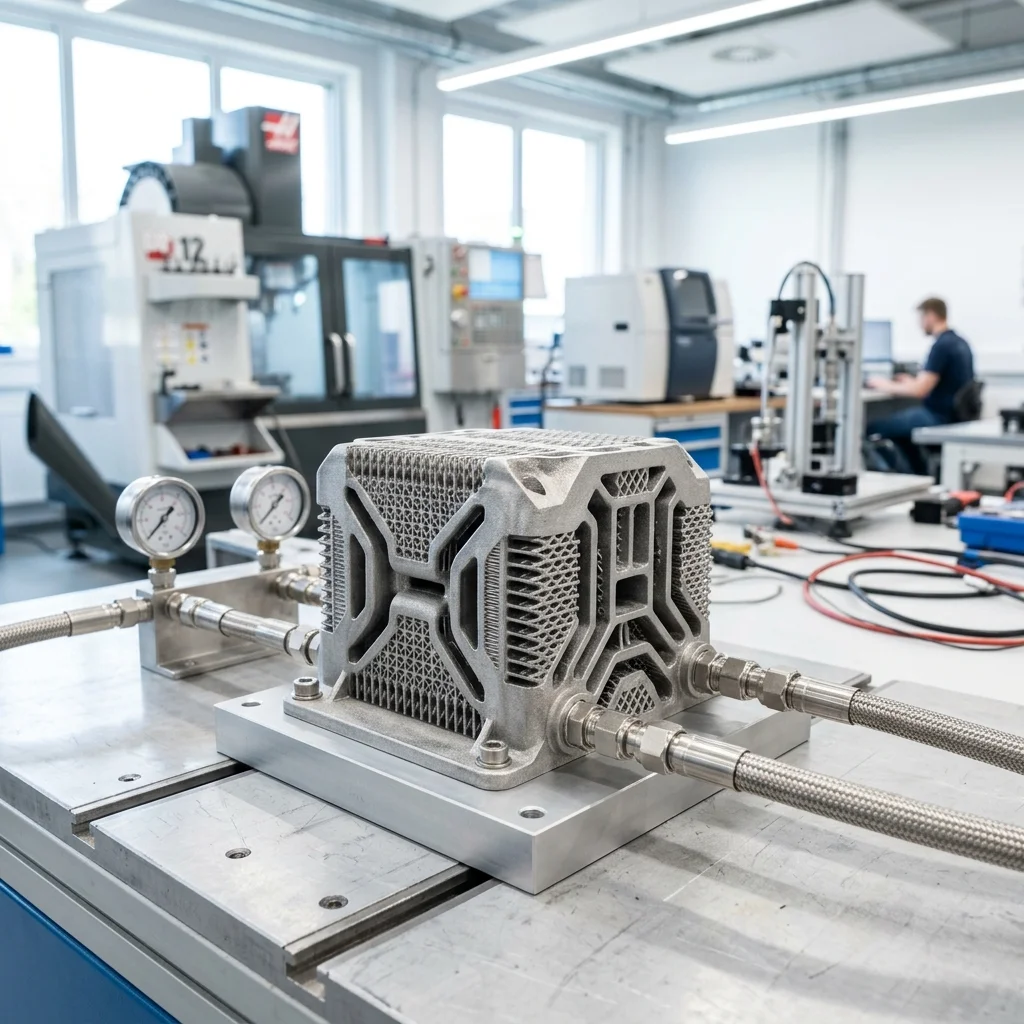
Traditional heat exchangers and heat sinks have hit a physical wall. For decades, engineering thought was confined by the limits of subtractive manufacturing: milling, turning, and brazing dictated the shape of our cooling systems. Today, the relentless demands of high-performance electronics, electric mobility, and the aerospace industry require something entirely different.
Enter additive manufacturing (AM). As the technical architect at EduFacturing, I often emphasize that 3D printing doesn't just create parts; it unlocks new physics. Through unprecedented design freedom, we can now engineer thermal solutions that manipulate fluid dynamics and heat flux in ways that were recently considered mathematical fiction.
The Geometry of Heat Transfer: TPMS and Lattices
When we strip away the constraints of the milling machine, we enter the realm of generative design and mathematical surfaces. The most striking examples are TPMS (Triply Periodic Minimal Surfaces) structures, like the well-known Gyroid. In traditional manufacturing, creating an internal network of continuous, smoothly curving channels without internal seams is simply impossible.
For thermal management, TPMS geometries offer an unprecedented surface-to-volume ratio. They eliminate 'dead zones' in fluid flow, induce beneficial turbulence that boosts heat transfer by 30% to 50%, and simultaneously minimize pressure drops. It is the ultimate balance between thermodynamics and hydrodynamics.
The Material Breakthrough: Copper, Aluminum, and Ceramics
Geometry is only half of the equation: the material is the 'conductor.' Metal 3D printing (DMLS / LPBF) has undergone a massive evolution. For a long time, pure copper was a nightmare for lasers due to its high reflectivity. Today, thanks to green and blue lasers, alongside innovative alloys like CuCrZr, we are successfully printing copper heat sinks with over 99% density and phenomenal thermal conductivity.
In the aerospace sector, advanced aluminum alloys (e.g., AlSi10Mg) enable the creation of ultra-lightweight, monolithic heat exchangers. These parts consolidate dozens of separate components into one, completely eliminating the risk of leakage from brazed joints. For extreme environments, technical ceramics are even entering the AM thermal management arena.
Industrial Applications: Where is the New Tech Working?
The adoption of these innovations has moved far beyond the laboratory. In the electric mobility (EV) sector, AM-printed conformal cooling plates wrap tightly around battery cells, ensuring uniform temperature distribution and prolonged battery life.
In High-Performance Computing (HPC) and data centers, microchannel 3D-printed cold plates make direct contact with massive GPU and CPU dies, dissipating thermal loads that traditional air or liquid coolers simply cannot handle. In motorsports and aerospace, every saved ounce of weight and every extra degree of cooling can be the difference between mission success and failure.
Engineering Challenges and the Path Forward
Naturally, mastering the 'picks and shovels' of this technology requires deep expertise. One of the primary challenges is the internal surface roughness within printed channels, which can alter the fluid boundary layer and increase hydraulic resistance.
To overcome this, engineers must be proficient not only in advanced CAD and generative design but also in deep CFD (Computational Fluid Dynamics) simulations and specialized internal post-processing techniques like chemical or abrasive flow machining.
Conclusion
Additive manufacturing is rewriting the rulebook for thermal management. It is transforming heat exchangers from bulky, assembled blocks of metal into organic, mathematically optimized arteries of modern industry. At EduFacturing, we believe that understanding this synthesis of software, hardware, and physics is the blueprint for tomorrow’s engineering. The future belongs to those who are bold enough to reshape the invisible flows of energy.
The full picture
This article is one page from The Big Book of 3D Printing: 704 illustrated pages covering every technology, material and fix in one reference.
Read it on Kindle →Engineer, author of The Big Book of 3D Printing and additive manufacturing expert
Updated on 11 September 2026
This article was written with AI assistance; the facts were checked against the sources on 11 September 2026.